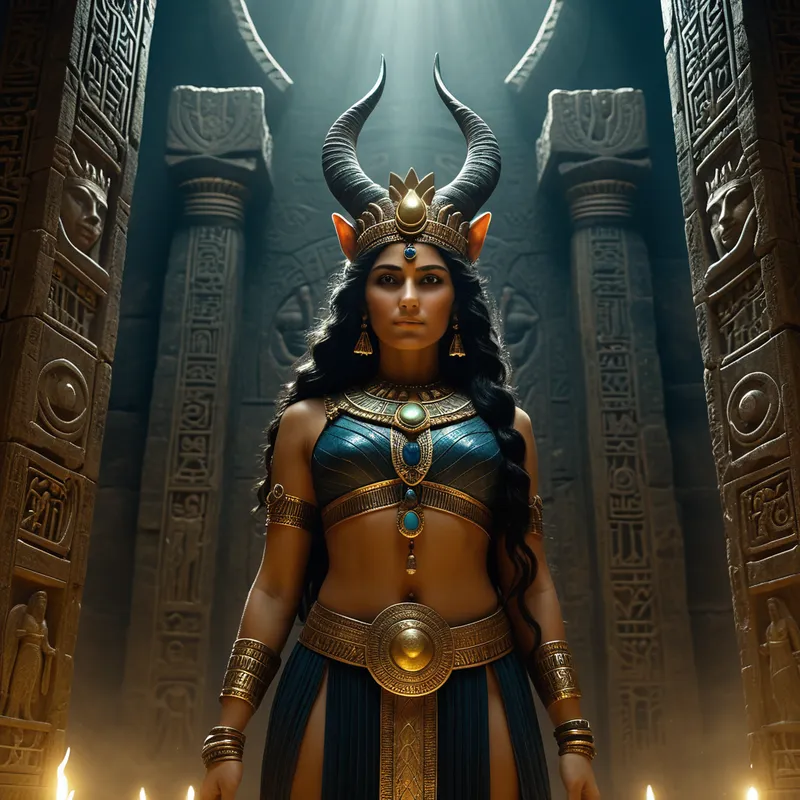
Ishtar's Procession Myth Meaning & Symbolism
The Queen of Heaven descends to the Land of No Return, shedding her divine garments and power to confront the ultimate mystery of death and rebirth.
The Tale of Ishtar's Procession
Hear now the tale that shakes the foundations of heaven and earth, the story not sung in the bright courts of the gods, but whispered in the dust of the forgotten road. The Queen of Anu was restless. In the great city of Nippur, Ishtar, she of the roaring storms and tender embraces, turned her ear not to the hymns of lovers or the clamor of battle, but to the silence that lay beneath all things. It was the silence of her sister, Ereshkigal, who ruled the Land of No Return.
A fire kindled in Ishtar's heart, a desire not for conquest, but for confrontation. "To the Great Below, the Land of No Return, I will descend," she declared, her voice causing the stars to tremble. "To witness the funeral rites of my sister's husband, the Bull of Heaven, and to see the face of Ereshkigal herself." Her handmaidens wept, for they knew the law of that dusty realm: who enters does not return. But Ishtar, clad in the seven me of her power—her shining crown, her lapis lazuli necklace, her sparkling beads, her breastplate, her golden ring, her measuring rod and line, and her royal robe—set her face toward the first of the seven gates of Kur.
At the first gate, the guardian, Neti, barred her way. "Halt, Queen of Heaven. You may not pass unless you pay the price of this land." "What is the price?" demanded Ishtar. "The crown upon your head," came the hollow reply. With a fury that shook the gate, Ishtar removed her crown. The light around her dimmed. At the second gate, she surrendered her necklace of the deep blue stone. At the third, her sparkling beads. At each of the seven gates, a piece of her divine identity was stripped away—her breastplate, her ring, her rod and line, and finally, her royal robe. Naked and shivering, stripped of all sovereignty and power, the Queen of Heaven entered the throne room of dust.
Before the mighty Ereshkigal, Ishtar could not stand. She rushed at her sister, but the Queen of the Great Below fixed her with the eye of death. Ishtar was turned to a corpse, a piece of rotting meat, and hung upon a hook on the wall. Above, all life ceased. The bull would not mount the cow, the man would not approach the woman. The earth was barren and silent.
In the heavens, the god Ea, saw the stillness. From the dirt under his fingernails, he fashioned Asushunamir, a being of perfect ambiguity. Sent to Ereshkigal, Asushunamir spoke words of such honeyed sympathy that the Queen of the Dead, in a moment of unguarded vulnerability, granted a boon. "Sprinkle the waters of life upon the corpse of Ishtar," Asushunamir requested. Ereshkigal, bound by her oath, raged but complied.
The waters of life revived Ishtar. But the law of the underworld held fast: a substitute must be found. As Ishtar ascended, gate by gate, each of her garments and powers were returned. But behind her, clinging to her shadow, came the galla, the bailiffs of the dead, to claim a life for her release. She emerged into the world of light, whole again, but forever marked by the dust of the Great Below. And the procession of the galla followed, seeking the one who would take her place in the land of shadows.
Cultural Origins & Context
This myth, known as Ishtar's Descent to the Underworld, is one of the most profound and complete narratives to survive from ancient Mesopotamia. Its earliest known versions are Sumerian, centered on the goddess Inanna, and were later adapted into Akkadian for Ishtar. It was not mere entertainment; it was sacred literature, likely recited during ritual ceremonies, perhaps connected to the cycles of the seasons, the reign of kings, or rites of passage.
The story functioned as a foundational explanation for the natural world—why vegetation dies in the summer heat and is reborn—and as a theological exploration of divine sovereignty. It established the terrifying, immutable laws of the cosmos, where even the most powerful deity is subject to the primal authority of death. The myth also served a societal function, reinforcing the idea that order, even in the divine realm, requires balance and sacrifice. The scribes who copied this tale onto clay tablets were not just preserving a story; they were maintaining the spiritual and cosmological blueprint of their civilization.
Symbolic Architecture
At its core, Ishtar's Procession is a masterful map of a necessary, terrifying, and transformative descent. Each of the seven gates represents a layer of the psyche, a successive stripping away of the persona—the masks and titles we present to the world.
The journey to wholeness demands the sacrifice of the symbols of power before one can meet the raw, unadorned Self.
Ishtar's seven me are not just jewelry; they are the constituent parts of her identity: leadership, attraction, communication, protection, commitment, judgment, and status. To enter the realm of the unconscious (the underworld), all these conscious constructs must be surrendered. Her confrontation with Ereshkigal is the ultimate encounter with the Shadow—the part of the psyche that holds all we have denied, repressed, or feared, often embodied as a terrifying, powerful feminine figure (the sister). Being turned to a corpse signifies the ego's necessary death, a state of complete psychic dissolution where old patterns and identities are broken down.
The rescue, engineered by the cunning Ea through the androgynous Asushunamir, symbolizes the emergence of a new, reconciling principle from the depths of the unconscious itself. Asushunamir, whose name hints at "their appearance is radiant," represents the transcendent function—a new attitude born from the tension of opposites (male/female, life/death, above/below) that can negotiate with the absolute power of the Shadow.
The Dreamer's Resonance
When this myth stirs in the modern dreamer, it announces a profound psychological initiation. One may dream of losing a job title (the crown), a relationship that defined them (the necklace), or a long-held belief (the measuring rod). The dream-ego finds itself in a descending elevator, a dark basement, or a labyrinthine cave—the personal Kur. The somatic feeling is one of dread, vulnerability, and profound disorientation, as the foundational structures of the dreamer's life feel dismantled.
This is not a nightmare of external threat, but an internal, archetypal process of deconstruction. The dreamer is being prepared, often against their conscious will, to meet a powerful, often feared, aspect of their own nature—the Ereshkigal complex. This might manifest as a terrifying figure of absolute authority or a state of depressive, "lifeless" inertia in the dream. The process feels like a death because it is. It is the death of an outworn attitude, a calcified self-image, necessary for any significant rebirth or new creative phase of life.
Alchemical Translation
For the individual on the path of individuation, Ishtar's Procession models the nigredo—the blackening, the putrefaction, the darkest night of the soul. The conscious ego, no matter how inflated or accomplished (the Queen of Heaven), must willingly submit to its own undoing to access deeper layers of the psyche.
The treasure you seek lies in the very place you refuse to look, guarded by the very aspect of yourself you most despise.
The alchemical work is in the stripping. Each "gate" is a conscious letting-go: of social status, of old wounds worn as identity, of strategies for control and measurement. The goal is not to reclaim these items unchanged, but to be re-clothed in them with a new understanding, having faced the core reality of one's existence without their buffer. The triumphant return is not to the old life, but to a life informed by the descent. The "galla" that follow represent the ongoing integration—the parts of our old life, habits, or relationships that may not survive our transformation and must be left in the past.
Ultimately, the myth teaches that love (Ishtar's domain) cannot be whole without confronting death (Ereshkigal's domain). The fully lived life requires this procession into the depths, this sacred humiliation of the spirit, to unite the Above and the Below within one's own being. The one who returns from such a journey is no longer just a ruler of the external world, but a sovereign of the inner, united realm.
Associated Symbols
Explore related symbols from the CaleaDream lexicon: