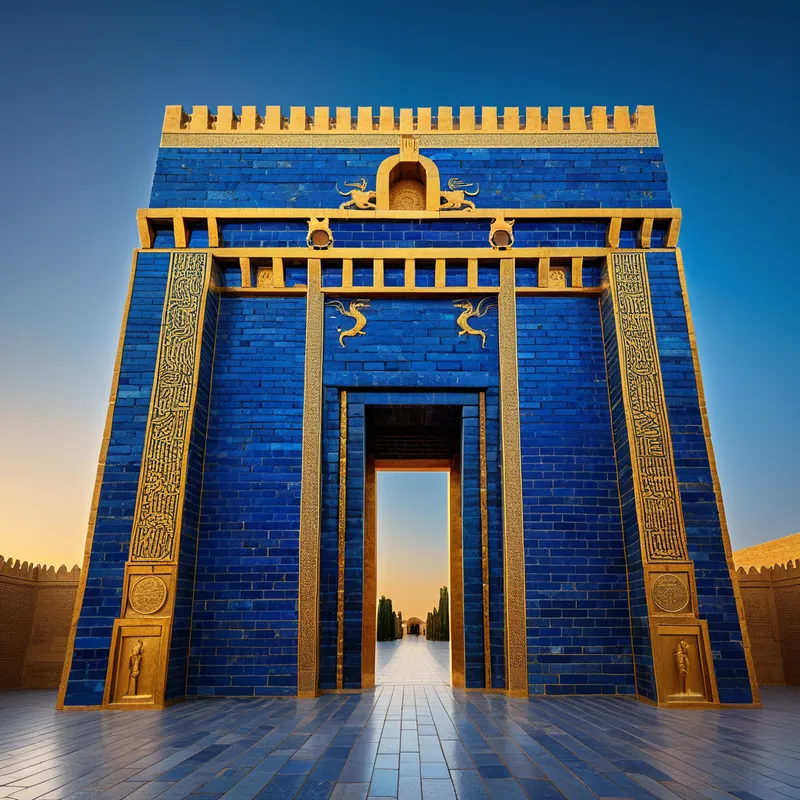
Ishtar's Gate Myth Meaning & Symbolism
The goddess Ishtar descends through seven gates to the underworld, stripped of her power, to confront death and initiate a cycle of renewal.
The Tale of Ishtar's Gate
Hear now the tale that echoes from the baked-brick heart of the world, a story older than empires, sung when the twin rivers ran thick with silt and stars. It begins not with a birth, but with a disappearance.
In the sun-drenched realm above, where the air hummed with the scent of cedar and barley, a great silence fell. The laughter of love ceased; the cry of the newborn was stifled. For Ishtar, the Lady of Heaven, the Fierce Star, had turned her gaze downward. Her beloved consort, the shepherd-god Tammuz, was gone, stolen into the dust-silent halls of Kur, the Land of No Return. A fire of grief and fury, hotter than the desert noon, ignited within her. She would not mourn from on high. She would descend.
She stood before the first gate, a maw of shadow in the roots of the world. Ereshkigal, her own dark sister, ruled here, and her laws were absolute. The guardian, Neti, barred her way, his voice like grinding stone. "None may enter adorned as they are in the world above."
Ishtar, whose very form was power, sneered. "Open the gate, Neti. I am Ishtar. I will pass."
"Then you must pay the toll," he intoned. "At the first gate, you must surrender your crown."
A shock ran through the heavens. The stars dimmed. But Ishtar, her jaw set, removed the radiant circlet from her brow and passed through. The light around her dimmed. At the second gate, he demanded her earrings, the rings of celestial hearing. The music of the world grew faint. At the third, her necklace of lapis, the chain of her authority. A weight lifted, but it was the weight of sovereignty. Gate by gate, the price was exacted: her shimmering robe, the girdle of birth-stones from her hips, the bracelets from her wrists and ankles. Finally, at the seventh and deepest gate, she stood naked, shorn of all identity, all power, all that made her Ishtar. Only her raw, essential self remained.
She stumbled into Ereshkigal's throne room, a cavernous place smelling of damp clay and old bones. Before she could speak a word of demand, Ereshkigal, whose pain was as vast and stagnant as her domain, fixed her with a gaze that was death itself. "Bind her!" The command echoed. With the gallu demons, Ereshkigal struck Ishtar, afflicting her with the sixty maladies, and hung her corpse-like form on a hook.
And above, the world died. The bull would not mount the cow, the ewe rejected the ram. In the fields, green shoots withered. In the bedchamber, desire turned to ash. The great god Ea, seeing the ruin, crafted a plan from deep cunning. He created Asu-shu-namir, a being of pure artifice, and sent it to flatter Ereshkigal's suffering, to coax from her the Waters of Life.
Tricked by empathy, Ereshkigal granted the gift. Asu-shu-namir sprinkled the water upon Ishtar's inert form. Life, sharp and painful, flooded back into her. But the laws of Kur held fast. A substitute was required. Revived but not yet free, Ishtar ascended, gate by gate, reclaiming her attributes as she went. When she emerged, blinking in the sun, she found her substitute: her beloved Tammuz, who would take his turn in the gloom, ensuring the cycle would turn again. The rains fell. The earth grew fertile. Love and war resumed their eternal dance, forever shadowed by the memory of the descent.
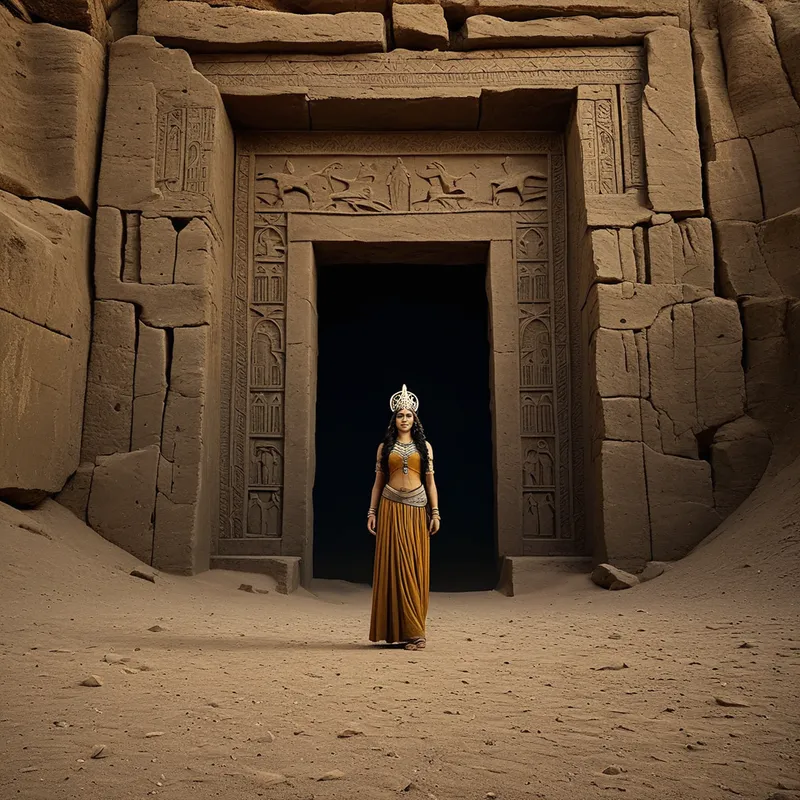
Cultural Origins & Context
This myth, known as The Descent of Ishtar, is not a singular story but a vital strand in the religious tapestry of ancient Mesopotamia, spanning Sumerian, Akkadian, and Babylonian cultures. It was recorded on fragile clay tablets in cuneiform script, often as part of liturgical texts or royal inscriptions. The tale was not mere entertainment; it was a sacred narrative performed, likely by temple priests or kalu singers, during key calendrical rituals, particularly those linked to the death and revival of vegetation at the height of summer.
Its societal function was profound and multifaceted. It explained the harsh, cyclical reality of the seasons—the withering of summer and the renewal brought by autumn rains. On a royal level, it mirrored the king's ritual role in ensuring fertility and order, his own symbolic descent into responsibility. For the common person, it provided a mythic framework for understanding loss, grief, and the fragile, negotiated return to life. The underworld was not a place of moral judgment but a stark, democratic reality, and even the gods were subject to its immutable laws. The myth affirmed that life, in all its passion and conflict, is purchased through a recurring sacrifice and a perilous negotiation with the realm of inertia and formlessness.
Symbolic Architecture
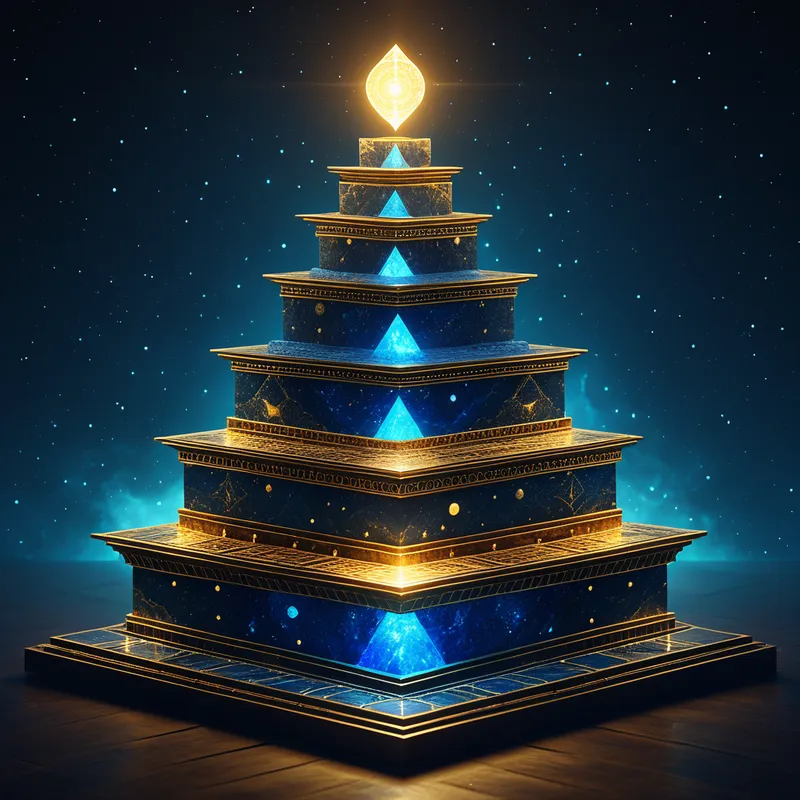
The myth’s power lies in its stark, architectural symbolism. The seven gates are not merely obstacles; they are the seven layers of the constructed self, the persona we present to the world. Ishtar’s crown, robe, and jewels are not just adornments but the accrued identities of power, love, warriorhood, and fertility.
To descend to the core of one’s being, one must be stripped of every title, every defense, every borrowed splendor. The gates do not take from you; they reveal what you are not.
The underworld, ruled by Ereshkigal, represents the unconscious—not a place of evil, but of raw, unmediated psychic reality. Ereshkigal is Ishtar’s shadow sister, the embodiment of everything the vibrant goddess of life has repressed: stagnation, grief, rage, and the silent pull of non-being. Their confrontation is the ultimate psychic civil war. Ishtar’s "death" on the hook is the necessary ego dissolution, the point of total vulnerability where transformation becomes possible. The rescue, engineered by Ea (wisdom) and executed by the crafted being Asu-shu-namir, signifies that rebirth requires a new kind of consciousness—a trickster-like, agile intelligence that can speak the language of the shadow and negotiate for the aqua vitae, the water of life.
The Dreamer's Resonance
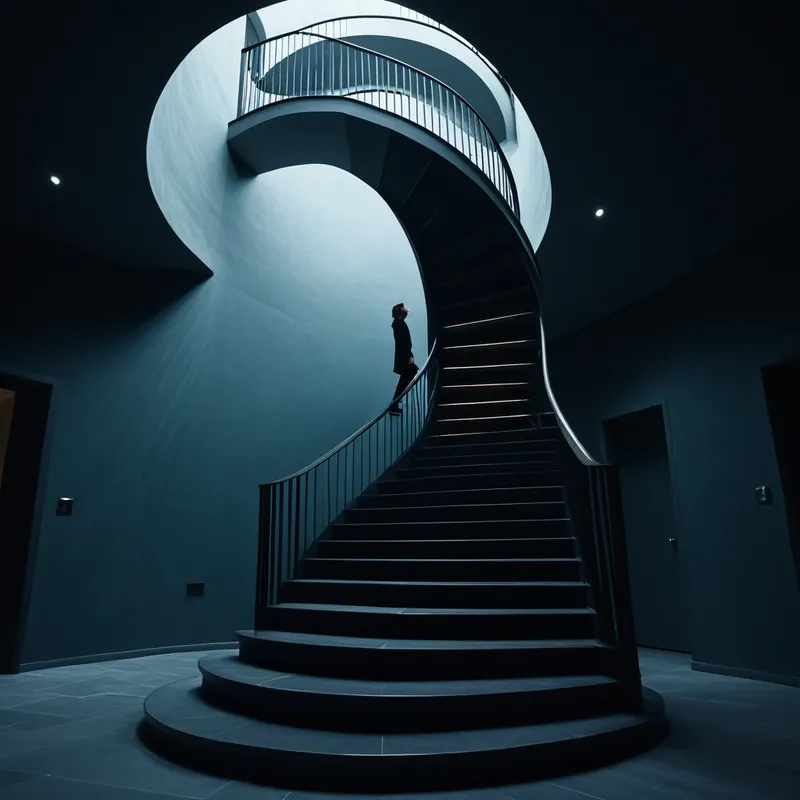
When this myth stirs in the modern dreamer, it announces a profound psychological initiation. To dream of descending a staircase, an elevator going down, or passing through a series of doors or checkpoints where you must relinquish possessions (a wallet, keys, a phone, clothing) is to dream the pattern of Ishtar’s Gate.
Somatically, this may be preceded by a feeling of life becoming sterile, a "living death" where passions dry up and relationships feel hollow—a direct mirror of the barren world above. The dream descent is the psyche’s imperative to go where the pain is, to confront the Ereshkigal complex: the accumulated grief, neglected rage, or deep depression we have walled away. The stripping away in the dream is not a punishment but a severe mercy. The anxiety upon waking—the feeling of exposure and vulnerability—is the somatic signature of the ego being dismantled. The process is one of enantiodromia, where an extreme conscious position (Ishtar’s glorious, public life) triggers a movement into its unconscious opposite (utter helplessness in the dark), initiating a rebalancing of the whole self.
Alchemical Translation
For the individual on the path of individuation, Ishtar’s journey is a precise alchemical map. The conscious personality, identified with its achievements and attributes (the opus of one’s life), must undergo a voluntary descensus ad inferos—a descent to the underworld. This is the alchemical stage of nigredo, the blackening, where all that was certain is dissolved in the dark waters of the unconscious.
The goal is not to retrieve the old self, jewel by jewel, but to be resurrected by a wisdom that comes from beyond the ego’s ken. One returns carrying the shadow, not escaping it.
The hero’s task is to endure the stripping, to hang on the hook of despair without fleeing into distraction or false positivity. This is the crucible. The intervention of Ea represents the emergence of a transcendent function—a new perspective born from the tension between the conscious attitude and the unconscious content. The modern "Asu-shu-namir" might be a creative act, a piercing insight, or therapeutic dialogue that finally names and honors the shadow’s pain, winning the Waters of Life.
Emergence is not a return to the old innocence. Ishtar ascends with the knowledge of the underworld etched into her being. Tammuz, the beloved, must take his turn below. Psychologically, this means accepting that life now includes a conscious relationship with death, depression, and limitation. The fertile, creative life that follows is deeper, more grounded, and paradoxically more vibrant because it has acknowledged and incorporated its own negation. The gate stands not as a barrier, but as a permanent threshold between the two realms of our being, reminding us that every true renewal is born from a courageous descent.
Associated Symbols
Explore related symbols from the CaleaDream lexicon: