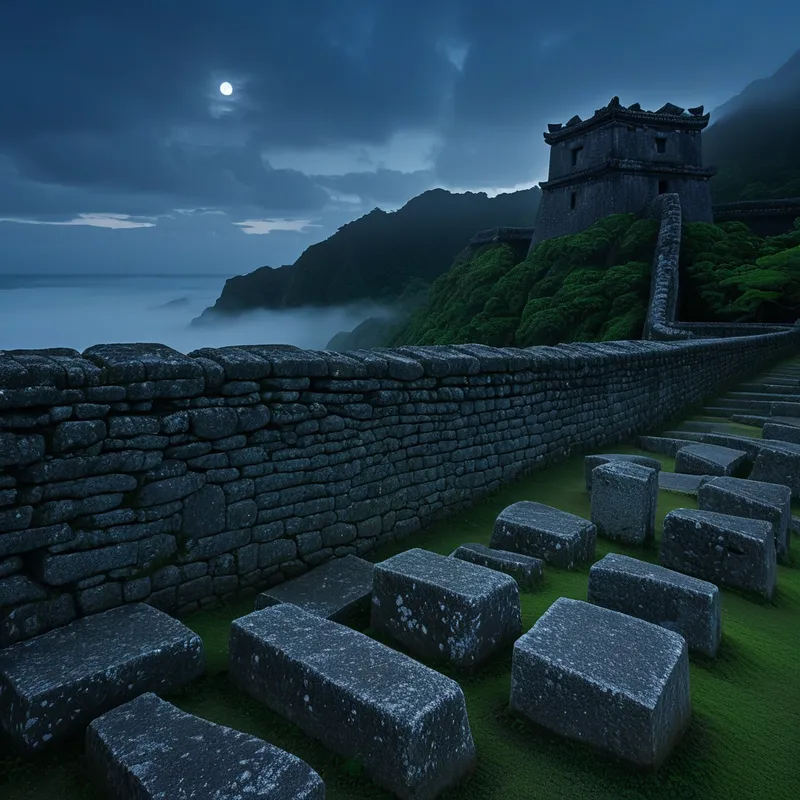
Ishigaki Myth Meaning & Symbolism
A myth of a primordial stone wall, born from divine conflict, that defines sacred space and embodies the foundational structures of the world and the self.
The Tale of Ishigaki
In the time before time, when the world was still a formless, churning broth, the kami walked upon the raw stuff of creation. The land was soft, the seas were restless, and the very air trembled with unshaped potential. From the High Plain of Heaven, the divine siblings, Izanagi and Izanami, looked down and saw the need for order. With the Ame-no-nuboko, they stirred the brine, and the first island, Onogoroshima, coagulated from the deep.
But creation is not a single act; it is a constant negotiation. The land, newborn and tender, was besieged. The sea, Watatsumi, roared with possessive fury, sending great waves to claw at the shores. The winds, capricious and wild, sought to scatter the soil back into the void. The earth itself shifted and sighed, threatening to dissolve. The fledgling world cried out for a spine, for a boundary against the relentless chaos.
Hearing this plea, the kami of the mountains and the kami of the stones convened. Their council was not of words, but of deep, tectonic intention. From the bones of the earth, they drew forth not just rock, but purpose. With a sound like the grinding of continental plates, the first stone was lifted. It was not merely placed; it was consecrated. Another followed, and another, each fitting against its neighbor with a perfection that sang of celestial geometry.
They built a wall. Not a small thing, but a rampart of such scale and majesty it seemed to hold up the very sky. This was Ishigaki. It rose, course by impossible course, along the vulnerable edge of the land. Where the sea crashed, Ishigaki stood unmoved, its face beaded with salt spray but utterly unyielding. Where the winds howled, they broke against its mass and were tamed into breezes. The wall defined here from there, land from sea, order from chaos. It was the first firm line drawn in the world.
And in its shadow, life dared to breathe. Seeds took root in the sheltered soil. Freshwater springs bubbled up from protected ground. The kami of the land could now descend and walk without fear of being washed away. Ishigaki did not fight; it simply was. Its presence was a declaration so absolute that chaos, confronted with such unwavering definition, had no choice but to recede. The mythic age of pure formlessness was over. The age of the world, with its sacred boundaries and defined spaces, had begun.
Cultural Origins & Context
The concept of Ishigaki is woven into the very fabric of Shinto and Japanese cultural geography. While not a single, standardized narrative like the Kojiki tales of Izanagi and Izanami, the motif of the primordial, defining stone wall is a profound archetype found in local folklore, shrine architecture, and the understanding of sacred space (himorogi).
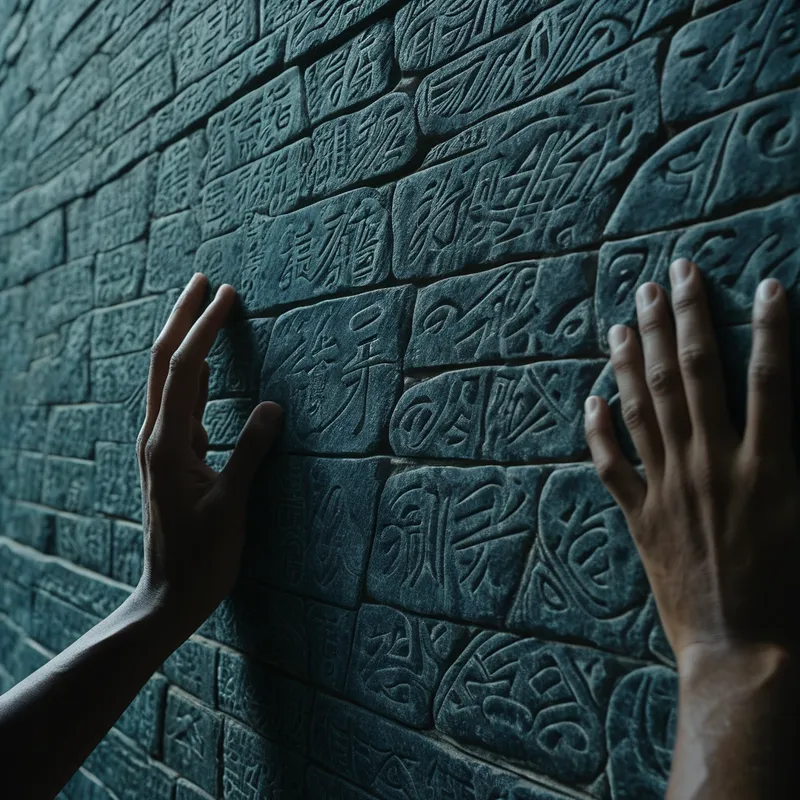
Its origins are pre-literate, emerging from an animistic worldview where landscape features were seen as direct manifestations of kami activity. The impressive stone walls (ishigaki) that surround ancient jinja like Ise Jingu or encircle burial mounds (kofun) are not merely practical fortifications; they are ritual re-enactments of this mythic act. They physically demarcate the sacred, purified interior (naiku) from the profane outside world, mirroring the primordial separation of order from chaos.
The myth was passed down not just through story, but through practice. The masons who built these walls performed their craft as a sacred duty, a collaboration with the kami of the stone. The societal function was foundational: Ishigaki provided a cosmological model for civilization itself. It justified the establishment of villages, the demarcation of rice paddies, and the construction of castles—all acts of imposing human order on the natural world, always with an awareness of the divine precedent set by the first wall.
Symbolic Architecture
At its core, Ishigaki symbolizes the necessary boundary. It is the archetypal structure that makes consciousness possible.
Before the wall, there is only the oceanic unconscious—formless, potent, and all-encompassing. The erection of Ishigaki is the first act of differentiation, the birth of the ego from the sea of the unconscious.
Psychologically, Ishigaki represents the foundational structures of the psyche: our core beliefs, our personal ethics, our sense of self. These are the "stones" we carefully select and fit together to create a stable identity capable of withstanding the internal and external chaos—the storms of emotion, the erosive tides of doubt, the shifting grounds of circumstance. The wall is not an aggressive defense, but a serene, immovable presence that defines what is "me" and what is "not-me."
The perfectly fitted stones speak to integration. A wall of haphazard rubble collapses. Ishigaki’s strength comes from the harmonious alignment of disparate parts into a greater, cohesive whole. This mirrors the psychological process of assimilating various aspects of our experience—trauma, joy, knowledge, instinct—into a resilient personality. The wall also creates sacred interior space. By defining a boundary, it makes room for the cultivation of something precious and protected within: the inner sanctuary of the Self.
The Dreamer's Resonance
When the motif of Ishigaki appears in modern dreams, it signals a profound process of psychic foundation-building or repair. The dreamer is confronting a need for greater structure, stability, or definition in their life.
Dreaming of building the wall, feeling the weight of the stones, indicates an active, conscious effort to establish healthy boundaries, solidify one's values, or create order from internal chaos. It is somatic work; one may wake feeling the ache of effort in their limbs. Dreaming of a crumbling or breached Ishigaki is a direct message from the unconscious that the dreamer's foundational structures are under threat. This could relate to a crisis of faith, a betrayal that shakes their self-concept, or a life transition that renders old boundaries obsolete. The emotional tone is often one of vulnerability and exposure.
Conversely, dreaming of finding shelter within an intact, majestic Ishigaki suggests the dreamer is successfully accessing their inner sanctum. They are drawing strength from their core, integrated self, feeling protected and defined amidst external turmoil. The wall in the dream is not a prison, but the necessary condition for inner freedom.
Alchemical Translation
The myth of Ishigaki models the alchemical stage of coagulatio—the process of moving from the fluid, dissolved state (solutio) to a solid, embodied, and defined state. It is the work of psychic incarnation.
Individuation is not about becoming boundless; it is about becoming well-bounded. The Self is not a diffuse cloud, but a temple, and every temple requires a sacred enclosure.
For the modern individual, the "chaotic sea" is the flood of information, social demands, internal complexes, and existential uncertainty. The alchemical work is to become the mason-kami. We must descend into the "bones of the earth"—our deepest instincts, ancestral wisdom, and bodily knowing—to select the true stones of our character. We must learn the art of fitting them together: perhaps the stone of discipline next to the stone of compassion, the stone of grief integrated with the stone of joy.
This is not an act of rigidification, but of sacred definition. The goal is not an impenetrable fortress that isolates, but a majestic, defining wall that creates a protected space within which our most authentic life can grow. The triumph of Ishigaki is not victory over chaos, but the establishment of a relationship with it. The wall allows the sea to exist, to be beautiful and powerful, without being allowed to destroy. In our own lives, this translates to building a psyche strong enough to acknowledge the depths of our own unconscious, our pain, and our shadow, without being overwhelmed by them. We transmute formlessness into form, chaos into a defined and habitable world—first in the soul, and then, inevitably, in the life that soul inhabits.
Associated Symbols
Explore related symbols from the CaleaDream lexicon: