Ishi-gami Myth Meaning & Symbolism
A myth of a stone granted divine spirit, embodying the silent, enduring consciousness within the landscape and the human psyche.
The Tale of Ishi-gami
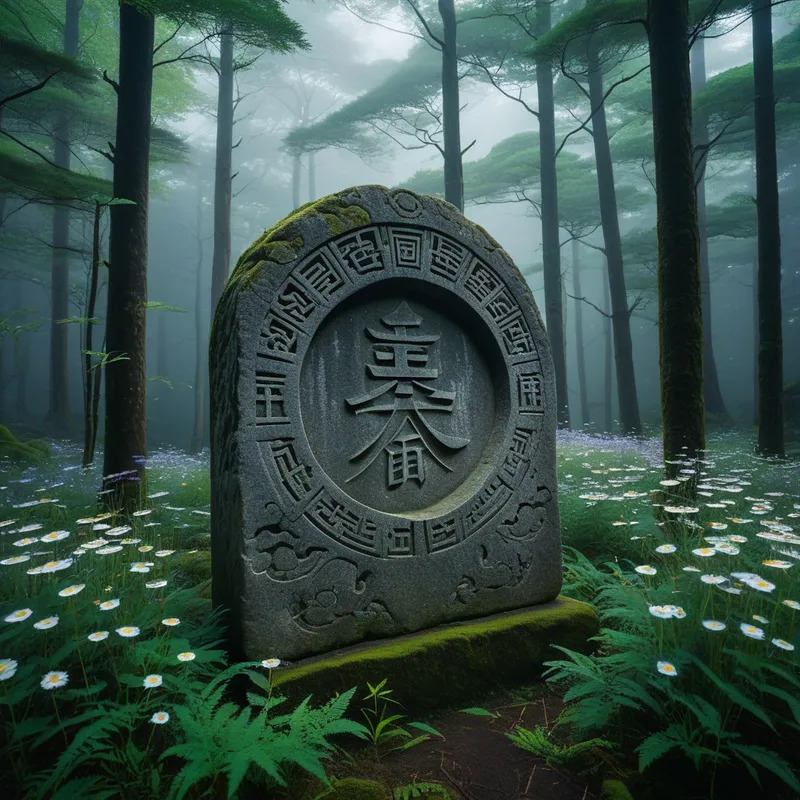
Listen. Before the first shrine was built, before the first name was given to the mountain, there was the stone. It lay in the riverbed, rounded by centuries of patient water, grey and unremarkable. The villagers passed it, their feet finding firmer ground. Children skipped it across the stream’s surface, a brief arc of flight before a final, sinking plunk. It was a thing of the world, of weight and silence.
But the world is not only what is seen; it is what is felt in the marrow of a quiet moment. An old woodcutter, his back bent like a seasoned bow, paused by the river to drink. His hands, gnarled as tree roots, cupped the cold water. As he rested, his gaze fell upon that same stone. Not as an obstacle, not as a tool, but as a presence. In the slanting afternoon light, flecks of mica within it caught the sun and held it, glittering like trapped stars. A profound stillness settled in his chest, a stillness that mirrored the stone’s own. He felt not loneliness, but a deep, abiding companionship with this ancient piece of the earth.
Without understanding why, he bent, the joints of his knees protesting, and lifted the stone from its watery bed. It was heavier than it looked, dense with time. He carried it not to his hut, but to the edge of the ancient forest, where the trees grew thick and the air hummed with unseen life. There, in a small clearing dappled with light, he placed it upon a bed of moss. He cleared the weeds around it. He brought a dipper of clear water and poured it gently over the stone’s surface, watching the water trace paths down its contours. He did this not as a chore, but as an act of recognition. A silent conversation had begun.
Seasons turned. The woodcutter returned, sometimes with a handful of wild berries, sometimes with a simple prayer whispered on the breeze. Others from the village noticed the change in him—a newfound peace, a grounded certainty. Curious, they followed. They saw the stone, now clean, cradled by the forest. They felt the peculiar kami-presence, the sacred energy, that had gathered there. It was not a thunderous deity, not a demanding spirit. It was a slow, deep, patient awareness. They began to bring their own small offerings: a sprig of sakaki, a pinch of salt, a quietly spoken hope.
The stone did not move. It did not speak. Yet, in its unwavering there-ness, it listened. It held the joys of a good harvest, the fears of a sick child, the quiet grief of a passing year. It became the Ishi-gami, the Stone God. Its power was not in action, but in profound, immovable reception. It taught that to be truly present is to become a vessel for the world’s soul.
Cultural Origins & Context
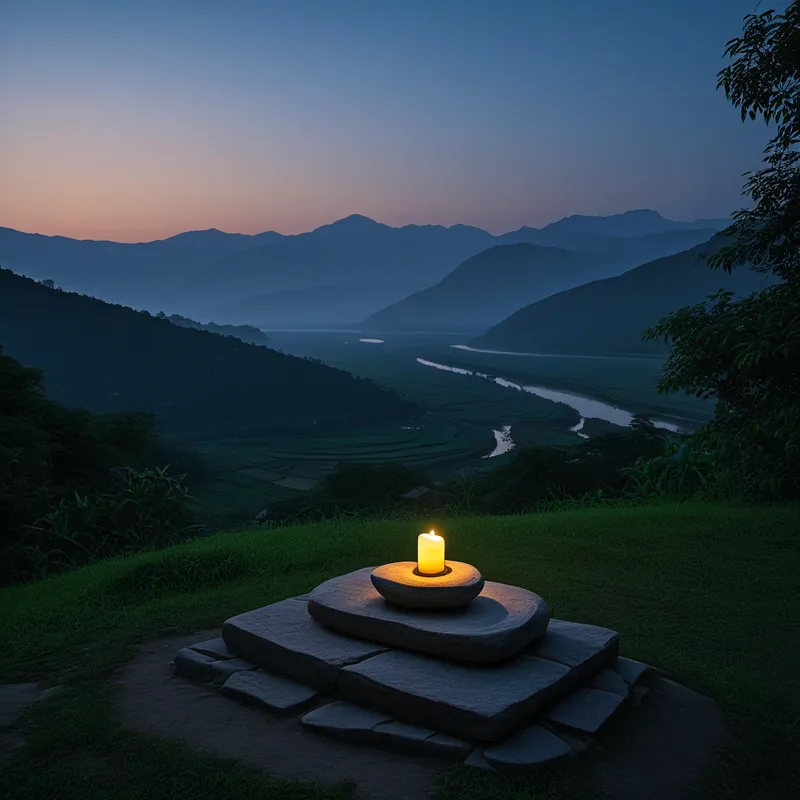
The veneration of Ishi-gami is a foundational thread in the tapestry of Shinto, Japan’s indigenous spiritual tradition. This myth did not originate from a single epic text, but from the cumulative, lived experience of an animistic worldview. It was passed down not by bards in courts, but through the daily practices of farmers, fishermen, and villagers intimately tied to their land.
In a culture where mountains, rivers, trees, and even unusually shaped rocks are seen as vessels for kami (sacred spirits), the Ishi-gami represents one of the most accessible and fundamental forms of divinity. Its societal function was multifaceted. Practically, it served as a localized focal point for community worship, a “neighborhood” deity offering protection and stability. Psychologically, it externalized the human need for a witness—a silent, non-judgmental presence to hold personal and communal stories. It reinforced the Shinto principle of kannagara, the way of the kami, which emphasizes living in grateful harmony with the spiritual essence inherent in all nature. The myth, therefore, is less a story with a plot and more a narrative model for a specific type of sacred relationship: one based on attentive recognition rather than dramatic revelation.
Symbolic Architecture
At its core, the Ishi-gami is a profound symbol of latent consciousness and the soul’s bedrock. The stone represents the most fundamental layer of the psyche—what in depth psychology might be called the psychoid layer, the unconscious foundation that borders the physiological and the archetypal. It is the Self before it is known, the core of being that simply is.
The stone is not inert; it is profoundly active in its stillness. It symbolizes the ego’s necessary encounter with that which does not change, the eternal witness within.
The transformation of the ordinary stone into a deity is not a change in the stone, but a radical change in human perception. This is the central alchemy of the myth: the woodcutter’s act of seeing kami where others saw only rock. The Ishi-gami thus symbolizes the moment when the unconscious is recognized as sacred. The offerings—water, salt, prayers—are symbolic acts of libido, of psychic energy, directed inward to nourish this newly discovered inner center. The stone’s enduring, listening presence symbolizes the Self’s constancy, a center of gravity that holds all our transient thoughts and emotions without being swayed by them.
The Dreamer's Resonance
When the pattern of the Ishi-gami emerges in modern dreams, it often signals a process of profound grounding and somatic integration. The dreamer may encounter a particularly significant stone—in a landscape, in their hand, or even as a part of their own body. This is not a call to action, but a call to being.
Psychologically, this dream motif suggests the psyche is attempting to consolidate a deep, non-verbal realization. The individual may be undergoing a period of fatigue from excessive “doing,” from a life lived on the surface of personality. The stone appears as an antidote: an image of immense patience, resilience, and silent integrity. The somatic process is one of slowing down, of feeling the weight of one’s own existence, of descending from the frantic chatter of the mind into the quiet, wordless knowing of the body. To dream of venerating a stone is to dream of beginning to honor one’s own foundational, perhaps neglected, essence. It is the unconscious compensating for a life out of balance, offering the image of the ultimate ground.

Alchemical Translation
The journey of the Ishi-gami models a critical, often overlooked stage of individuation: the transmutation of the personal complex into a sacred, impersonal center. Our modern struggles are rarely with dragons; they are with weight—the weight of anxiety, of responsibility, of a fragmented identity. We seek to flee this weight, to make ourselves lighter, more mobile, less substantial. The Ishi-gami myth proposes the opposite alchemy.
The first step is the woodcutter’s pause—the conscious decision to stop and truly perceive. In psychological terms, this is the act of introspection, of turning attention away from external drama and toward the inner landscape. The “stone” one finds may be a core wound, a lifelong pattern, or a simple, undeniable truth about one’s nature that has been ignored.
The alchemy occurs not in changing the stone, but in changing your relationship to it. To carry it to the clearing of consciousness and to begin the daily ritual of acknowledgment is to perform the opus of the soul.
The subsequent “veneration”—the daily, mindful attention—is the work of integration. You pour the water of your awareness over this hard fact of your being. You clear the weeds of old narratives around it. You do not ask it to become something else; you learn its language of silence and endurance. Over time, what was a burden—a hard, cold, personal problem—begins to radiate a different quality. It becomes a source of stability. It becomes the Ishi-gami of your psyche: the silent, unmoving center that listens to all your passing storms and joys, the touchstone of your authentic self. You realize the goal is not to become spiritually weightless, but to become spiritually grounded, to achieve the dignity and peace of the stone that has found its rightful place in the clearing.
Associated Symbols
Explore related symbols from the CaleaDream lexicon: