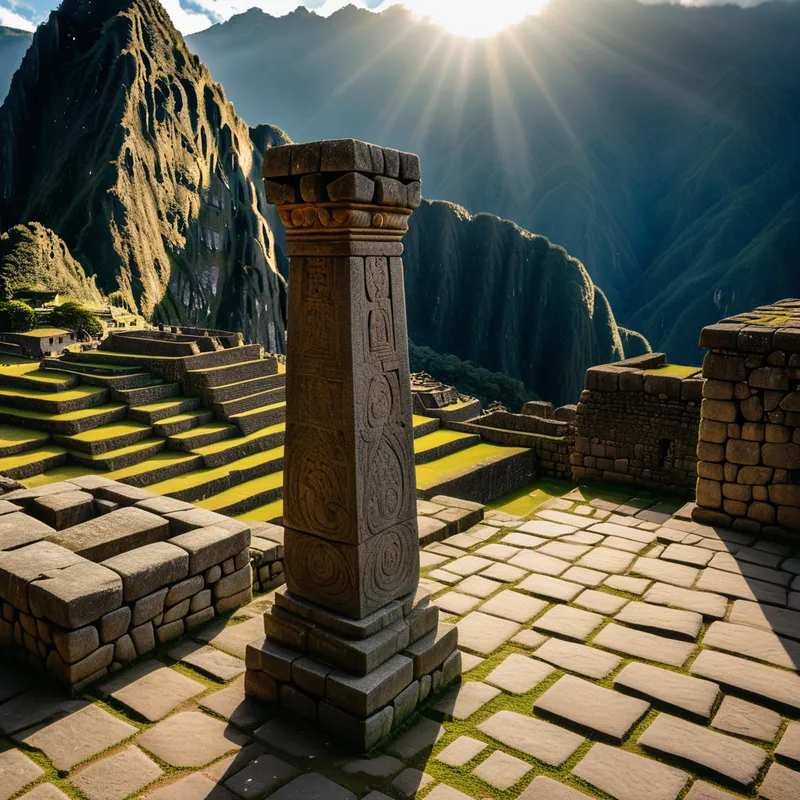
Intihuatana Stone Myth Meaning & Symbolism
The sacred stone that binds the sun to the earth, ensuring cosmic order and the soul's alignment with the eternal cycles of time and spirit.
The Tale of Intihuatana Stone
Listen. Feel the thin, cold air of the roof of the world. Here, where the condor’s shadow is a fleeting god upon the land, the people of the Tawantinsuyu lived in a sacred pact. The sun, Inti, was their father, their life-giver. But each year, as the days grew shorter and the shadows longer, a deep dread crept into their hearts. What if Inti, in his great journey across the sky, decided not to return? What if he continued his descent, leaving the world in perpetual cold and darkness? The crops would fail, the llamas would perish, and the spirit of the people would freeze in their chests.
The Sapa Inca, the son of Inti, felt this terror as a physical weight. He climbed to the highest, most sacred sanctuary, a city of stone kissed by clouds. There, upon a carved platform that seemed to touch the very belly of the sky, stood a single, enigmatic pillar of granite. It was not merely carved; it was called from the stone—a four-sided prism, its angles precise, its top a complex series of planes and levels. This was the Intihuatana.
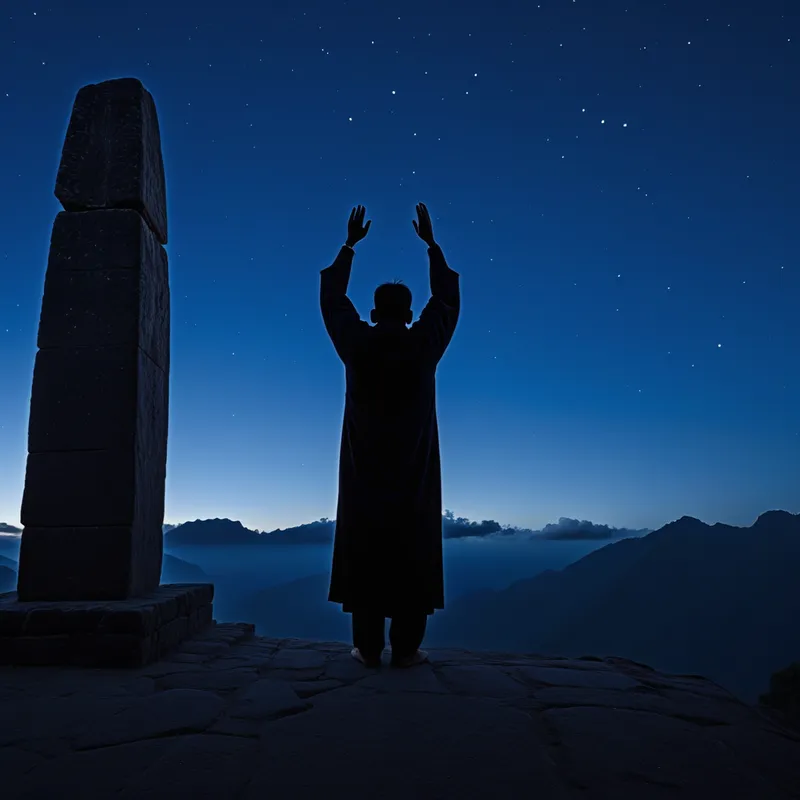
On the morning of the winter solstice, the darkest day, the Sapa Inca and his priests gathered in silence so profound it was a prayer itself. The world held its breath. The stone stood dark, a silent sentinel. As the first, faint hint of light bruised the eastern peaks, the Sapa Inca approached. He did not speak with words, but with his entire being—a conduit of human fear and divine hope. He placed his hands upon the cold granite, feeling the heartbeat of the Pachamama beneath him.
He began the ritual, a dance of alignment, of profound plea. He was not commanding the sun; he was binding it, not with ropes of fiber, but with cords of intention, of ceremony, of sacred geometry etched into the stone and mirrored in the cosmos. He traced the shadow the stone cast, a dark finger pointing to the heart of the coming dawn. He offered chicha and perfect coca leaves, the essence of the earth, to the stone, to the sky.
And then… it happened. The first sliver of solar fire crested the mountain. It did not simply illuminate; it engaged. The light struck the uppermost angle of the Intihuatana not as a passive glow, but as an active connection. The stone awoke. Its shadow, sharp and undeniable, fell along a sacred groove, a path predetermined by the wisdom of the ancestors. In that precise moment of alignment, the Sapa Inca felt the tension in the universe snap taut. The sun was caught. It was hitched. Its southward flight was arrested. The great celestial llama was tethered to the post of the world. The sun would now turn back. Light and warmth would return. The pact was renewed. The stone had done its work—it had held the cosmos in place.
Cultural Origins & Context
The myth of the Intihuatana is not a singular story with a named hero, but a foundational cosmological principle woven into the fabric of Incan civilization. It emerged from the high-altitude reality of the Andes, where the sun’s path is not an abstract concept but a direct determinant of survival. The “tale” was lived annually in the Inti Raymi ceremony, a state-sponsored ritual of immense political and spiritual significance led by the Sapa Inca himself.
Its tellers were the Amautas (wise teachers) and the priests of the Inti cult. It was passed down not merely as narrative, but as embodied knowledge—in the architecture of Coricancha in Cusco, in the precise orientation of temples, and in the very construction of outposts like Machu Picchu, where the Intihuatana was the axis mundi. Its societal function was paramount: it legitimized the divine authority of the Inca as the mediator between humanity and the cosmos, it ensured agricultural and calendrical order, and it provided a profound psychological security against the terrifying chaos of a sun that might abandon the world.
Symbolic Architecture
At its core, the Intihuatana is a symbol of the human imperative to create order from chaos, to find a fixed point in a turning world. It represents the archetypal act of orientation.
The stone is not an object, but a verb: the act of anchoring the transcendent to the immanent, of making the eternal measurable by the temporal.
Psychologically, it embodies the Logos principle. The hero of this myth is not a person, but the ritual itself—the conscious, precise application of will, observation, and sacred art to influence reality. The stone is the Self manifested in the world: a central, immovable reference point from which all else gains its meaning and relationship. The “conflict” is the psyche’s fear of dissolution, of being lost in the unconscious (the long night). The “resolution” is the establishment of a conscious standpoint—the Ego aligned with the Self—that can navigate the cycles of life without being destroyed by them.
The Dreamer's Resonance
When this myth pattern activates in the modern dreamer, it often manifests as dreams of searching for or trying to operate a mysterious, ancient mechanism—a dial, a lever, a stone altar—that controls time, the weather, or the stability of reality itself. The dreamer may feel an urgent, somatic pressure: “I must align this, or everything will fall apart.”
This is the psyche signaling a critical phase of re-orientation. The dreamer is undergoing a “solstice” in their inner life—a point of maximum descent, where an old identity, a old way of being, is dying. The dream of the Intihuatana is the Self presenting the tool for the turnaround. The psychological process is one of moving from passive suffering (“the days are getting darker”) to active, ritualized participation in one’s own transformation. The somatic feeling is often a tense anticipation in the solar plexus, a holding of breath that seeks release in a precise, correct action of will or insight.
Alchemical Translation
The alchemical process mirrored here is coagulatio—the making solid, the fixing of the volatile spirit. In the individuation journey, we are all beset by the “wandering sun” of our own libido—our vital energy that can become diffuse, scattered, or lost in complexes or endless potentialities.
The work is to become the priest-architect of your own soul, to carve your Intihuatana from the raw stone of experience.
First, one must identify the “high place”—the elevated, conscious perspective (often achieved through introspection or therapy). Then, one must fashion the “stone”—a core principle, a vow, a creative work, a practiced meditation, a moral stance. This is not a rigid dogma, but a precisely crafted tool for measurement. The “ritual” is the daily, mindful application of this principle to one’s life, observing how the light of consciousness falls upon it. The moment of “hitching” is the profound inner realization where a pattern snaps into place, where a commitment is made, where the diffuse energy is focused and tethered to a purpose. The sun (the Self) is not controlled, but its return journey—the movement toward greater wholeness and expression—is ensured. The individual moves from being a victim of inner seasons to the sacred steward of their own cyclical becoming.
Associated Symbols
Explore related symbols from the CaleaDream lexicon:
- Stone — The primary symbol of permanence, the anchor of the soul and the material interface between human intention and cosmic law in the ritual.
- Sun — The transcendent life-force, consciousness, and divine father principle that must be engaged with and ritually bound to ensure cyclical renewal.
- Temple — The sanctified space, both external and internal, where the sacred alignment between the individual and the cosmic order is performed.
- Ritual — The precise, conscious action that transforms anxiety into sacred duty, creating a bridge of meaning between the human and the divine.
- Order — The supreme goal of the myth, representing the triumph of cosmos over chaos, of predictable cycles over existential terror.
- Shadow — Not as a negative, but as the necessary, measurable indicator cast by the stone of consciousness, revealing the sun’s true position and path.
- Mountain — The place of ascent and perspective, the earthly throne closest to the sky where such a profound binding of celestial forces is possible.
- Circle — The eternal cycle of solstices, seasons, and life that the Intihuatana ritual seeks to acknowledge, honor, and perpetuate.
- Key — The stone itself functions as a metaphysical key, unlocking the correct alignment of time and space, and securing the cosmic order.
- Altar — The Intihuatana as the ultimate altar, not for sacrifice of life, but for the offering of human attention and precision to sustain life itself.
- Root — The deep, ancestral wisdom and connection to Pachamama (Earth) that grounds the stone and gives it the authority to interact with the sky.
- Philosopher's Stone — Its alchemical cousin, representing the same goal of achieving a perfected, permanent state of being through a transformative, precise art.