Inipi Ceremony Myth Meaning & Symbolism
The sacred story of receiving the sweat lodge, a womb of stone and steam where spirits cleanse the people, forging them anew from darkness into light.
The Tale of Inipi Ceremony
Listen. Before the people walked as they do now, they walked in confusion. The world was heavy upon them. Sorrow clung to their skin like dust. Sickness whispered in their bones. They had forgotten how to be clean, not just in body, but in spirit. They carried the mud of their mistakes, the smoke of their anger, the cold ash of their grief.
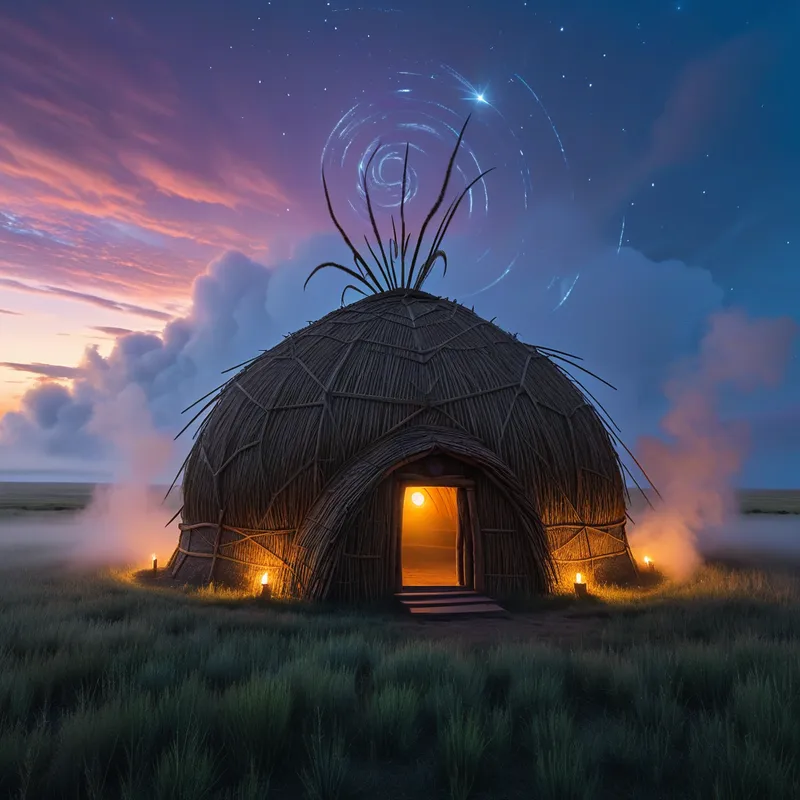
In their need, they cried out. Their prayers were not words, but a silent heat that rose from the prairie, a longing for a return to the first purity. The Great Spirit, Wakan Tanka, heard this heat. And from the oldest grandmother of all things, Iktomi, in the form of a wise, ancient spider, came a vision. She spoke not to the chiefs, but to a humble holy man in his dream. She showed him a round structure, like her own web, but made of the supple bones of the willow, the tree that bends but does not break. She showed him a pit in the center, a belly for the earth.
“You must gather the ancient ones,” Iktomi whispered on the dream-wind. “The Grandfathers. They have slept in the heart of the hill since the world was young. They remember the first fire. Bring them into the lodge.”
The people were afraid. The stones from the fire were terrifying, red-eyed and fierce. To sit with them in darkness seemed like a death. But the holy man was steadfast. He led them. They built the lodge, stretching buffalo hides over the willow frame, making a womb that was utterly dark. They lit a great fire outside, a sun to heat the Grandfathers. When the stones glowed with an inner sun of their own, they were brought in, one by one, with reverence. The door of hide fell shut. The world disappeared.
Then came the water. Upon the Grandfathers, the holy man poured it. Not a splash, but a prayer. Hssssssss. The lodge was born in that sound. It was not mere steam that filled the blackness; it was the breath of the earth itself, hot, dense, and alive. It was the first breath of creation. In that total dark, with the sacred heat pressing upon them, the people met their shadows. Their fears rose like vapors. Their regrets burned on their skin. They felt they would dissolve.
But as they endured, as they sang the ancient songs that came unbidden to their lips, a change stirred. The heat was no longer an enemy, but a purifying embrace. The steam washed through them, not as water washes dirt from a bowl, but as lightning cleanses the sky. It sought out the spiritual sickness, the stuck sorrow, the hidden anger, and carried it out through their very pores. In the final round, as the door opened, the light that streamed in was not the same light they had left. It was new. They crawled out, not as they entered, but raw, trembling, and utterly clean—reborn from the sacred womb of stone and steam, children of the earth and sky once more.
Cultural Origins & Context
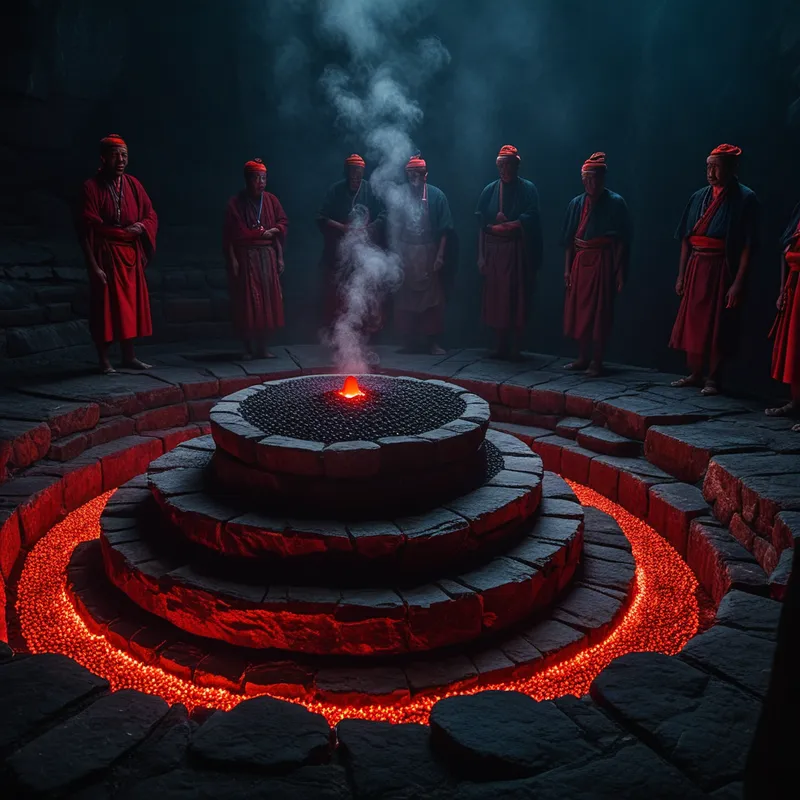
The Inipi</abemony is not merely a story from the past; it is a living, breathing ritual central to Lakota spirituality and identity. Its origins are traced to divine revelation, received by holy men (Wičháša Wakháŋ) in visions and dreams. This sacred knowledge was not written but meticulously preserved and transmitted orally through generations of these spiritual leaders, who served as the ceremony’s guides and firekeepers.
Its societal function was and remains profound. It was a necessary purification before all other major ceremonies—the Vision Quest (Hemblečiye), the Sun Dance (Wiwáŋyaŋg Wačhípi), and before going to war or on a hunt. It served as a communal reset, a way to restore wolakota both within the individual and the community. The lodge itself, a microcosm of the universe, reinforced the Lakota worldview: the willow frame represents all that grows, the hides the animal kingdom, the pit the earth, the stones the ancient powers, the steam the flowing waters, and the dome the sky. To enter the Inipi was to enter the cosmos in miniature, to realign oneself with its fundamental order.
Symbolic Architecture
The myth of the Inipi is a masterful blueprint for psychic death and rebirth. Every element is a profound symbol.
The lodge is the womb of the Great Mother. Its darkness is not the darkness of fear, but the fertile darkness of potential, the void from which new consciousness is born. To enter is to willingly return to a pre-conscious state, to shed the accumulated layers of the persona.
The Grandfather stones are the enduring, indestructible core of the Self—the psychic bedrock that must be heated in the fires of ordeal to radiate transformative power.
The fire that heats them is the fierce, purifying energy of the unconscious, the libido or life force in its rawest form. The water poured upon them is consciousness, the directed intention and prayer of the participant. Their meeting creates the steam—the transcendent function, the third thing that arises from the tension between unconscious heat and conscious direction, which has the power to alter the very fabric of the psyche.
The experience of heat, darkness, and pressure is the somatic metaphor for confronting the shadow. There is no escaping oneself in the lodge. Every repressed thought, every unacknowledged fear, rises to the surface of awareness to be “sweated out.” The final opening of the door is the emergence into a new psychic reality, where the ego, having surrendered to a greater process, is reintegrated—humbled, cleansed, and reconnected to the Self.

The Dreamer's Resonance
When the pattern of the Inipi arises in modern dreams, it signals a profound somatic and psychological process of detoxification and incubation. The dreamer may find themselves in an overly hot, confined space—a stuck elevator, a shrinking room, a steaming bathroom. There is often a sense of inescapable pressure and a confrontation with uncomfortable “heat,” which could manifest as intense emotion, shame, or anxiety within the dream.
This is the psyche’s innate ritual. It indicates that the dreamer’s unconscious is actively working to purge accumulated psychic toxins: outdated identities, unresolved grief, or swallowed anger. The confinement is not a prison, but the necessary boundary for this intense inner work. To dream of finally emerging from such a space into cool, fresh air or clear light suggests the process is nearing completion. The psyche is announcing, “You are in the lodge. Endure. The purification is underway. A rebirth is preparing.” The body may even respond upon waking with a sense of having sweated or a deep, cathoric fatigue, mirroring the physical ordeal of the ritual.

Alchemical Translation
For the modern individual navigating the path of individuation, the Inipi myth models the essential, non-negotiable phase of mortificatio and solutio—the alchemical dying and dissolving. Our culture offers endless distractions from inner discomfort, but the myth insists that true transformation requires a voluntary descent into the “lodge” of our own being.
We must construct this sacred space through intentionality—perhaps in therapy, meditation, journaling, or any disciplined inner practice. We must gather our “Grandfathers”—the core, often hardened truths about ourselves we’ve ignored. We must apply the fire of honest self-reflection and the water of conscious feeling. The resulting “steam” is the painful yet liberating insight that burns away illusion.
The ceremony teaches that purity is not a pristine, static state, but an active process of burning away the inessential. We are not made clean by avoiding the mud, but by being forged in it.
The triumph is not an escape from the heat, but a transmutation by the heat. The ego’s victory is in its surrender to a process greater than itself. To crawl out of our self-constructed lodge is to be reborn into a more authentic life, where actions are aligned not with societal expectations or neurotic complexes, but with the wisdom of the heated stone and the cleansing breath of spirit. We live again, not as better masks, but as more genuine souls.
Associated Symbols
Explore related symbols from the CaleaDream lexicon: