Indra's Palace Myth Meaning & Symbolism
The tale of a celestial king whose divine palace, built by pride, is dissolved by a humble sage, revealing the illusory nature of all constructs.
The Tale of Indra's Palace
Listen, and let the tale unfold.
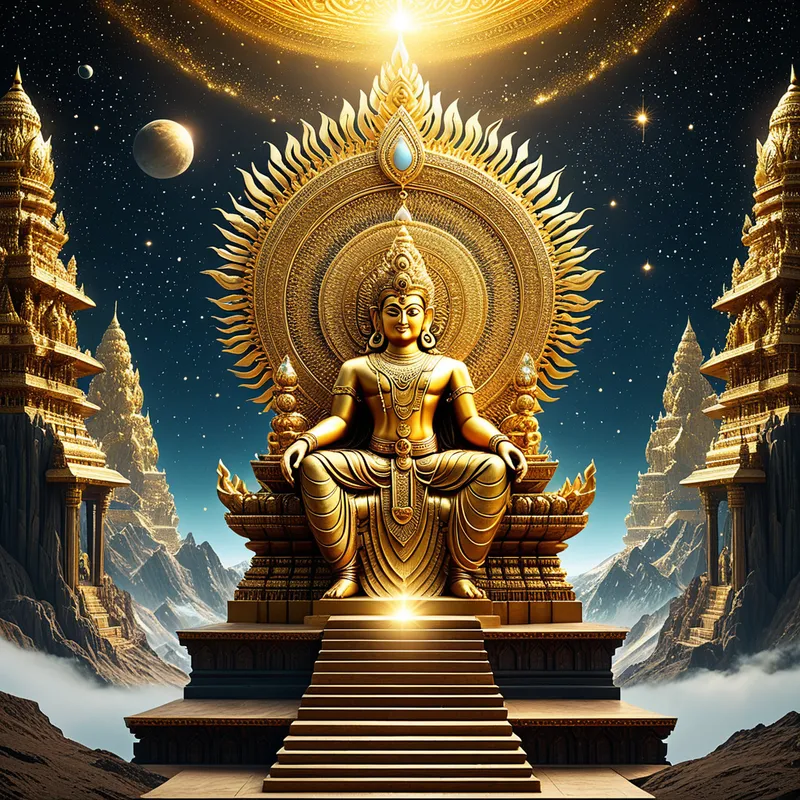
In the highest realm of the cosmos, atop the axis of the world, stood the city of the gods, Amaravati. And at its heart, a palace. Not merely a palace, but the Palace—a structure of such splendor it made the sun seem dim. Its pillars were of diamond, its floors of polished moonstone, and its spires pierced the very fabric of the heavens. This was the abode of Indra, the thousand-eyed lord of storms, the victor of demons, the sovereign of the skies.
Indra, swollen with the nectar of victory and the adoration of all beings, surveyed his domain. Yet, a whisper of discontent stirred in his divine heart. Was it enough? For a king of such puissance, should not his dwelling reflect the infinite scope of his glory? He summoned Vishvakarma, the architect of the universe himself. "Build me a palace," commanded Indra, his voice like rolling thunder, "without equal, without end. Let every corner proclaim my majesty. Let its grandeur be eternal."
And so Vishvakarma labored. He pulled starlight into tapestries, forged galaxies into gateways, and set constellations as jewels in the ceilings. The palace grew and grew, its halls multiplying, its gardens expanding into realms of perpetual spring. It became a labyrinth of opulence, a monument to a single, swelling thought: I am the greatest.
But as the palace expanded, so did Indra's demands. No sooner was a wing completed than he desired another, grander still. Vishvakarma, weary of the insatiable hunger of the god-king, sought counsel from a higher power. He went to Vishnu.
Vishnu, perceiving the cosmic imbalance born of this unchecked pride, devised a remedy of exquisite subtlety. He sent a visitor to Amaravati. Not an army, not a rival god, but a boy. A young, humble brahmin sage, radiant with an inner peace that outshone all of Indra's jewels.
The boy stood at the celestial gates, requesting an audience. Admitted to the throne room, he beheld Indra in all his glory and did not tremble. Instead, he gazed with a calm, fathomless curiosity. "O King of Gods," the boy said, his voice clear as a mountain stream, "Vishvakarma is indeed the master of all craftsmen. But tell me, of all the Indras who have come before you, and all who will come after, which one commanded the most magnificent palace of all?"
Indra's thunderous confidence faltered. "What do you mean, 'Indras who have come before'? I am Indra!"
The boy smiled, a smile holding the patience of ages. "O Lord, in the breath of the Brahman, universes are born and die like bubbles in a vast ocean. With each universe, a new cycle begins, a new Dharma is established, and a new Indra ascends the throne. I have seen them. Countless Indras, each believing himself the first and the last, each building a palace for his reign."
As the boy spoke, a vision unfolded within the hall. Indra saw, not with his thousand eyes but with a sudden, terrifying inner sight, an endless procession of himself—a chain of Indras stretching back into an unfathomable past and forward into an unimaginable future. He saw his magnificent palace, this masterpiece of ego, as one in an infinite series, each destined to crumble into cosmic dust. The solid gold beneath his feet felt like mist. The towering pillars seemed to waver like heat haze.
The boy, his purpose served, vanished. And in the silence he left behind, the great palace of Indra, that monument to eternal pride, began to… recede. It did not crumble or burn. It simply lost its substance, its claim on reality. Its infinite corridors folded in upon themselves; its impossible grandeur dissolved into a profound, quiet understanding. Indra was left not in ruins, but in truth. The palace was gone, and for the first time, he could see the boundless sky.
Cultural Origins & Context
This profound narrative is found within the Upanishads, specifically the Kaushitaki Upanishad and elaborated in the great Mahabharata. It is a classic example of a upakhyana—an instructional story embedded within a larger epic. Told by sages to kings and seekers, its primary function was pedagogical, not merely entertaining.
In the Vedic period, Indra was the paramount deity, a heroic, sometimes brash champion. By the time this myth was crystallized in the Upanishadic era, a profound philosophical shift was occurring. The focus was moving from external ritual and propitiation of gods for material boons (Artha and Kama) to internal inquiry and the pursuit of liberation (Moksha). This story serves as a pivot between those worlds. It uses the most powerful external symbol of success—the palace of the king of gods—to dismantle the very notion that such external achievements constitute reality or the self. It was a tool for deconstructing spiritual complacency and intellectual pride, even (or especially) among the most powerful.
Symbolic Architecture
The myth operates on multiple symbolic levels, each a layer of the palace itself, meant to be seen through.
Indra represents the Ahamkara, the "I-maker" or ego-consciousness in its most inflated, sovereign state. He is the ruler of the personal psyche, believing his domain (the constructed self) to be permanent, central, and absolute. His palace is the entirety of the ego's creation: our identity, achievements, status, and the narrative we build about who we are. It is meticulously constructed, beautiful, and feels utterly real.
The most perfect prison is one the inmate believes is a palace.
The boy sage is the sudden irruption of transcendent wisdom (Jnana). He is not a destroyer but a revealer. His question does not attack the palace; it simply reframes it within a context so vast that the palace's claim to absoluteness becomes absurd. He introduces the perspective of Yugas and Samsara—cosmic, cyclical time—against which the ego's linear timeline of "my life, my achievement, my legacy" collapses.
The dissolution of the palace is not a punishment, but a natural consequence of true seeing. When the ego is seen in its proper, relative context, its solidity evaporates. What remains is not nothingness, but the true "sky" of consciousness—the Atman—which was always there, previously obscured by the magnificent but opaque architecture of the self.

The Dreamer's Resonance
When this myth pattern stirs in the modern unconscious, it often manifests in dreams of profound architectural shift. One may dream of their childhood home having impossible, endless new wings they must explore, filled with both wonder and dread. Or of a magnificent corporate headquarters or institution (a modern "palace") that begins to liquefy, its walls turning to water or its floors becoming translucent, revealing abysses beneath.
Somatically, this can correlate with feelings of vertigo, groundlessness, or a sudden loss of reference points upon waking. Psychologically, it signals a critical moment in what James Hollis calls "the middle passage"—the point where the first adulthood, built on societal and parental expectations (our first palace), is being revealed as insufficient. The psyche is initiating a deconstruction. The dreamer is not being attacked; they are being shown the true scale of their existence, and the old structures cannot hold under that gaze. It is the terrifying, necessary prelude to a more authentic foundation.
Alchemical Translation
The alchemical process mirrored here is solutio—the dissolving of rigid, solidified forms back into their fluid state. In individuation, we spend the first half of life in coagulatio—solidifying an ego, a persona, a place in the world. This is necessary and good. But to grow beyond it, that structure must be dissolved so its essence can be reconstituted at a higher level.
Indra's crisis is the crisis of the successful individual who has "won" the outer game but feels an inner void. The alchemical work is to invite the "boy sage"—the voice of the Self, often perceived initially as a threat, a humiliation, or a baffling insight. This involves consciously questioning our most cherished self-assumptions: "Am I only this role? Is this achievement who I am? What persists when this title, this relationship, this identity, is seen as transient?"
The goal is not to live without a palace, but to build your dwelling knowing it is made of cloud, so you may always cherish the sky.
The triumph is Indra's silent realization at the end. He does not rebuild the same palace. He is humbled, which etymologically means "brought back to the earth" (humus). From that grounded, open space, true creation can begin—not from a need to prove infinity, but from a participation in it. The modern individual undergoing this transmutation moves from being the ruler of a finite kingdom to being a steward of a boundless inner landscape, where identity becomes fluid, compassionate, and connected to the endless cycle of becoming. The palace of the ego falls, so the self may inhabit the universe.
Associated Symbols
Explore related symbols from the CaleaDream lexicon: