Indra Myth Meaning & Symbolism
The myth of the thunder-wielding king of gods, his cosmic battles, his fall from grace, and his ultimate, humbling transformation.
The Tale of Indra
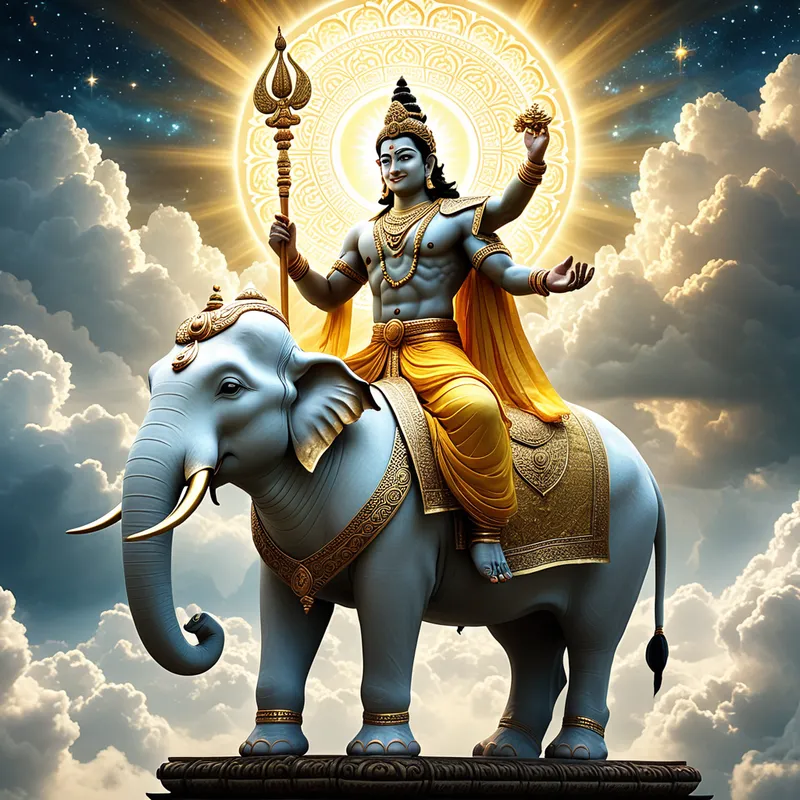
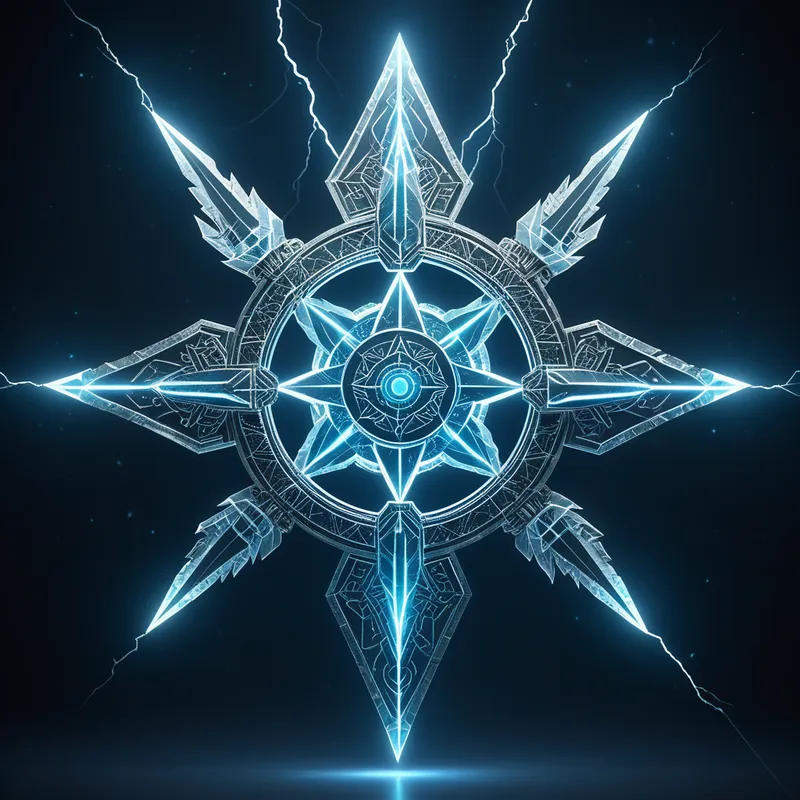
Listen. In the time before time, when the worlds were still soft and the gods walked with the echo of creation in their steps, there was a king. His name was Indra. His palace was Amaravati, a realm of wish-fulfilling trees and rivers of honey. His mount was Airavata, born from the churning of the milky ocean, whose trunk could summon monsoons. In his hand, he clenched the vajra, forged from the bones of the sage Dadhichi, who gave his own skeleton so that order might prevail.
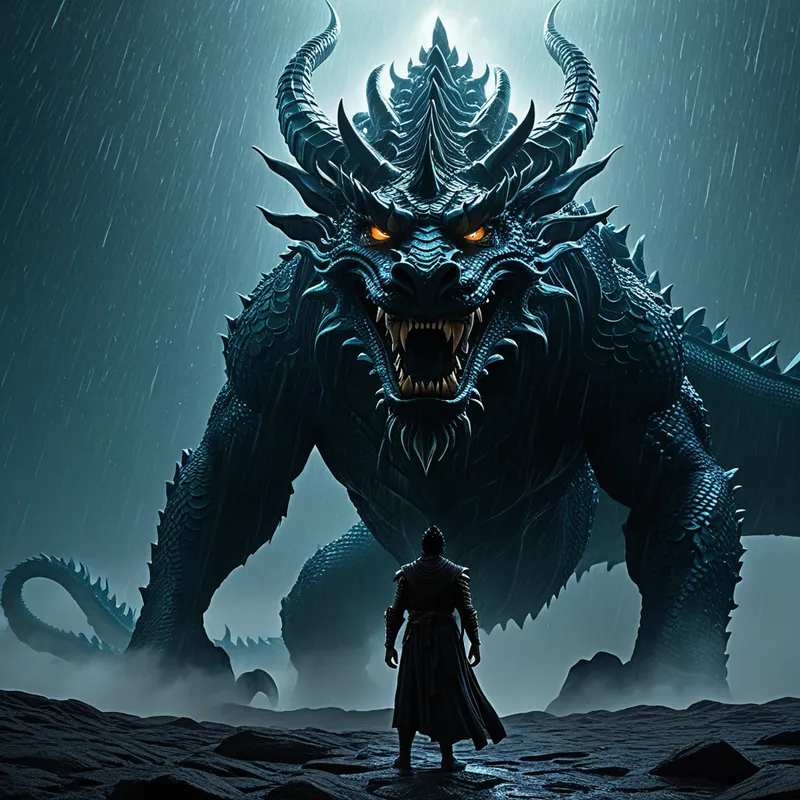
But order was under siege. The demon Vritra, a dragon of cosmic scale, had coiled himself around the source of all waters—the primordial, undifferentiated chaos. He held the seven rivers captive in his belly. The earth cracked with thirst. Life gasped. The heavens themselves grew silent, waiting.
Indra, fueled by the intoxicating soma, felt the call to kingship as a fire in his veins. He rode out on Airavata, the thunder of his approach shaking the foundations of the mountains. The battle was not of mere flesh, but of essence. Vritra was obstruction itself, the inertia that says "No" to life's flow. Indra was the furious "Yes," the decisive strike that cleaves darkness.
He raised the vajra, its facets catching the last light of a parched sun. With a roar that was both terror and triumph, he hurled it. The vajra pierced Vritra’s scaled hide, not with mere force, but with the power of resolved intention. The demon bellowed, a sound of shattering stone, and his form unraveled. From his split body, the seven rivers gushed forth, roaring back into the world, soaking the cracked earth, filling the empty riverbeds. Indra stood victorious, the liberator, the provider culture."). He was Svargapati, the undisputed sovereign. The gods sang his praises, and for an age, he basked in the glory.
Yet, kingship untested decays. In his pride, Indra once insulted a great sage, Gautama, by casting an impure eye upon his wife, Ahalya. For this transgression, he was cursed. A thousand vulvae appeared on his body, a mark of shame. Later, in another fit of arrogance, he ordered the divine architect, Vishvakarma, to build him a palace so grand it would have no equal. As the construction swelled endlessly, the wise sage Narada visited. With gentle words, Narada asked if any king before him had ever possessed such a home, or if any after him would. The question echoed in the vast, unfinished halls. Indra saw the infinite chain of kings, each with their moment of glory, each fading to dust. His pride turned to dust with it. The construction stopped. The king of gods was humbled, his sovereignty tempered by the wisdom of impermanence.
Cultural Origins & Context
The myth of Indra is not a single story but a constellation of hymns, epic narratives, and philosophical commentaries spanning millennia. His primary home is the Rigveda, where over a quarter of its hymns are dedicated to him. He is the paramount deity of the Vedic period (c. 1500–500 BCE), a reflection of a pastoral, warrior society that venerated the life-giving, destructive, and sovereign power of the thunderstorm.
These stories were not merely entertainment; they were the operating system of a cosmic worldview. They were chanted by priestly poets, the rishis, during elaborate fire sacrifices (yajna). The function was twofold: cosmological and societal. Cosmologically, the ritual re-enactment of Indra’s slaying of Vritra was believed to maintain the cosmic order (rita), ensuring the seasonal return of the rains and the fertility of the land. Societally, it reinforced the ideal of the warrior-king, the raja, who protects his people from chaos and provides prosperity. Over time, as Hindu philosophy evolved towards concepts of a supreme, formless absolute (Brahman) and devotional (bhakti) traditions centered on deities like Vishnu and Shiva, Indra’s status diminished. He became a figure of flawed, temporal power, a god-king subject to karma and hubris, making his myths profound psychological parables rather than statements of ultimate divinity.
Symbolic Architecture
Indra is the archetype of the conscious ego in its zenith. His vajra is not just a weapon; it is the lightning flash of discriminative awareness, the power to make a decisive cut through ambiguity, confusion, and psychic stagnation (Vritra). He represents the necessary, heroic function of the psyche that establishes order, defends boundaries, and asserts the will.
The king must first conquer the outer chaos to build his kingdom, only to discover that the greatest dragon resides within the walls of his own pride.
His palace, Amaravati, is the psychic complex of achievement and status we build around a strong ego. His fall—through lust (with Ahalya) and infinite ambition (his palace)—reveals the shadow of the Ruler: inflation, entitlement, and a disconnect from the deeper Self. The curse of the thousand eyes (or vulvae) transforms shame into a kind of painful, all-seeing awareness. His encounter with the sage Narada is the moment the ego confronts the perspective of the Atman or the Self. The endless parade of Indras shatters the illusion of personal uniqueness and permanence, forcing a humbling reorientation from "I am the king" to "I participate in kingship."
The Dreamer's Resonance
When the pattern of Indra stirs in modern dreams, it often manifests as a profound somatic and psychological confrontation with one's own authority and its limits. You may dream of wielding great power—a brilliant light, a commanding voice, a potent tool—to overcome a monstrous obstacle, feeling immense exhilaration. This is the ego successfully marshaling resources to face a life challenge.
The fall, however, is more telling. Dreams of a magnificent building that becomes a labyrinth, a crown that grows unbearably heavy, or a once-powerful symbol (like a sword or badge) that turns brittle and shames you point to Indra’s second act. The psyche is processing the inflation that follows success. The body may register this as tension in the solar plexus (the seat of personal power), a stiff neck (carrying the crown), or anxiety about exposure (the curse of the thousand eyes). The dream is initiating a necessary de-throning, a sacred humiliation that makes space for a more authentic, less rigid form of sovereignty.

Alchemical Translation
The alchemical journey of Indra models the full arc of psychic transmutation, moving from the leaden weight of brute power to the gold of wise sovereignty. The initial battle with Vritra is the nigredo, the necessary dark struggle where the conscious ego (Indra) must engage and defeat the undifferentiated, paralyzing power of the unconscious (the serpent holding the waters). Victory releases psychic energy (the waters), enabling life and creativity to flow—the blossoming of the personality.
The subsequent inflation and fall represent the albedo, the whitening, but here it is a bleaching by the glaring light of self-awareness. The ego is purified not by being destroyed, but by being seen in its true, limited context. Narada’s question is the solvent that dissolves the ego’s identification with its own throne.
True sovereignty is not the ego's unchallenged rule, but its conscious service to a reality greater than itself.
The final stage is the rubedo, the reddening or maturation. A humbled Indra does not cease to be king; he becomes a different kind of ruler. His power is now in service to the cosmic order (dharma), not his personal glory. For the modern individual, this translates to the process of individuation: first, one must build a strong, competent ego (slay the dragon, get the job, build the life). Then, one must have that ego structure humbled by encounters with the unconscious—through failure, loss, or the simple, crushing perspective of eternity. The triumph is not in remaining an untouchable hero, but in becoming a conscious participant in a vast, mysterious drama, wielding one's personal vajra with humility and precision, for the benefit of the whole inner kingdom.
Associated Symbols
Explore related symbols from the CaleaDream lexicon: