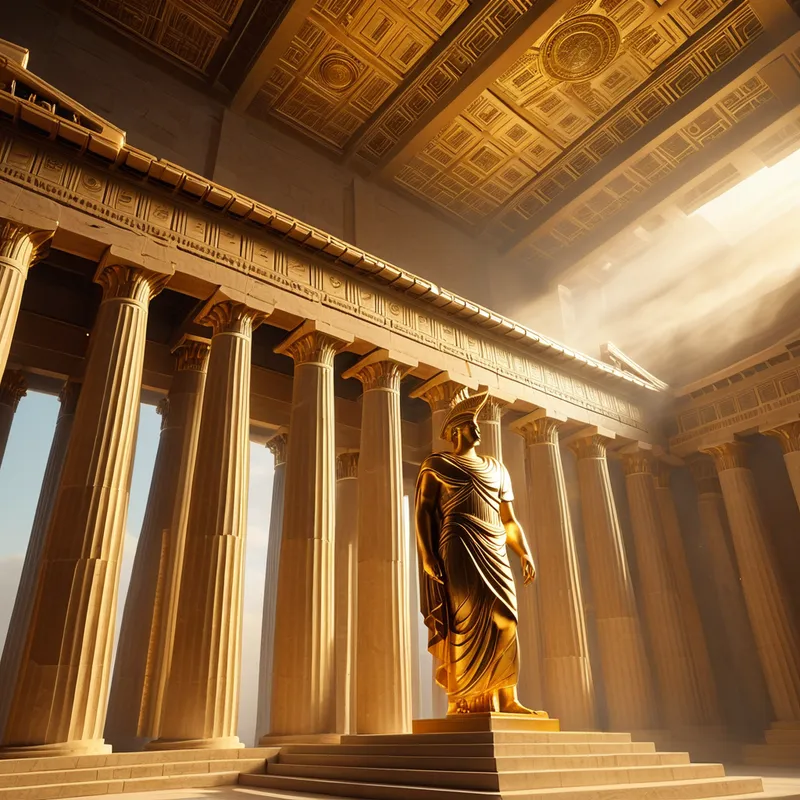
Incense in Temples Myth Meaning & Symbolism
A myth of how mortal prayer, through divine alchemy, becomes sacred incense, bridging the chasm between earth and Olympus on fragrant smoke.
The Tale of Incense in Temples
Hear now, a story not carved in marble, but written on the air itself—a tale of the bridge between mud and majesty.
In the beginning, when mortals first lifted their eyes to Olympus, they felt a chasm, vast and cold, between their earthly cries and the golden silence of the gods. Their prayers, earnest and raw, seemed to fall back to the dust from which they came, unheard. They offered grain, they poured wine, they slaughtered fattened bulls, yet the silence remained, a wall of perfect, divine indifference.
The people despaired. Zeus, from his high throne, observed this sorrow. He saw not ingratitude, but a fundamental flaw in the medium. Mortal offerings were of the earth, heavy, bound by gravity and decay. How could such gross matter ascend to the realm of pure idea, of eternal form?
He summoned his swift son, Hermes, the one who traverses all realms. "Go," spoke the Thunderer, his voice like distant rockslides. "Descend to the smithies of the mind, to the forges of longing. Find the key that turns weight into wing, substance into spirit."
Hermes, with his caduceus in hand, did not travel to a mountain or a forest, but into the very heart of human supplication. He moved among the altars, a whisper in the crowd. He heard the priestess of Hestia, keeper of the sacred flame, as she wept over the communal fire. "If only our gratitude could rise as easily as this smoke," she sighed, stirring the embers beneath a spitted hare. A thin, greasy plume rose, carrying the scent of cooking meat—earthy, mortal, fleeting.
But in that sigh, Hermes heard the spark. He took the priestess's sorrow, the people's collective yearning, and the very essence of the sacrificial flame. He carried these not to Olympus, but to the secret workshop of Hephaestus. There, in the volcanic glow, he presented his case: "We need an alchemy of aspiration. A sacrifice that sacrifices its own body."
Hephaestus, his mighty brow furrowed in thought, stoked his fires. He understood transformation. From ore, he made armor; from divine will, he made automatons. This was a subtler art. He took resins wept by sun-scorched trees in distant, sacred lands—frankincense from Arabia Felix, myrrh from thorny shrubs. These were not food; they were the tears of the earth, already distilled by suffering and light.
At the anvil of creation, with Hermes's breath of meaning and his own hammer of form, Hephaestus performed the sacred work. He did not shape the resin, but imbued it with a latent potential. He forged a covenant into its very essence: When touched by sacrificial fire—not the fire of hunger, but the focused, intentional flame of the altar—you shall not burn to ash alone. You shall release your soul.
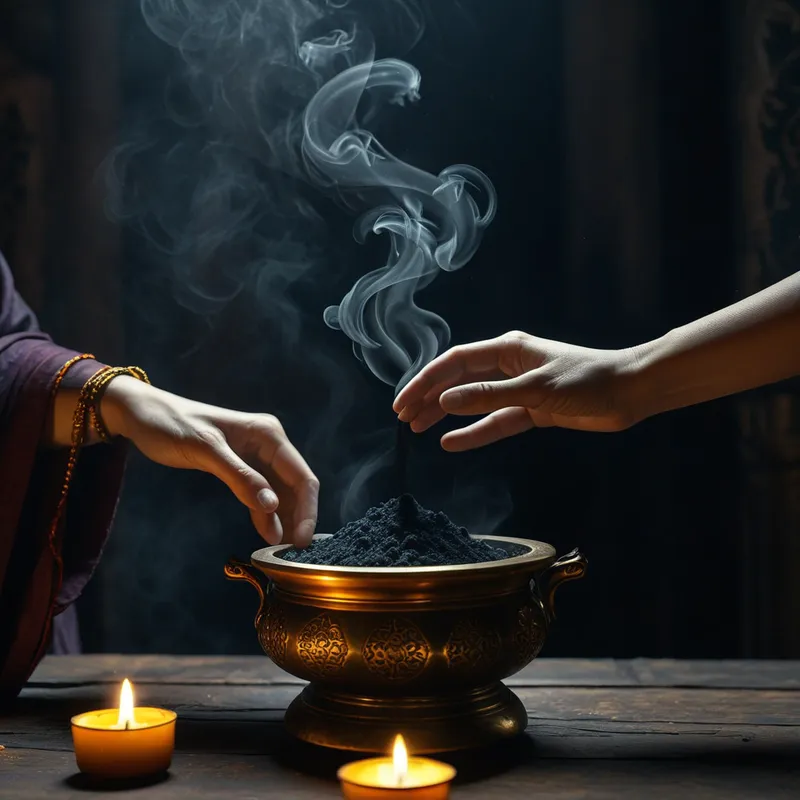
The next dawn, as the priestess approached Hestia's altar with a heavy heart, she found not a lump of common resin, but a golden tear of fragrant sap. A divine instruction, whispered by Hermes, guided her hand. She placed it on a charcoal born of sacred oak. A crackle, a hiss, and then… not smoke, but a column of fragrant air, sweet and complex, rising in a unwavering spiral.
It did not dissipate. It climbed, a visible prayer, through the temple's columned shadows, past the roof, into the bright morning. On Olympus, Zeus smelled not burning, but devotion. He heard not words, but the essence of the plea—the gratitude, the fear, the hope—distilled into an aroma that spoke directly to the divine senses. The bridge was built. The chasm was spanned by a fragrant, ethereal road. The silent wall was breached by scent.
Cultural Origins & Context
This myth, woven into the fabric of Greek religious practice rather than penned in a single epic, originates from the profound ritual logic of Greek polytheism. It was not a tale told by bards for entertainment, but an implicit narrative enacted daily in every temple, household shrine, and public altar across the Hellenic world. The "story" was passed down through ritual action, taught by priest to acolyte, by parent to child, in the sacred choreography of offering.
Its societal function was foundational. It explained and sanctified the central act of thysia. While animal sacrifice provided communal feasting, incense represented the purely spiritual component of the exchange. It modeled the correct interior attitude for worship: sacrifice must involve a transmutation. The raw, chaotic stuff of human need (prayer) had to be refined into an acceptable medium (fragrant smoke) to reach the gods. This myth justified the expense of imported incense—it was not mere perfume, but the essential technology of communion. It also elevated the role of fire from a utilitarian tool to a divine alchemical agent, a transformer of realms, sacredly tended by the priestess of Hestia.
Symbolic Architecture
At its core, the myth of temple incense is a profound map of psychic transformation. The raw, unformed resin symbolizes the prima materia of the human psyche—our dense, tangled emotions, our inarticulate yearnings, our "stuck" suffering. It is consciousness in its undifferentiated, earth-bound state.
The sacred fire is not destruction, but the focused heat of conscious attention. It is the act of holding our pain in awareness, rather than in ignorance.
The fragrant smoke is the liberated essence. It represents emotion and thought refined into spirit, intention clarified into its purest form. The act of the priestess is the ego’s role in the individuation process: it does not create the transformation, but it consciously facilitates the conditions (the sacred container, the ignited charcoal) for a greater, archetypal process to occur.
Hermes symbolizes the transcendent function—the psychic capacity to mediate between the unconscious (the raw human need) and the supra-personal, ordering principles (the gods/Olympus). He is the psychopomp of meaning. Hephaestus represents the transformative, suffering-laden but creative power of the deep Self, which can take the raw material of experience and re-forge it into a vehicle for transcendence. The gods' acceptance of the incense signifies that the Self recognizes and integrates the offering of our transformed experience.

The Dreamer's Resonance
When this myth stirs in the modern unconscious, it often manifests in dreams of transformation through elemental air and fire. One might dream of being in a stifling, windowless room (a state of psychological stagnation) where they discover an old brazier. As they breathe onto cold ashes, a spark ignites, and from a pocket, they produce a strange amber stone that melts into fragrant smoke, which then opens a skylight to a starry sky.
Somatically, this correlates with the process of sighing—the deep, often unconscious release of breath that carries away tension. Psychologically, the dreamer is in a stage where intellectual analysis or emotional catharsis alone is insufficient. There is a deep, often spiritual longing to have one's inner struggles mean something, to contribute to a sense of connection or growth, rather than just be endured or solved. The dream signals that the psyche is ready to engage in an alchemical process: to place a specific, burdensome complex (the "resin") into the vessel of consciousness and apply the focused heat of attention, not to be rid of it, but to extract its hidden essence—its lesson, its depth, its potential for wisdom.
Alchemical Translation
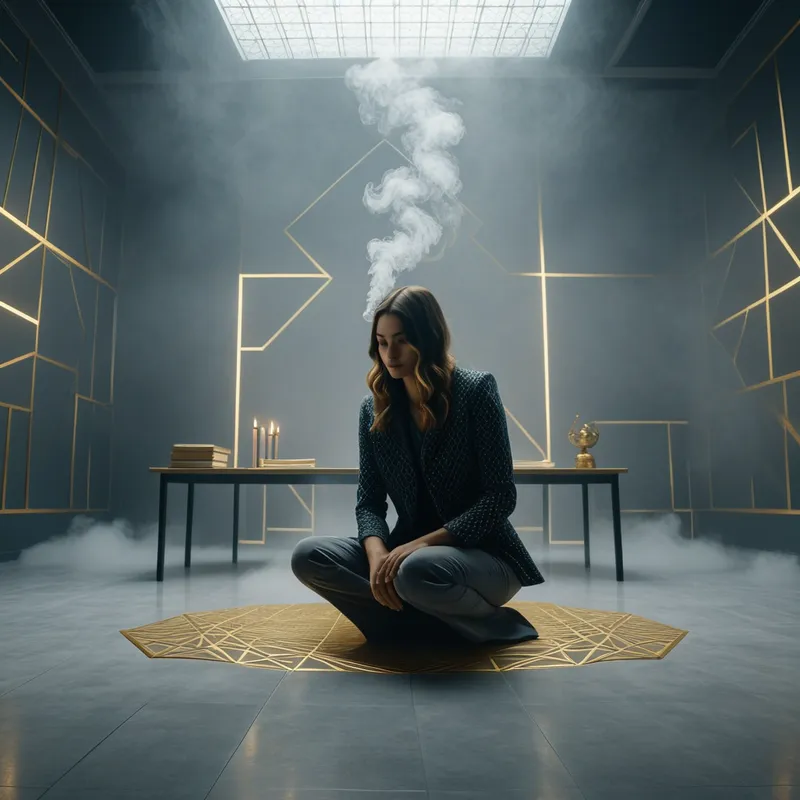
For the individual, this myth models the opus of turning leaden experience into golden insight. The "temple" is the sanctified inner space we create through mindfulness, therapy, or creative practice—a space set apart from the mundane where transformation is the sole aim.
The first step is the offering: consciously identifying a piece of our "stuck" life—a grief, a resentment, a pattern of failure—and presenting it on the inner altar. This is not complaining, but a sacred acknowledgment. The second is the application of sacred fire: this is the disciplined, sustained attention we give to this material. It is the heat of honest self-reflection, of feeling the feeling fully without being consumed by it, of journaling, of discussing it in depth.
The incense smoke is the insight that arises not from solving the problem, but from suffering it through consciously. It is the unexpected compassion, the sudden understanding of a parent's flaw, the creative idea born of sorrow.
The final stage is the ascent: the release of the insight. This is where we let the transformed understanding waft out of our personal vessel. We may share a hard-won wisdom, create art from our pain, or simply allow the insight to change our attitude, thereby affecting our outer world. The "gods" who receive it are the archetypal patterns of the collective unconscious; we contribute our distilled experience to the great human story. We complete the circuit. Our personal suffering, through this alchemy, becomes a thread in the sacred tapestry, and we feel, in that moment, the chasm between our lonely ego and the vast, meaningful Self bridged by the fragrant smoke of our own endured and transformed life.
Associated Symbols
Explore related symbols from the CaleaDream lexicon: