Inanna's Lapis Lazuli Measuring Rod Myth Meaning & Symbolism
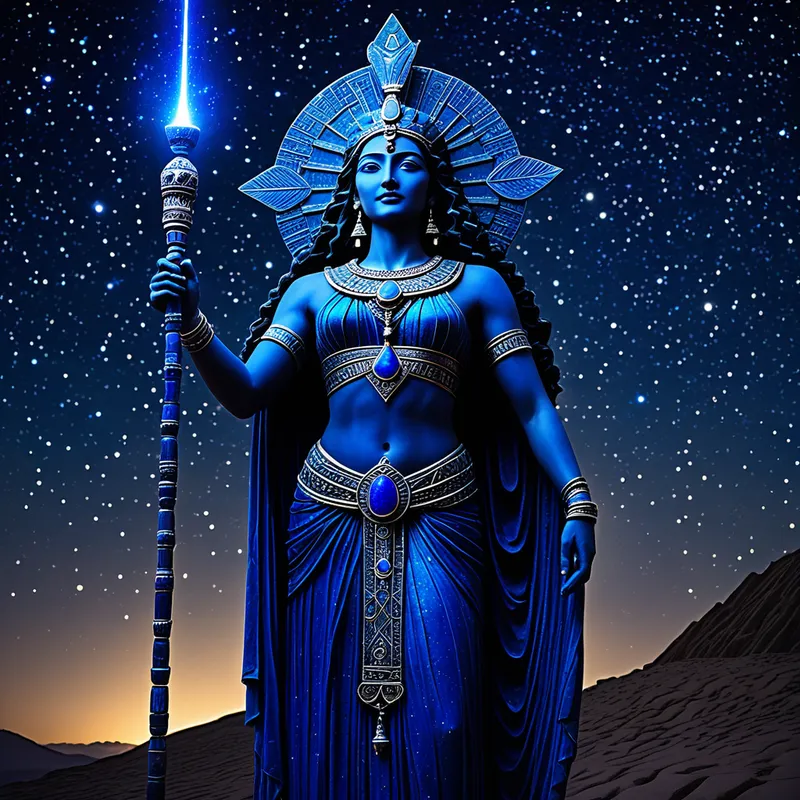
The Queen of Heaven receives a sacred rod of lapis lazuli, a divine instrument to measure the cosmos and establish the foundations of civilization.
The Tale of Inanna's Lapis Lazuli Measuring Rod
Hear now, you who dwell in the lands between the two rivers, the story of the moment the world was measured and made firm. The air was thick with the scent of cedar and river silt, and the stars hung low over the holy city of Uruk. In her temple, Inanna, Queen of Heaven, Lady of the Morning and Evening Star, waited. She was not idle. Her will was a palpable force, a pressure building against the dome of the sky, for she knew a gift was coming—a tool to shape the chaos into order.
From the eastern mountains, where the sky meets the earth, came the messenger. He bore not a scroll or a weapon, but a single object wrapped in cloth the color of a moonless night. Kneeling before the dais, he unveiled it. A collective gasp echoed through the hall. There it lay: the Lapis Lazuli Measuring Rod. It was not merely an object; it was a captured piece of the firmament. Its blue was the deep, star-dusted blue of midnight heavens, veined with flecks of gold like distant constellations. It was cool to the touch, humming with a silent, foundational power.
Inanna reached for it. As her fingers closed around the sacred stone, a shockwave of certainty passed through her. The rod was an extension of her sovereignty, a divine me made manifest. She understood its purpose instantly. It was not for battle, though it could command armies. It was not for love, though it could delineate the sacred marriage bed. It was the principle of measurement itself.
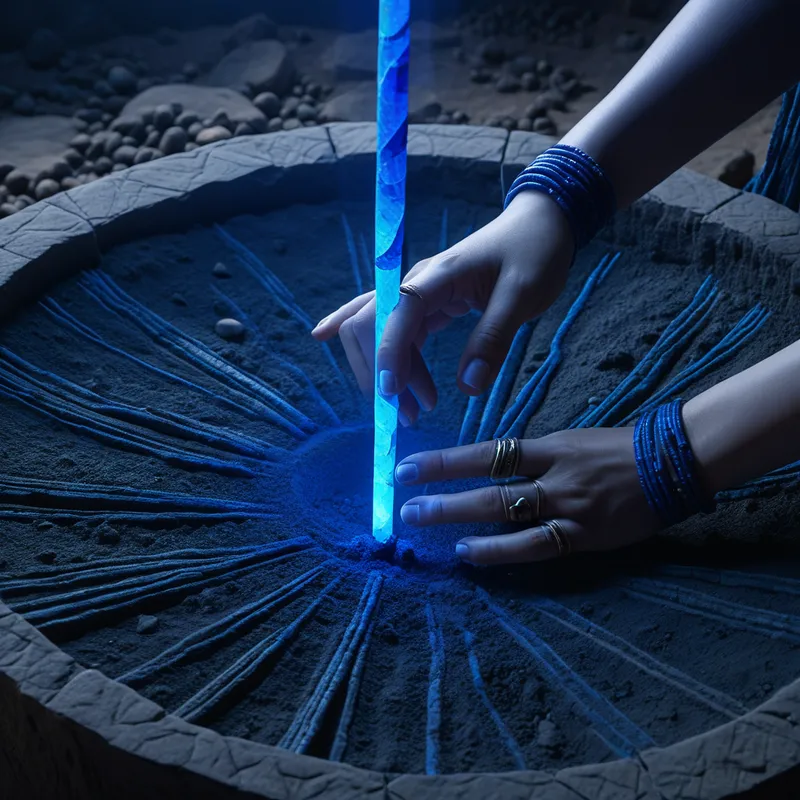
She descended from her temple, the rod held aloft. The people of Uruk followed in a silent, awestruck procession. She went to the edge of the wild, untamed land. She drove the point of the lapis lazuli rod into the soft earth. A visible pulse, a wave of shimmering blue light, radiated outwards. Where it passed, the formless wilderness knew its place. Boundaries became clear. The foundation trench for the city wall was revealed. The dimensions of the marketplace, the granary, the homes—all were inscribed upon the world by that single, defining act. She measured the heights for temples and the depths for canals. With each measurement, civilization took root. Chaos retreated, not destroyed, but given form and limit. The rod was the line between the wild and the cultivated, the infinite and the habitable, the dream and the built reality. Inanna, with her celestial tool, had given the world its bones.
Cultural Origins & Context
This myth is not a single, isolated story but a powerful motif woven into the fabric of Sumerian cosmology and kingship ideology. It originates from the world's first urban civilization, where humanity's greatest struggle was imposing sustainable order on the unpredictable forces of nature—the flooding Tigris and Euphrates, the blazing sun, and marauding winds. The myth was likely recited in temple rituals and during the coronation of kings, who derived their right to rule from Inanna.
The rod was a symbol of the me, the collection of over a hundred divine decrees that Inanna famously won from the god of wisdom, Enki. These me encompassed everything from kingship and truth to weaving and woodworking—the blueprints of culture. The measuring rod, specifically of precious lapis lazuli (imported from far-off Afghanistan), represented the tangible application of these abstract blueprints. It connected the ruler’s earthly task of surveying land, building cities, and administering justice directly to the celestial authority of the goddess. To hold the rod was to mediate between heaven and earth, to translate divine order into human reality.
Symbolic Architecture
At its core, the myth presents a profound psychological truth: consciousness begins with measurement. Before the rod strikes the earth, reality is a undifferentiated, potential-filled void—a psychological Uroboros. The Lapis Lazuli Measuring Rod is the archetypal instrument of distinction.
The first act of creation is not to make something from nothing, but to draw a line through the chaos of the all-possible. To measure is to choose, to define, to take a stand within the infinite.
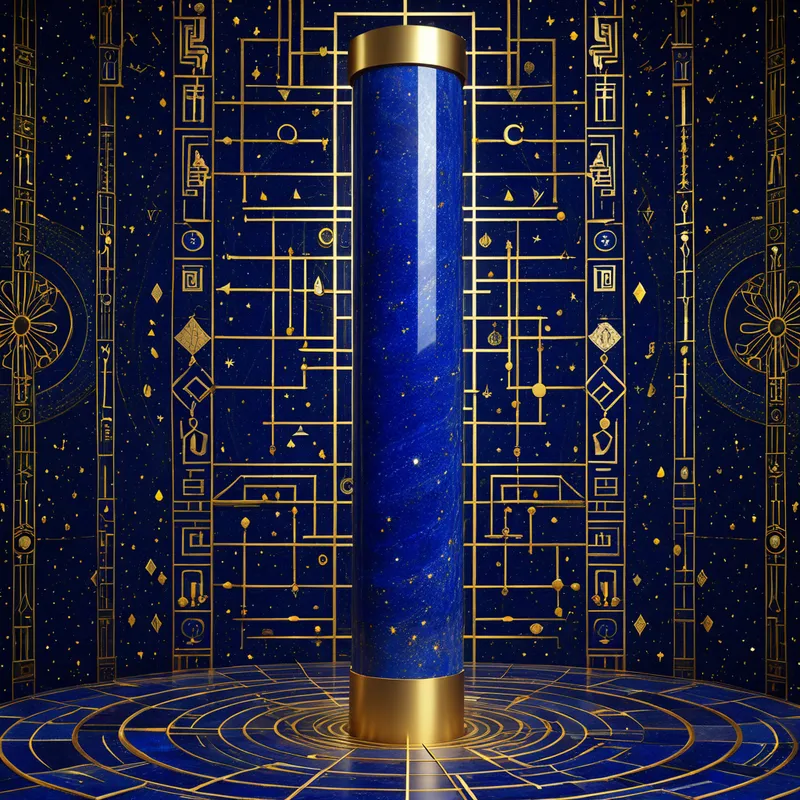
The Lapis Lazuli itself is dense with symbolism. Its celestial blue connects it to the heavens, the realm of archetypes and divine law. The flecks of golden pyrite within it are "stars," suggesting the cosmic order is embedded within the tool. It is precious, hard, and enduring—qualities of a well-defined, resilient psyche.
The Measuring Rod is the principle of limitation that makes experience possible. It is the ego-function, the part of the psyche that says "this, not that." It establishes boundaries, sets goals, enforces laws, and creates the sacred precinct—the temenos—within which the individual self can safely develop. Inanna, as the Ruler archetype, wields this function not for tyranny, but for generative foundation. She does not obliterate the wild; she gives it a relationship to the cultivated self.
The Dreamer's Resonance
When this myth stirs in the modern unconscious, it often surfaces in dreams of profound re-orientation or foundation-laying. A dreamer might find themselves holding a staff, a wand, or a ruler of strange, luminous material. They may be trying to measure a vast, dark room, gauge the depth of a well, or mark the boundaries of a new property.
Somatically, this can correlate with a felt sense of "getting one's bearings" after a period of chaos or dissolution—perhaps after a loss, a major life transition, or an existential crisis. The psyche is attempting to re-establish its core structures. The dream is an internal enactment of Inanna's ritual: the ego, backed by the authority of the Self (the divine Inanna within), is attempting to plant its standard in the shifting sands of the unconscious and declare, "Here, I will build. This is my limit. This is my law." The anxiety in such dreams is not of the measuring itself, but of the formless space that precedes it. The rod is the answer to that anxiety.

Alchemical Translation
The individuation process requires exactly this mythic movement. We begin in a state of psychic diffusion, identified with family complexes, cultural expectations, and unconscious impulses—a personal wilderness. The alchemical opus begins with separatio and coagulatio: separation and coagulation.
The Lapis Lazuli Rod is the instrument of separatio. It is the courageous act of self-definition that says, "I am this, which means I am not that." It is the firm boundary that makes relationship possible, the vow that makes love meaningful, the principle that gives action integrity.
Forging one's personal "measuring rod" is the work of a lifetime. It involves discovering our own intrinsic, celestial "lapis lazuli"—our core values, non-negotiable truths, and authentic authority. These must be hard-won, mined from the distant mountains of experience and polished through reflection. To then "plant" this rod is the act of living from that center, allowing our deepest principles to define the architecture of our lives: our relationships, our work, our creative expression.
This is not a rigid, imprisoning act. Inanna’s measurement creates the sacred space, the temenos, within which the mysteries of the soul—the lover, the warrior, the mourner—can safely unfold. The rod establishes the vessel. The transformative contents—the passions, the sorrows, the ecstasies that Inanna also embodies—require that vessel to hold them. Thus, the myth models the ultimate psychic triumph: the establishment of a sovereign, measured self, capable of containing the infinite, unmeasured depths of being. We become, like Uruk, a city both planned and alive, bounded by divine law and pulsating with human spirit.
Associated Symbols
Explore related symbols from the CaleaDream lexicon: