Idunn's Golden Apples Myth Meaning & Symbolism
The goddess Idunn guards magical apples that grant the gods eternal youth, until her abduction threatens the cosmos with decay and demands a heroic rescue.
The Tale of Idunn’s Golden Apples
Listen, and hear the whisper of the wind through the leaves of Yggdrasil. In the high halls of Asgard, where the rainbow bridge Bifrost gleams, a quiet terror was taking root. It began not with a roar, but with a creeping stiffness in the joints of Odin the All-Father, a faint silvering in the golden hair of Thor, a weariness behind the keen eyes of the gods. The very timbers of their great hall seemed to groan with a subtle fatigue. For the source of their vitality was gone.
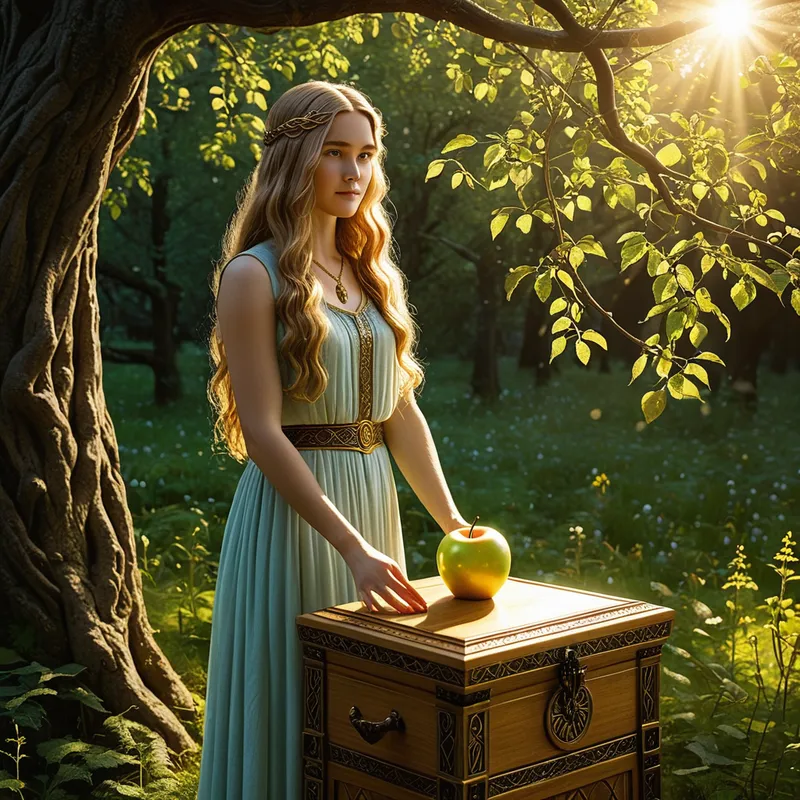
She was Idunn, the ever-young, keeper of the sacred grove. Her presence was like the first breath of spring, and in her care was a casket of unassuming wood. Within it lay the treasure of the Aesir: apples of pure, shimmering gold. Not the gold of greed, but of life itself. When the gods felt age’s first cold touch, they would come to her, and she would offer them this fruit. With a single bite, the years would fall away like an old cloak, their strength and vigor restored in a flood of golden light. Through her, the cosmos remained in its prime.
The unraveling began with Loki Laufeyson, the silvertongued, whose curiosity was a blade that cut both ways. Journeying beyond the walls of Asgard with Odin and Hoenir, Loki’s cleverness failed to kindle a fire for their meal. An eagle perched in a great oak above offered aid—for a price. The eagle, who was the storm giant Thjazi in disguise, took the lion’s share of their food. Enraged, Loki struck at the bird with a staff, only to find it fused to the eagle’s back and himself dragged, screaming, across the stones and through the sky towards Jotunheim.
To secure his release, Loki agreed to a monstrous bargain: he would lure Idunn, and her apples, out of Asgard.
Returning home, his smile a mask over treachery, Loki sought out Idunn. With the cunning of a fox, he spoke of a wondrous tree he had found in a forest, bearing apples of such beauty they surely rivaled her own. “But they must be false,” he sighed, “for nothing could compare to your golden truth. Perhaps you should see them, to know your own treasure’s worth?” Trusting in his kinship, Idunn followed him to the walls of Asgard, her precious casket in hand.
No sooner had she stepped beyond the safety of the walls than the sky darkened. Thjazi, in his full eagle-form, a tempest of feathers and fury, descended. His talons, like iron hooks, closed around Idunn. Her cry was lost in the wind as he soared away, carrying her and the source of the gods’ immortality to his bleak, stone fortress in Jotunheim.
In Asgard, the decay was swift and terrifying. Beards grew white and long. Eyes clouded. Strength seeped from mighty limbs. The gods gathered, a council of the aged and desperate. The pattern was clear: Loki had been the last with Idunn. Confronted by the withering fury of his kin, Loki broke. He would retrieve her, or perish in the attempt.
Freyja lent him her falcon cloak. Donning it, Loki became a streak of feathered lightning across the nine worlds. He flew to Thjazi’s high hall, finding Idunn alone, her light dimmed in the giant’s gloom. With a whisper, he changed her into a single, perfect nut, clutched it in his talons, and shot back towards Asgard.
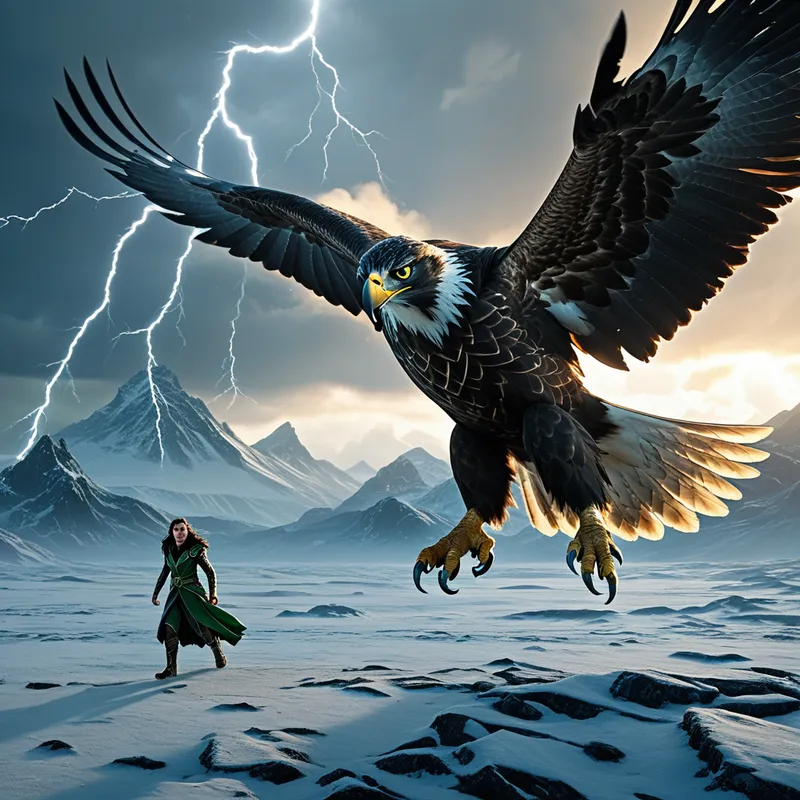
But Thjazi returned. Seeing his prize gone, his rage shook the mountains. He took to the air, his giant form becoming an eagle so vast its wings blotted out the sun. The chase was a tempest across the sky. Loki, straining every feather, could hear the thunder of the giant’s wings gaining. As the walls of Asgard came into view, the gods saw their approach. They acted with the last of their collective will. On the ramparts, they piled the sweepings of their halls—wood shavings, bark, and kindling. As Loki the falcon shot over the wall, they set the pyre ablaze.
Thjazi, blind with pursuit, could not turn. He plunged into the heart of the fire. His great wings became torches, and he fell, burning, to the ground where the gods ended him. And from the falcon’s grasp, Idunn was restored, standing once more in her grove. She opened her casket. The golden light spilled out, and as the gods partook, youth returned. The cycle was restored. The world tree breathed again. But in the ashes of the giant, a new seed of vengeance was sown, for the story of the gods is a story of debts that must one day be paid.
Cultural Origins & Context
This myth survives primarily within the Poetic Edda and is recounted more fully in the Prose Edda of the 13th-century Icelandic scholar Snorri Sturluson. It is a tale from the Aesir’s struggle to maintain cosmic order against the encroaching entropy of the giants, the Jotnar. It was not merely entertainment but a sacred narrative that explained a fundamental paradox of the divine: even the gods are subject to time and decay, requiring a recurring sacrament of renewal.
The story would have been told in hall and hearth, a reminder of the fragility of vitality and the necessity of safeguarding the sources of communal health. Idunn’s apples are the divine correlate to the stored harvest that sustains a community through winter. Her abduction represents the ultimate catastrophe: the failure of the life-cycle, the drying up of the wellspring. The tale validates the social role of the keeper, the guardian of sacred resources, and the catastrophic consequences of betrayal from within the trusted circle, embodied by Loki.
Symbolic Architecture
At its heart, this is a myth of the contained life-force. Idunn is not the creator of the apples; she is their guardian. Her power is in her steadfast, gentle stewardship. The apples themselves are a perfect symbol of cyclical immortality—not linear, eternal life, but a perpetual return to the prime state. They must be consumed again and again, mirroring the natural cycles of the seasons and the necessary human rituals of nourishment and celebration that ward off spiritual stagnation.
The golden apple is not a prize to be won, but a sacrament to be shared; its magic lies not in possession, but in periodic, grateful reception.
Loki represents the intellect untethered from loyalty, the cleverness that, in its hunger for novelty or under duress, jeopardizes the very system that sustains it. His flight and rescue are a forced integration of his shadow—he must use his trickster nature to mend the chaos he created. Thjazi is the raw, devouring aspect of nature and time itself, which seeks to hoard and possess the source of renewal, freezing it in a sterile captivity. The gods’ collective action—lighting the pyre—signifies the necessary, sometimes destructive, communal effort required to destroy a parasitic force and restore balance.
The Dreamer’s Resonance
To dream of Idunn’s apples is to touch a profound somatic and psychological process of depletion and the search for renewal. One may dream of a lost or locked box containing something glowing; of a cherished garden that has become overgrown and barren; or of a trusted figure leading them into danger. These are dreams of the life-force in crisis.
Somatically, this can correlate with periods of burnout, chronic fatigue, or a feeling of aging prematurely—not just physically, but in soul. The psyche is signaling that its vital resources, its psychological immunity, have been compromised. The abduction scene mirrors a feeling of having one’s core energy, creativity, or joy stolen, often by an overwhelming external demand (the giant) facilitated by an inner betrayal (the Loki-like compromise of one’s values or boundaries). The dreamwork involves identifying what or who the “giant” is in one’s waking life, and where one has made Faustian bargains that led to a loss of essential vitality.
Alchemical Translation
The myth models the individuation process as the recovery and conscious stewardship of one’s innate, renewing essence. We all possess an inner Idunn—the part of the psyche that holds the potential for continual regeneration. The “apples” are our core passions, authentic joys, and creative wells that, when accessed, restore our sense of purpose and vitality. However, the pressures of the outer world (the giants) and the cunning of our adaptive, survivalist ego (the inner Loki) often conspire to lure this essence away, locking it in service to ambition, fear, or obligation.
The alchemical work is not to create gold from lead, but to remember, again and again, where you have hidden your own golden apples, and to have the courage to feast upon them.
The heroic rescue is an intra-psychic journey. It requires donning the “falcon cloak” of heightened awareness (Freyja’s gift, representing intuition and connection to the divine feminine) to journey into the frozen, giant-held territories of our shadow—our repressed burdens and stolen energies. There, we must perform the crucial act: transmuting the complex. Like Loki changing Idunn into a nut, we must condense our lost vitality into a portable, essential form we can carry back. The final conflagration is the necessary, often painful, sacrifice of the devouring complex (the giant) that hoarded our energy. We must burn the old structures of obsession and possession at the gates of our conscious self. Only then is the life-force restored, not as a permanent state, but as a renewable sacrament, eaten daily to sustain the holy work of becoming.
Associated Symbols
Explore related symbols from the CaleaDream lexicon: