Ida and Pingala Myth Meaning & Symbolism
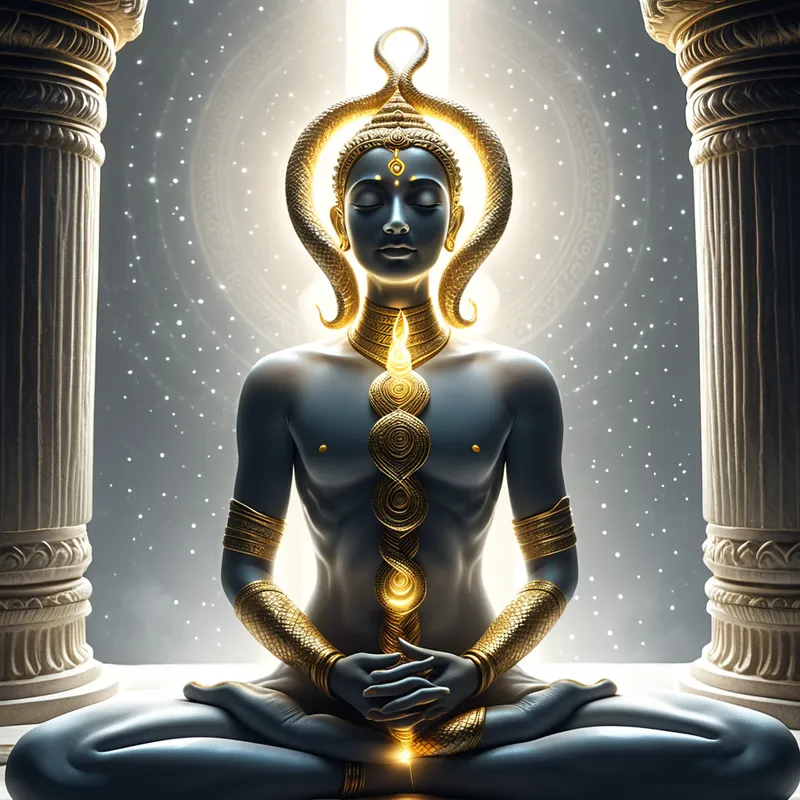
The myth of the twin channels, Ida and Pingala, who spiral around the central axis of being, representing the sacred marriage of duality within the human soul.
The Tale of Ida and Pingala
In the time before time, when the universe was a single, dreaming breath, there existed a being of pure potential. This was Sushumna, the silent axis of the world, a pillar of still, dark fire that stretched from the roots of creation to the crown of the heavens. Sushumna slept, and in that sleep, the One dreamed of Two.
From the left side of that slumbering form, a cool, silver light began to weep. It was not a tear of sorrow, but of profound becoming. This light gathered and flowed, taking the form of a graceful, sinuous river. She was Ida. Her essence was the soft glow of the moon on still water, the quiet intuition of the night, the receptive wisdom that receives and reflects. She carried the scent of jasmine and the feeling of a deep, calming breath.
From the right side, a warm, golden pulse began to beat. It was not a hammer blow, but the first rhythm of a heart. This pulse coalesced into a vibrant, coursing stream. He was Pingala. His essence was the fierce radiance of the noonday sun, the active will that moves and conquers, the vital force that burns and builds. He carried the heat of a desert wind and the crackle of awakening energy.
Seeing the silent pillar of Sushumna between them, a great longing arose in both. Ida yearned for the sun's warmth to give her reflections depth; Pingala ached for the moon's coolness to temper his fire. But Sushumna was closed, a sealed gateway, and they could not reach each other directly. A cosmic loneliness settled upon them.
So, they began to move. Not in opposition, but in a desperate, beautiful orbit. Ida, the lunar river, began to spiral down the left side of the sleeping axis. Pingala, the solar river, began to spiral down the right. Around and around the dark pillar they wound, their paths never touching, yet forever intertwined. At the base of the great axis, near the seat of primal power, they met for the first time, their energies crossing in a sigh of recognition. Then they continued their journey, crossing again and again at sacred points along the pillar, each crossing a silent, yearning conversation.
Their eternal dance created a tension, a sacred friction. Where Ida flowed, the world knew thought, calm, and inwardness. Where Pingala surged, the world knew action, passion, and outward expression. But the center—the dark, silent Sushumna—remained asleep, the marriage unconsummated, the bridge unbuilt. The myth tells us they spiral still, in every living being, weaving the tapestry of our dual nature, waiting for the moment the central fire awakens and calls them home to unity.

Cultural Origins & Context
The myth of Ida and Pingala is not a narrative told around a fire with gods and heroes, but a map whispered from guru to disciple in the forest ashrams and tantric lineages of ancient India. Its primary home is within the corpus of texts known as the Upanishads and, more specifically, the specialized teachings of Tantra and Pranayama.
This knowledge was considered rahasya—secret and experiential—passed down through direct initiation. It functioned as a precise anatomical and cosmological model of the human being, not as a physical body, but as a <abbr title="The subtle, energetic counterpart to the physical body."">subtle body composed of channels (nadis) and energy centers (chakras). In a culture deeply invested in the mechanics of liberation (moksha), this myth provided the blueprint. It explained the fundamental human condition: we are creatures of duality, oscillating between thought and action, cool reason and hot passion, day and night. The societal function was deeply psychological and soteriological; it diagnosed the root of human suffering (identification with the dualistic dance) and prescribed the cure (awakening the central channel to unify the opposites).
Symbolic Architecture
At its heart, this is a myth of primordial duality seeking reconciliation. Ida and Pingala are not merely "energy channels"; they are archetypal principles that structure all of human experience.
Ida is the principle of the yin: the moon, the feminine, the unconscious, receptivity, intuition, coolness, the past, the mind, and the parasympathetic nervous system's rest-and-digest mode.
Pingala is the principle of the yang: the sun, the masculine, consciousness, activity, logic, heat, the future, the vital breath (prana), and the sympathetic nervous system's fight-or-flight mode.
Their eternal spiral around the central Sushumna symbolizes the endless oscillation of our waking life. We are perpetually caught in the cross-currents: one moment introspective and calm (Ida dominant), the next moment extroverted and driven (Pingala dominant). The myth posits that our ordinary state of awareness is this pendulum swing, never finding true, still center.
The points where they cross—often aligned with the chakras—represent moments of potential integration, fleeting instances where logic meets intuition, or action is informed by reflection. But the final resolution is not a compromise between the two; it is the transcendence of duality altogether through the awakening of the dormant third force.
The Dreamer's Resonance
When this mythic pattern stirs in the modern unconscious, it manifests in dreams of profound duality and the search for center. A dreamer may find themselves:
- At a literal crossroads, torn between two equally powerful paths.
- In a house with two conflicting atmospheres—one room icy and silent, another blazing and chaotic.
- Meeting twins or doubles of themselves, one calm and detached, the other aggressive and restless.
- Experiencing a somatic split, feeling one side of their body numb or cold and the other hot or agitated.
These dreams signal a psychological process where two dominant, yet opposing, complexes or attitudes are vying for control of the personality. The ego is caught in the middle, like the sleeping Sushumna. The dream is not advocating for choosing one side over the other, but is highlighting the tension itself as the crucial psychic event. The discomfort of the split is the soul's way of pressuring the dreamer to seek a third, transcendent position—to stop swinging on the pendulum and discover the still point of the axis.

Alchemical Translation
The individuation process, the journey toward psychic wholeness, is perfectly modeled by this myth. We begin identified with the dance of opposites: we believe we are our moods, our conflicting thoughts, our vacillating desires (the rule of Ida and Pingala). The first stage of alchemy, nigredo or the blackening, is felt as this inner conflict and suffering.
The work of integration is not to destroy Ida or Pingala, but to honor both as essential tributaries to a greater river.
The analytical work of psychology helps us consciously recognize these patterns—when we are lost in lunar introspection or solar ambition. This conscious recognition begins to "charge" the central axis, the nascent Self. The practice, the opus, is to hold the tension of the opposites without fleeing to one pole. This is the disciplined breath in yoga (pranayama), where alternate-nostril breathing (Nadi Shodhana) is a literal, somatic ritual of balancing these channels.
When this tension is held consciously and patiently, a transmutation occurs. The latent energy of Sushumna—the unified Self—awakens. In psychological terms, a new, third attitude emerges that contains and transcends the previous duality. The cool discernment of Ida and the passionate engagement of Pingala no longer fight for control but become instruments of a centered, purposeful consciousness. The individual no longer is the conflict; they have faculties of thought and action, which they can employ from a place of inner unity. The spiral ladder of the paired serpents becomes the caduceus of healing, and the awakened axis becomes the embodied truth of the individual, rooted in the earth and crowned in transcendent awareness.
Associated Symbols
Explore related symbols from the CaleaDream lexicon: