
Ichthys Myth Meaning & Symbolism
A secret sign of faith, the fish symbol navigates persecution, carries divine identity, and marks the soul's baptism into a new, hidden life.
The Tale of Ichthys
The world was stone and iron, and the air tasted of dust and suspicion. In the shadow of eagles and the echo of marching legions, a whisper moved. It did not travel on papyrus or shout from the rostrum. It traveled on the breath of slaves, in the hushed conversations of weavers at the loom, in the fleeting touch of hands in a crowded street.
It was a time of two suns: the blazing, public sun of Caesar, and a hidden, inner sun that warmed only the heart. To speak of this inner light aloud was to invite the wolf at the door. So the people of the Way spoke in pictures. They spoke in code.
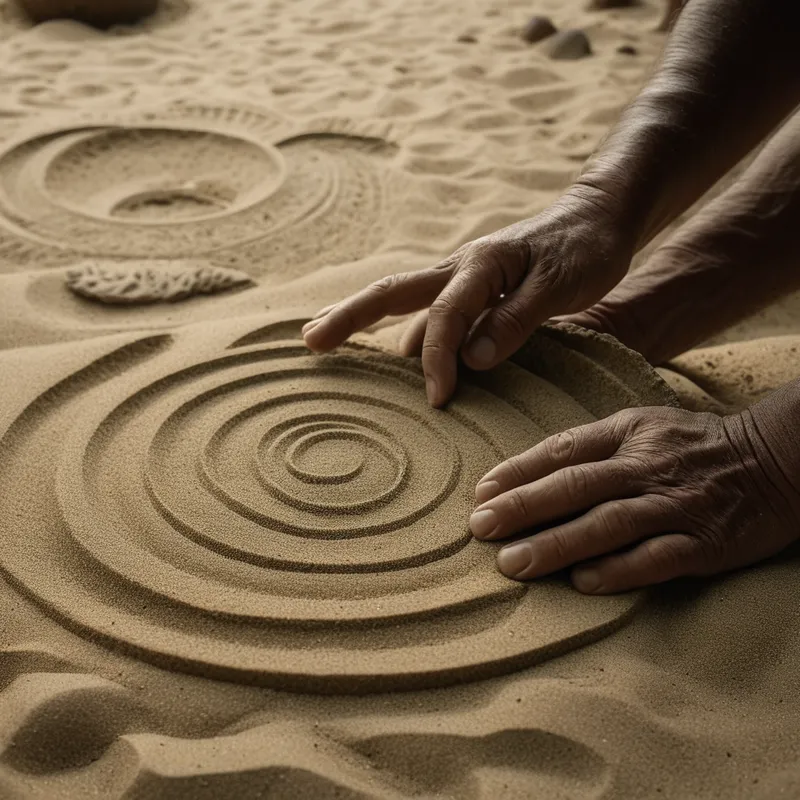
A traveler, footsore and wary, enters a strange city. His spirit seeks a hearth, but his eyes must be cautious. He sees a stranger drawing water. With the tip of his staff, almost idly, he draws a single, graceful curve in the dust. An arc, like the back of a creature from the deep. He pauses, meets the stranger’s eye, and completes the second, mirroring arc. The two lines meet, a simple shape born in the dirt: the silhouette of a fish.
The stranger does not startle. He looks, and with his own sandal, he draws a single line through the shape, bisecting it. A secret geometry is completed. No word has been spoken, yet a covenant is sealed. The traveler is not a spy; he is a brother. The fish, Ichthys, has swum between them, and in its silent wake, doors open, bread is shared, and prayers are whispered in the safety of catacombs lit by a single, defiant lamp.
This was the myth lived, not told. The hero was not a single figure, but every soul who carried the sign. The conflict was the crushing weight of the world, seeking to extinguish a fragile flame. The rising action was the daily courage to make the mark, to trust the sign, to find the tribe in the wilderness of empire. The resolution was not a victory of swords, but of survival—the persistence of a truth so vital it could live and breathe and multiply in the dark, fertile depths, unseen by the powers of the land.
Cultural Origins & Context
The Ichthys emerged not from the pulpits of grand basilicas, but from the gritty reality of the 1st and 2nd centuries. Early followers of Jesus were a scattered, often persecuted minority within the Roman Empire. Public proclamation of faith could mean social ostracization, economic ruin, or martyrdom.
In this crucible, the symbol served multiple vital, pragmatic functions. Firstly, it was a covert identifier. As depicted in the tale, the simple, quickly-drawn fish allowed believers to recognize one another without attracting the attention of authorities. Secondly, it was a mnemonic and teaching tool. The Greek word for fish, ΙΧΘΥΣ (Ichthys), became an acrostic for Iēsous Christos Theou Yios Sōtēr: “Jesus Christ, God’s Son, Savior.” This encoded a core theological statement within a mundane object.
The symbol was passed down through lived practice—scratched on walls as graffiti in the catacombs, etched onto seals, and later incorporated into ring and lamp designs. Its societal function was one of boundary-making and community preservation. It created an invisible network, a “secret society” bound not by blood but by shared belief and shared risk, using the common, non-threatening image of a fish—a creature central to the gospel stories and a staple of the Galilean diet—as its banner.
Symbolic Architecture
The Ichthys is a symbol of profound psychic duality. It represents the conscious identity forced into hiding, and the deeper, instinctual self that continues to navigate and thrive.
The fish does not fight the ocean; it is born of it, moves through it, and finds its sustenance within it. So too, the soul does not fight the unconscious depths but must learn to inhabit them.
Psychologically, the fish symbolizes the nascent Self in its most vulnerable, yet most essential, state. It is the newly forming center of the personality, the “Christ within,” which in its early stages must be protected from the overwhelming pressures of the collective consciousness (the Roman state, societal norms, the “world”). The act of hiding the symbol is not cowardice, but the necessary incubation of a fragile psychic content. The water in which the fish swims is the unconscious itself—the medium of all life, connection, and transformation, but also of danger and the unknown.
Furthermore, the fish is a creature of a different element. It cannot live on dry land, the realm of logos, law, and open declaration. Its element is the fluid, feeling, intuitive world of the psyche. The symbol thus champions a mode of being that is adaptive, fluid, and rooted in a reality that is not immediately visible to the dominant, outward-looking consciousness.
The Dreamer's Resonance
When the symbol of the fish, or the act of drawing or finding it, appears in a modern dream, it rarely speaks of organized religion. Instead, it signals a process of covert self-discovery. The dreamer is likely in a life situation where some essential, authentic part of themselves feels threatened, unacceptable, or too vulnerable to expose.
Somatically, this might correlate with a feeling of constriction in the throat (the unsaid), a tightness in the chest (hidden emotion), or a sense of being “in over one’s head.” The dream-ichthys is a compensatory symbol from the unconscious. It says: Your true self is alive, but it is operating in secret. You are navigating by feel, not by map. You are seeking your tribe—those who will recognize your sign without explanation.
A dream of finding a hidden ichthys carved on a stone or drawn on a document suggests the dreamer is on the verge of recognizing this hidden aspect in themselves or is about to encounter an ally. A dream of a fish swimming away into dark waters may indicate a fear that this nascent self is being lost to the depths, requiring an act of trust to follow it. The symbol calls for attention to what must, for now, remain unspoken but is nonetheless actively guiding one’s course.

Alchemical Translation
The myth of the Ichthys models the early, critical stages of individuation—the opus of becoming whole. This is the alchemy of the orphan archetype finding its hidden lineage.
The first stage is dissolution (solutio). The conscious ego, with its open affiliations and public persona, is dissolved by the pressure of the outer world (persecution) or an inner crisis. One is cast into the aqua permanens, the deep waters of the unconscious, feeling lost and anonymous.
The first birth is into the world; the second birth is into the self, and it often requires a period of hidden gestation.
The drawing of the fish in secret is the coagulation (coagulatio). In the midst of the formless deep, a new form is secretly shaped. This is the crystallization of a new, more authentic identity principle—the Self. It is not yet strong enough for daylight, so it is given a symbolic, encrypted form. The individual begins to “sign” their true nature in subtle choices, private thoughts, and select, trustworthy relationships.
Finally, the recognition by another—the completion of the symbol—is the conjunction (coniunctio). The inner, hidden Self finds its mirror in the outer world. This is not a grandiose union, but a quiet, profound recognition that one is not alone in the deep. The personal struggle is revealed to be part of a universal pattern. The orphan discovers it belongs to a hidden family of the soul. The once-secret sign becomes the proof that the journey through the depths has direction and purpose, leading not back to the old dry land, but toward a new shore where the inner and outer can finally, safely, meet.
Associated Symbols
Explore related symbols from the CaleaDream lexicon: