Icarus Myth Meaning & Symbolism
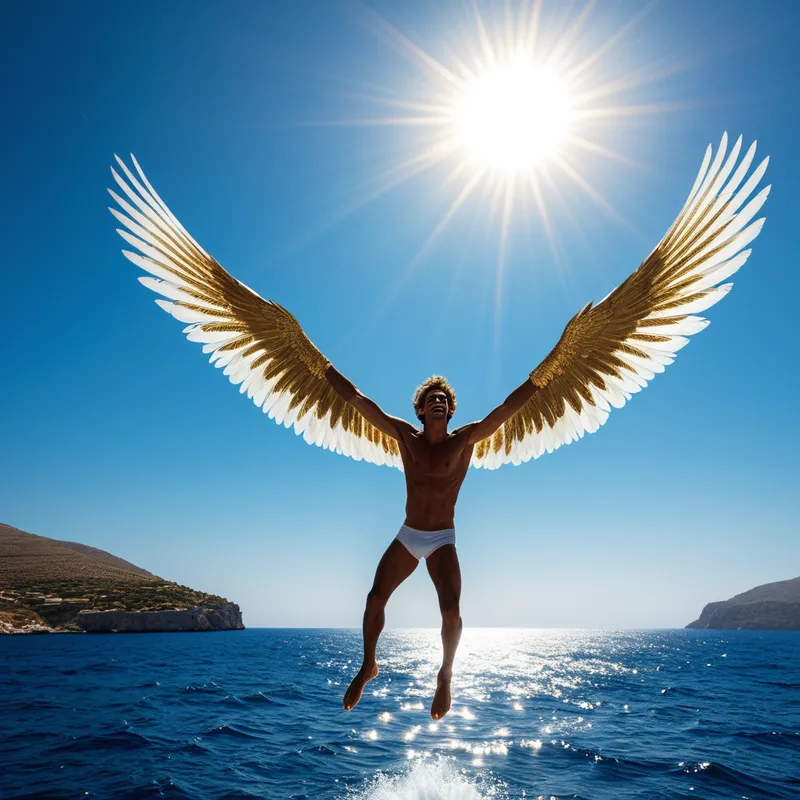
A youth, gifted wings of wax and feather, flies too close to the sun, melting his wings and falling into the sea—a parable of soaring ambition and its fatal limit.
The Tale of Icarus
Hear now the story of a fall that echoes through the ages, a whisper on the wind from the time when gods walked with men and monsters lurked in the labyrinth. It begins not with flight, but with captivity, in the sun-baked stone of Knossos.
The master craftsman Daedalus, his genius a cage as much as a gift, was trapped with his young son, Icarus, by the wrath of King Minos. The sea, watched by a hundred ships, was a wall. The land, guarded by Minos’s soldiers, was a prison. But Daedalus, whose mind could outwit stone and beast, looked to the empty, boundless sky. “Minos may control the earth and the water,” he declared, his voice low with the fire of invention, “but he does not control the air.”
Gathering feathers fallen from gulls and hawks, he worked with the patience of a spider. He laid them in rows, from the smallest to the longest, to mimic the true wings of a bird. He fastened them with thread at their quills, and at their base, with wax he had gathered and rendered soft. He shaped two great pairs: one for himself, broad and steady, and one for his boy, lighter, meant for a heart still unburdened. As he fitted the wings to his son’s shoulders, he spoke the warning that would become the axis of the tale: “Follow my path, Icarus. Do not fly too low, lest the sea spray weigh down your feathers. But mark me well—do not fly too high. If you go too near the sun, the heat will melt the wax. Hold to the middle way.”
And then they were aloft. The first dizzying lurch gave way to a rhythm, a glorious beating against the pull of the earth. The prison island shrank beneath them, a toy of stone. The fishermen in their boats below looked up, stunned, believing they saw gods passing overhead. Daedalus led, a steady, dark shape against the blue. But Icarus, oh Icarus… He felt the sun’s call. It was not just light; it was a presence, a golden father more brilliant than his own. The caution thrummed in his ears, but it was drowned by the roar of his own pulse, by the intoxicating freedom. He beat his wings harder, climbing the invisible ladder of the sky. The air grew thin and pure. The world below was a painted map. He was conquering the realm of Helios himself.
A drop of warmth fell on his arm. Then another. He glanced back. The neat lines of feathers were softening, wilting. A plume detached, spinning down into the abyss. Panic, cold and final, seized him. He flapped wildly, but the structure was failing. The wax became a river, the feathers a scattered storm. The glorious sun, his newfound companion, had betrayed him. A cry—not of a boy, but of a falling star—tore from his throat as the sky let him go. He tumbled, a broken puppet, into the embrace of the sea that would bear his name forever. Daedalus, turning too late, saw only the empty air and the feathers floating on the waves. The father’s invention had saved himself, but it could not save his son from the ecstasy of the heights.

Cultural Origins & Context
This haunting story comes to us primarily from the Roman poet Ovid, in his Metamorphoses, though its roots are undeniably older, woven into the broader cycle of tales surrounding Daedalus, the Minotaur, and the court of King Minos. In the oral tradition of ancient Greece, such myths were not mere entertainment; they were the foundational software of the culture, encoding values, warnings, and explanations of the human condition.
Told in symposia, performed in plays, and depicted on pottery, the story of Icarus served a crucial societal function: it was a parable about sophrosyne—the cardinal Greek virtue of moderation, self-control, and prudence. It graphically illustrated the dangers of hubris, the overweening pride that seeks to transgress divinely or naturally ordained limits (ate). In a culture that revered balance and measure, Icarus was the ultimate cautionary figure. His flight was a technological marvel, a testament to human ingenuity (Daedalus), but his fall was the inevitable consequence of that ingenuity untethered from wisdom. The myth warned the brilliant, the ambitious, and the young that the gods—or the fundamental laws of nature—demand respect, and that the middle path is the path of survival.
Symbolic Architecture
At its core, the myth of Icarus is an exquisite map of a psychic catastrophe. Every element is a living symbol. Daedalus represents the disciplined, cunning intellect—the ego that can engineer an escape from a tangible prison (the labyrinth of a difficult life, a oppressive situation). The wings themselves are the brilliant, fragile synthesis of nature (feathers) and human craft (wax)—a temporary technology of transcendence.
The sun is not merely a celestial body; it is the symbol of the ultimate, the divine, the source of all consciousness and life. To fly toward it is the soul's deepest impulse toward enlightenment, unity, and deification.
But here lies the tragic paradox. Icarus represents the untamed spirit, the youthful puer aeternus (eternal boy) aspect that is pure aspiration, unburdened by the gravity of consequence. His fatal flaw is not ambition itself, but the inflation that comes with it. The ecstasy of flight becomes identification with the divine (“I am like a god”), which melts the very bonds—the wax of human limitation—that made the ascent possible. The sea that receives him is the unconscious, the primordial womb from which life emerged and to which it returns, a symbol of dissolution and the end of individual distinction.
The Dreamer's Resonance
When the Icarus pattern stirs in the modern dreamscape, it often signals a critical moment of psychological inflation or impending deflation. To dream of flying with makeshift or fragile wings speaks to a current, exhilarating expansion of the self—a new career breakthrough, a creative surge, a spiritual awakening. The dreamer feels liberated, powerful, above their problems.
But the dream of the fall, of the melting wax, or of desperately clutching at disintegrating feathers is a somatic alarm from the unconscious. It is the psyche’s attempt to correct a dangerous trajectory. The body may feel it as vertigo upon waking, a tightness in the chest, or a profound sense of dread. This dream is not a prophecy of literal failure, but a stark illustration that the dreamer’s current path—driven by unchecked ambition, spiritual bypassing, or a rejection of necessary human limits—is unsustainable. The unconscious sea is calling the soaring consciousness back to ground, back to embodiment, before a catastrophic crash occurs.
Alchemical Translation
For the individual on the path of individuation, the Icarus myth models a necessary, if painful, phase of psychic transmutation. The initial alchemical operation is one of sublimatio—ascent, spiritualization, the drive to rise above the base material of one’s circumstances (the labyrinth). This is a vital and noble impulse.
However, the myth warns that sublimatio without its counterpart, coagulatio (the return to earth, to solidity and embodiment), is a recipe for psychic death. The successful initiate must learn to integrate the Daedalus and the Icarus within.
The goal is not to never fly, but to learn the art of the navigable ascent—to honor the sun’s pull while respecting the melting point of one’s own wax.
The true alchemical triumph is found in the father’s mournful, continued flight. Daedalus lands, he grieves, he continues his craft. He embodies the consciousness that can utilize the technology of transcendence while remaining rooted in the reality of consequence. For the modern soul, the work is to build wings strong enough to explore the heights of potential, but with a mindfulness that keeps one in dialogue with the human condition. The fall of Icarus is not the end of the story, but the crucible in which grandiosity is burned away, leaving, if we are wise, a humbler, more durable wisdom—the wisdom of the middle way, forged in the memory of the sun’s devastating, beautiful kiss.
Associated Symbols
Explore related symbols from the CaleaDream lexicon:
- Helicopter
- Balloon
- Rocket
- Trampoline
- Jump
- Sublime Cliff
- Popsicle Stick
- Wingsuit
- Riding Rollercoaster
- Urban Rooftop
- Daring Acrobat
- Starry-eyed Dreamer
- Weather Balloon
- Aerial Tramway
- Airplane Takeoff
- Skydiving Experience
- Glider
- Skateboard Ramp
- Parked Airplane
- Helicopter Ride
- Explosive Rocket
- Aluminum Wing
- Helium Balloon
- Transcendent Xenon
- Transparent Wing
- Grasshopper Leap
- Vivarium Escape
- Frigate Bird
- Dizzying Heights
- Astronaut
- Extreme Sports Gear
- Parachute
- Track and Field Jump
- Kite
- Jetpack
- Playground Slide
- Carnival Rides
- Kite Flying
- Carnival Ride
- Napoleon's Hat
- Wright Brothers' Plane
- Amelia Earhart's Aviator Goggles
- Van Gogh’s Starry Night
- Neil Armstrong's Space Suit
- Quixotic Legend
- Outdoor Swing
- Parachute Plane
- Zip Line
- Toy Airplane
- Swing Set
- Paper Airplane
- Skyscraper Window
- Abandoned Exploration Tools
- Tower of Babel
- Free Fall
- Zero Gravity
- Clipping
- Tachometer
- Inflation
- Vertigo
- Ascending
- Floating
- Tumbling
- Wax
- Maximum
- Pride
- Apogee
- Plummet
- Tumble
- Rise
- Slip
- Flying