
Ibong Adarna Myth Meaning & Symbolism
A magical bird whose song can heal a king sends three princes on a perilous quest, testing their character and catalyzing profound transformation.
The Tale of Ibong Adarna
Listen, and let the old tale take root. In the kingdom of Berbanya, a shadow fell where once there was light. King Fernando, a ruler once mighty as the narra, lay stricken upon his royal bed. No physician’s herb, no shaman’s chant could touch the deep malaise that withered his spirit and twisted his body. The air in the palace grew thick with the scent of decayed hope.
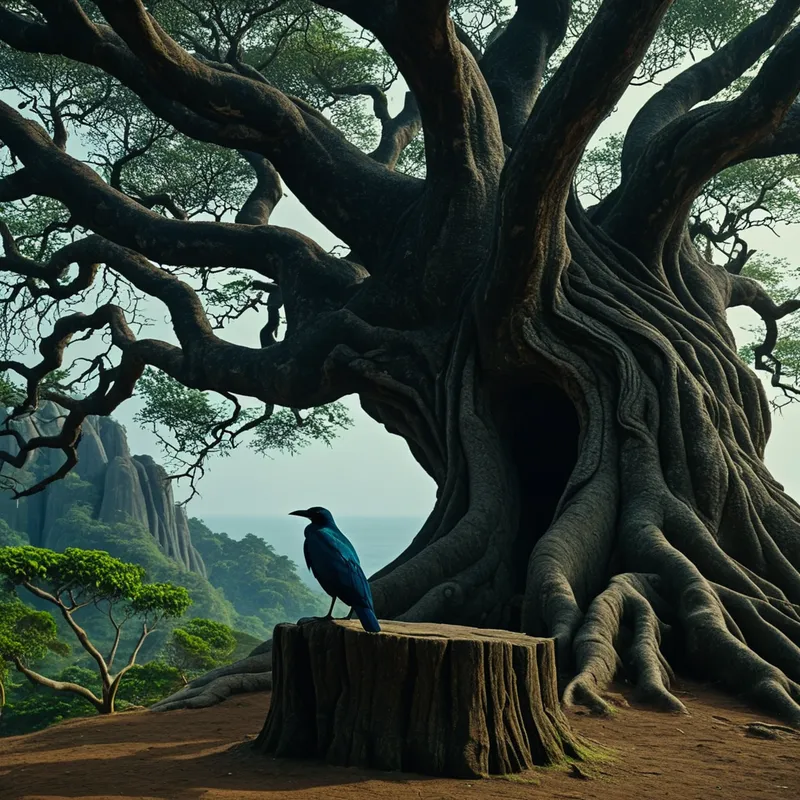
A prophecy, whispered from the lips of a wandering albularyo, offered the only thread of salvation: find the Ibong Adarna. This was no ordinary creature. It dwelled deep within the enchanted forest of Mt. Tabor, on the branches of the mystical Piedras Platas. Its feathers held the seven colors of the rainbow, ever-shifting, and its song… its song was the sound of creation itself. Each stanza could heal any ailment, but to hear it was to risk a terrible fate. For the bird’s melody was a siren’s call that lulled listeners into a profound, enchanted sleep. Upon finishing its seven songs, it would defecate, turning any who heard it to stone.
The king’s three sons heeded the call. First went Don Pedro, the eldest, proud and headstrong. He found the glittering tree and the resplendent bird. As the first notes flowed, sweet as tuba honey, his resolve melted. He slept, and was turned to a statue of cold, grey stone. Next went Don Diego, the second, cunning but impatient. The same fate befell him; the song was a net he could not see.
Finally, the youngest, Don Juan, set forth. His heart was pure, but wisdom traveled with him in the form of an old hermit’s aid. The sage gave him a blade and lemons—bitter fruit to fight a sweet sleep. Don Juan hid behind the Piedras Platas. When the Adarna began its celestial aria, its voice weaving spells of forgetfulness, he sliced the lemons and let the sharp, stinging juice fall into his eyes. Pain kept him awake where willpower would have failed. Through seven agonizing songs, he wept burning tears, but he remained conscious.
As the last note faded, the magnificent bird, its duty done, slept. Don Juan gently captured it. But his task was not complete. With water from a miraculous well, he restored his petrified brothers to life. Their return was not one of gratitude, but of envy. On the journey home, they betrayed him, beating him unconscious and leaving him for dead in a deep, dry well. They presented the Adarna to their father, but the bird, sensing the falseness of the moment, fell silent and dull. The king remained unhealed.
Don Juan, however, was not forsaken. From the depths of his symbolic grave, he was rescued by a princess, Maria Blanca, who lowered her long, dark hair like a rope of salvation. Through trials of love and magic, Don Juan proved his worth anew. He returned to Berbanya, not with vengeance, but with truth. The sight of him, alive and radiant, broke the spell of silence. The Ibong Adarna sang its full, healing song. King Fernando rose, whole again. The poison of the kingdom—the sickness of betrayal, envy, and dishonor—was washed clean by the song of a bird and the integrity of a true heart.
Cultural Origins & Context
The tale of Ibong Adarna exists in the rich, oral tapestry of pre-colonial and colonial Philippine folklore. It is a korido, a metrical romance that likely evolved during the Spanish colonial period (16th-19th centuries), blending indigenous animist beliefs with imported chivalric and Christian motifs. Passed down through generations by storytellers and eventually codified in written awit and corrido booklets, it served as both entertainment and moral instruction.
Its societal function was multifaceted. For a people under colonial rule, it presented a world where indigenous magic (the Adarna, the Piedras Platas) held the ultimate power to heal ailing authority, a subtle narrative of cultural resilience. Familially, it reinforced core values: the duty of children to parents, the perils of sibling rivalry, and the ideal that true leadership (Don Juan) is earned through humility, perseverance, and moral fortitude, not merely birthright. It was a mirror held up to the community, reflecting the eternal struggle between integrity and corruption.
Symbolic Architecture
At its heart, the myth is a profound map of psychic illness and the arduous path to wholeness. King Fernando’s mysterious sickness represents a state of collective or patriarchal dysfunction—a ruling principle (the King) that has lost its connection to life and spirit.
The Ibong Adarna is the soul’s own healing melody, a numinous symbol of the transcendent function. Its seven-colored, shifting plumage signifies the totality of the psyche, the full spectrum of experience and emotion that must be integrated for healing to occur.
The enchanted forest of Mt. Tabor is the unconscious itself, and the Piedras Platas is the axis where the divine (the bird) touches the earthly. The brothers’ petrification is a perfect metaphor for a psychological complex: they are frozen, stuck in a rigid pattern (of pride, envy) by the beauty of the unconscious content they cannot consciously withstand. Don Juan’s lemons are the bitter, painful consciousness required to engage the numinous without being dissolved by it. His betrayal and descent into the well is the essential night sea journey, where the ego is shattered so the Self can be reborn.

The Dreamer's Resonance
When this myth stirs in modern dreams, it signals a profound somatic and psychological process: the call to heal a deep, perhaps inherited, wound. Dreaming of a sick parent or authority figure mirrors King Fernando’s ailment—a felt sense that an internalized guiding principle is failing. The quest for a magical, elusive bird or object speaks to the soul’s intuition that the remedy lies not in external fixes, but in a risky journey inward.
The somatic experience might be one of heavy lethargy (the king’s sickness) juxtaposed with restless searching (the prince’s journey). Dreaming of being turned to stone reflects feelings of being paralyzed by an overwhelming emotion or insight. To dream of using something bitter (like lemons) to stay awake is the psyche rehearsing the difficult, conscious work of holding tension without dissociating. The final healing song in a dream often manifests as a wave of profound relief, a release of tears, or a vision of brilliant, harmonious color—the body registering the resolution of a deep conflict.

Alchemical Translation
The myth of Ibong Adarna is a precise alchemical manual for individuation. The prima materia is the sick kingdom—the neurotic, fragmented psyche.
The capture of the bird is the nigredo, the darkening. It is the conscious confrontation with the dazzling, autonomous power of the unconscious (the Self). This stage is fraught with the danger of inflation (pride of the older brothers) or of being overwhelmed and “turned to stone” (identified with a complex).
Don Juan’s betrayal and descent into the well is the crucial albedo. The ego is sacrificed, stripped of its naive identity. This is the humbling, the “washing in the well,” that prepares the vessel. His rescue by Maria Blanca (the anima) represents the soul’s guidance emerging from the depths. Their subsequent trials are the citrinitas, the refinement.
The final return and the bird’s healing song embody the rubedo. The transcendent function, once captured and integrated through ordeal, now operates consciously. The healed king is the renewed ruling principle of the psyche, no longer autocratic and frail, but resilient and connected to the soul’s own magical, life-giving music. The individual is no longer ruled by the sickness of unconscious complexes (the betraying brothers) but is sovereign in their own, healed kingdom.
Associated Symbols
Explore related symbols from the CaleaDream lexicon:
- Bird — The Ibong Adarna itself, symbolizing the transcendent soul, a messenger from the unconscious with the power to heal or petrify depending on the listener's consciousness.
- Forest — The enchanted realm of Mt. Tabor, representing the deep, unknown, and fertile territory of the unconscious mind where the quest for wholeness must take place.
- Healing — The core purpose of the quest; the restoration of the king signifies the psychological process of integrating fragmented parts of the self into a healthy, functioning whole.
- Journey — The perilous voyage of the three princes, mapping the archetypal hero's path of departure, initiation, and return that is fundamental to psychological growth.
- Stone — The fate of those who listen unprepared, symbolizing psychological paralysis, rigid complexes, and a state of emotional petrification that requires living water to undo.
- Water — The liquid from the miraculous well that restores the petrified brothers, representing the fluid, healing power of the unconscious to soften and revive what has become rigid and dead.
- Betrayal — The act of the elder brothers, embodying the shadow's sabotage from within, where aspects of the psyche (like envy and pride) undermine the progress of the conscious ego.
- Song — The Adarna's magical melody, representing the numinous, transformative language of the unconscious that can either enchant and trap or heal and liberate.
- Tree — The Piedras Platas, the mystical axis mundi where heaven and earth meet; it is the point of connection between ordinary reality and the divine or unconscious realm.
- Sleep — The enchanted slumber induced by the song, symbolizing a loss of consciousness, a passive succumbing to unconscious forces that must be resisted for transformation to occur.
- Hero — Don Juan, who embodies the archetypal process of enduring ordeal, integrating help (the hermit, Maria Blanca), and returning with the boon to restore his world.