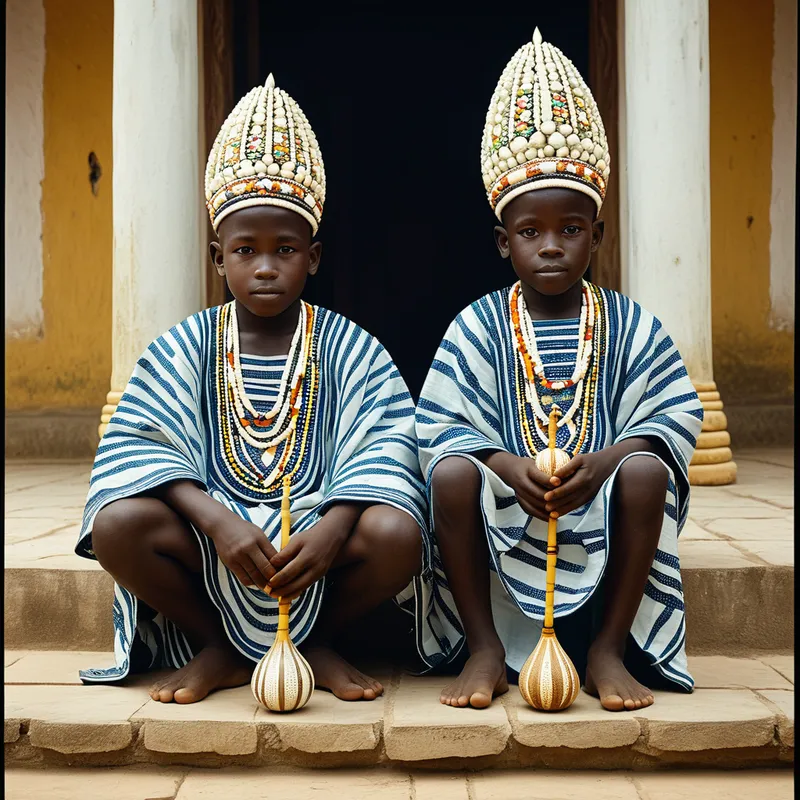
Ibeji the Divine Twins Myth Meaning & Symbolism
A myth of sacred twins born from tragedy, embodying the cosmic dance of duality and the alchemy of turning profound grief into eternal, protective joy.
The Tale of Ibeji the Divine Twins
Listen. The story begins not with a shout, but with a silence so deep it echoed in the womb of the world. It begins with Oshun, she whose laughter makes the rivers dance, whose tears are honey. From her union with the warrior-king Ogun, or in some tellings, with the divine king Shango, she carried a double blessing. Not one heartbeat, but two, pulsed in rhythm beneath her ribs—a sacred duality, a promise of double joy.
The world held its breath for their arrival. When the time came, the twins, Taiwo and Kehinde, entered the world as all first children do: crying, perfect, and utterly dependent. But theirs was a bond written in the stars before their names were whispered on the wind. Taiwo, the first to arrive, was the explorer, sent by Kehinde to test the waters of life. Kehinde, the second-born, was the wiser, the observer who followed, learning from the path his sibling forged. They were two halves of a single soul, a living dialogue between action and reflection, courage and caution.
Yet, the world of Aye is a fragile vessel for such potent divinity. The soil of earth was too coarse, the air too thick with mortal sorrow. The twins, so radiant, so intertwined with the delicate balance of opposites, could not endure the harsh weight of a singular reality. In a turn as swift and cruel as a sudden storm, their bright sparks were extinguished. They returned to the realm of Orun, leaving behind a void shaped exactly like their two small bodies.
Oshun’s river ran gold with her grief. Her famous joy turned to a wail that silenced the birds. She wandered the banks, her finery neglected, her mirror reflecting only emptiness. Her sorrow was a tempest that threatened to drown the very concept of happiness. The other Orisha looked on, powerless. How does one heal a wound that has cut the universe in two?
Then, from the depths of her divine despair, Oshun performed an act of supreme alchemy. She did not rage against fate. Instead, she gathered the essence of her loss—every memory of a first smile, every echo of shared laughter, the phantom weight of two heads cradled in her arms. She took this unbearable weight and began to spin it, not into forgetfulness, but into a new form of remembrance. She petitioned the supreme creator, Olodumare, and the wisdom of Orunmila.
And so, from the raw material of a mother’s shattered love, the Ibeji were born anew—not as mortal children, but as eternal Orisha. They became the divine protectors of all twins in the world, the sacred custodians of duality itself. Where there was once only the silence of loss, there now stood two eternal figures, embodiments of joy, playfulness, and abundance. They became a promise: that what is lost in the realm of flesh is transformed and preserved in the realm of spirit. Their story teaches that the deepest grief, when honored, can become the source of the most protective and enduring joy.

Cultural Origins & Context
The myth of Ibeji is woven into the very fabric of Yoruba society, which historically has one of the highest rates of twin births in the world. This biological fact was not seen as mere chance but as a divine event, a direct blessing—or a profound spiritual challenge—from the Orisha. The story was not merely entertainment; it was a vital cosmological map and a social survival guide.
Passed down through generations by Babalawo and elders, the myth served a crucial societal function. In a time of high infant mortality, the loss of twins was devastatingly common. The myth of Ibeji provided a framework to process this trauma. It transformed a potential source of shame and terror (the death of sacred children) into a sacred narrative of ongoing connection. It mandated that if one or both twins died, the family must commission ere ibeji figures. These figures were cared for as living entities—fed, clothed, and included in family life—ensuring the twins' spirits remained happy and would bless, rather than curse, the household with prosperity and protection.
Thus, the myth moved from the cosmic to the intimately domestic. It was told to comfort a grieving mother, to instruct a carver, to guide a family in ritual. It cemented the understanding that duality—life/death, joy/sorrow, presence/absence—is not a flaw to be corrected but a fundamental, sacred principle of existence to be honored and balanced.
Symbolic Architecture
At its core, the Ibeji myth is a profound exploration of the psyche's inherent duality. The twins represent the fundamental pairs that structure reality: conscious and unconscious, ego and shadow, mortal and immortal, action and wisdom.
The first twin, Taiwo, is the pioneer of consciousness—the ego that ventures into the unknown world. The second, Kehinde, is the deep, observing Self—the unconscious that holds the pattern and the wisdom.
Their inseparable bond symbolizes the essential, though often conflicted, relationship between these inner forces. Their tragic death represents the inevitable "death" or repression that occurs when such pure, archetypal duality is forced into a singular, material existence. It is the trauma of incarnation itself.
Oshun’s transformation of grief into a new divine form is the central alchemical act. It symbolizes the psyche's innate capacity to metabolize profound loss and trauma. The grief is not erased; it is transmuted. The raw, paralyzing emotion becomes the creative fuel for a new psychological structure—the internalized "divine twins," or the reconciled inner opposites that offer protection, joy, and abundance from within.
The ere ibeji figures are perhaps the most potent symbol. They are the tertium quid—the third thing that emerges from the tension of opposites. They are not the living children, nor are they mere memorials. They are ritual containers, sacred technology that allows a dialogue between the visible and invisible worlds, between loss and ongoing relationship.
The Dreamer's Resonance
When the pattern of Ibeji stirs in the modern dreamer, it often signals a profound confrontation with inner duality and a call to reconcile a split within the psyche. One may dream of identical children, mirrored figures, or paired animals (birds, fish). They may be playing joyfully, arguing fiercely, or one may be lost or injured.
Somatically, this can feel like a tug-of-war in the chest, a sensation of being pulled in two directions, or a profound, inexplicable loneliness that feels like a missing half. Psychologically, the dreamer is often grappling with a fundamental inner conflict: the logical mind versus the emotional heart, the drive for career success versus the need for creative expression, the persona shown to the world versus the hidden shadow self.
The death or loss of the twins in the dream mirrors a felt sense that this internal conflict is causing a kind of "spiritual death"—a loss of vitality, joy, or authenticity. The dream is presenting the wound of inner division. The subsequent search in the dream, often led by a nurturing or grieving feminine figure (the Oshun archetype), is the psyche initiating its own healing process, seeking the ritual or insight that will allow these warring parts to be honored and integrated, not eliminated.

Alchemical Translation
The myth of Ibeji provides a masterful model for the modern journey of individuation—the process of becoming a whole, integrated Self. It maps the path from naive unity, through traumatic division, to a conscious, sacred reconciliation.
The first stage is the "Blessed Birth": the innate, unconscious wholeness of childhood or a new project, where opposites coexist without conflict. Then comes the "Traumatic Split": life experience, crisis, or societal pressure forces us to choose one side over the other (logic over feeling, duty over desire). One "twin" is sent into the world (the adapted ego), while the other is left behind or dies (the repressed Self). This creates the foundational wound, the source of our neuroses and our longing.
The alchemical fire is not ignited by joy, but by the conscious suffering of this split. Oshun’s grief is the necessary ingredient—the full, unflinching acknowledgment of what has been lost.
The work of "Psychic Ritual Carving" follows. This is the slow, deliberate process of therapy, creative work, or deep reflection where we craft our own internal ere ibeji. We give form and attention to both the successful, outward-facing part of ourselves (Taiwo) and the wiser, observing, often neglected inner voice (Kehinde). We "feed" them with attention, honor their different perspectives, and listen to their dialogue.
The final stage is "Sacred Duality." Integration does not mean creating a bland, uniform self. It means allowing the twins to coexist in perpetual, creative tension. The trickster energy of the Ibeji—their playfulness and unpredictability—becomes accessible. The individual gains the resilience and abundance that comes from no longer being at war with themselves. The once-devastating split becomes the source of inner wealth, protective insight, and a joyful capacity to engage with the dualistic nature of life itself. The grief is not gone; it has become the sacred ground from which a more conscious, durable joy can eternally spring.
Associated Symbols
Explore related symbols from the CaleaDream lexicon:
- Twin — The core symbol of sacred duality, representing the inherent and necessary pairs within the psyche and the cosmos, such as consciousness and the unconscious, or life and death.
- Grief — The raw, transformative emotion that acts as the alchemical fire, burning away naive unity to make space for a conscious, sacred reconciliation of opposites.
- Mother — Embodied by Oshun, representing the nurturing, creative force that holds the space for transformation and performs the alchemy of turning loss into enduring spiritual presence.
- Ritual — The structured, sacred action (like carving and caring for ere ibeji) that provides a container for processing trauma and mediating between the worlds of the visible and the invisible.
- Divine — The transcendent quality that emerges from the reconciliation of opposites, transforming a personal, mortal tragedy into an eternal, protective archetypal principle.
- Joy — The ultimate fruit of the alchemical process; not a simple happiness, but a durable, abundant state that arises from the integration of wholeness after profound loss.
- Child — Represents the nascent, potential aspects of the self—the new possibilities, vulnerable instincts, and pure states of being that must be protected and integrated.
- Spirit — The essential, immortal essence of a being that persists beyond physical form, which is honored and engaged with through ritual and memory.
- Balance — The dynamic, active state of equilibrium sought by honoring both twins, representing the psychological and cosmic ideal of harmony between opposing forces.
- Dance — The playful, ever-moving interaction between the twins, symbolizing the healthy, lively relationship between integrated inner opposites, full of creativity and spontaneity.
- Sacrifice — The necessary surrender of the twins' mortal existence, which becomes the sacred offering that makes their divine, eternal form possible.
- Rebirth — The core promise of the myth: that from the ashes of a profound ending, a new, more resilient and conscious form of being can emerge.