I Ching Myth Meaning & Symbolism
An ancient divinatory text born from cosmic observation, revealing patterns of change and the dynamic interplay of Yin and Yang within all existence.
The Tale of I Ching
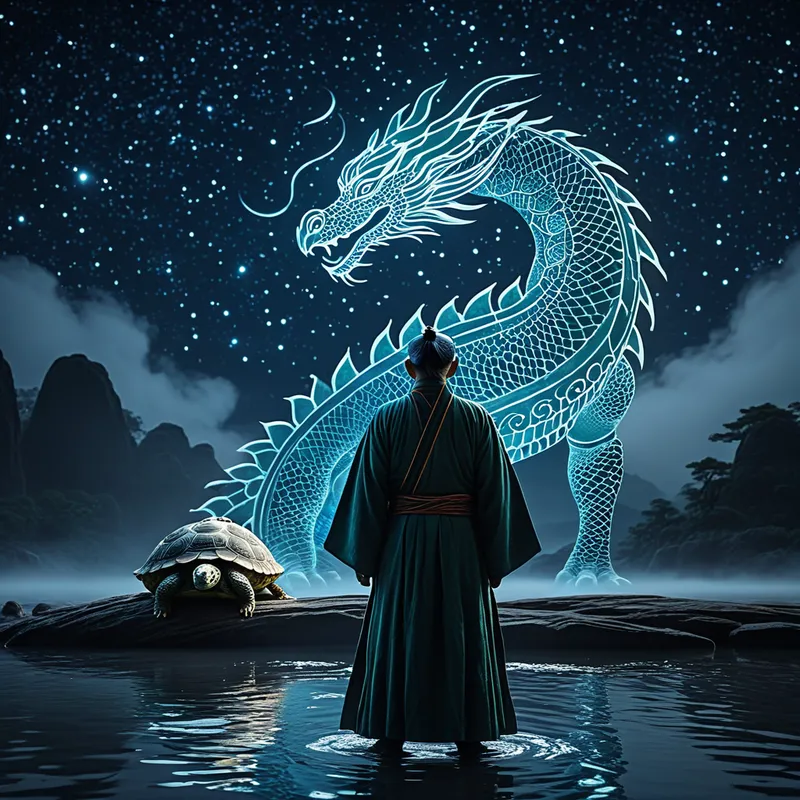
In the time before time, when the world was a broth of mist and potential, the great sage Fu Xi walked the banks of the Yellow River. His mind was not on the earth, but on the heavens—the wheeling dance of stars, the orderly procession of seasons, the silent, majestic laws that governed the flight of birds and the flow of rivers. He felt a profound ache, a longing to understand the hidden script of the cosmos, the language in which the universe whispered its secrets.
One day, as the sun bled into the horizon, the waters of the river churned. From the depths emerged a creature of myth—the Dragon-Horse in some tellings, the Spirit Turtle in others. Its shell was not mere bone, but a living chart of the heavens. Upon it, Fu Xi saw a pattern of markings—dots and lines, arranged in eight distinct clusters of three. They were not random. They spoke of fullness and emptiness, of movement and stillness, of light and dark. In that moment, the chaos of the world resolved into order. The eight Trigrams were revealed: Qian, the strong; Kun, the yielding; Zhen, the shaking; and all their brothers.
Generations flowed like the river. The sage-kings who followed—King Wen of Zhou, imprisoned by a tyrant, and his son, the Duke of Zhou—faced the ultimate conflict: the chaos of human fate, the torment of not knowing the right action in a world of danger and moral ambiguity. In the darkness of his cell, King Wen contemplated Fu Xi’s trigrams. He saw that life was not a simple triad, but a complex hexad. He stacked the trigrams, one upon another, creating sixty-four six-line figures, the Hexagrams. To each, he gave a name and a judgment—a core meaning. His son later added the line texts, the specific counsel for each changing line within the whole.
Thus, the I Ching was born. It was not a book of fixed answers, but a mirror of change itself. It did not speak from a mountaintop but emerged from the muddy waters of human struggle, from the silent observation of nature, and from the profound need to find harmony within the ceaseless transformation of all things.
Cultural Origins & Context
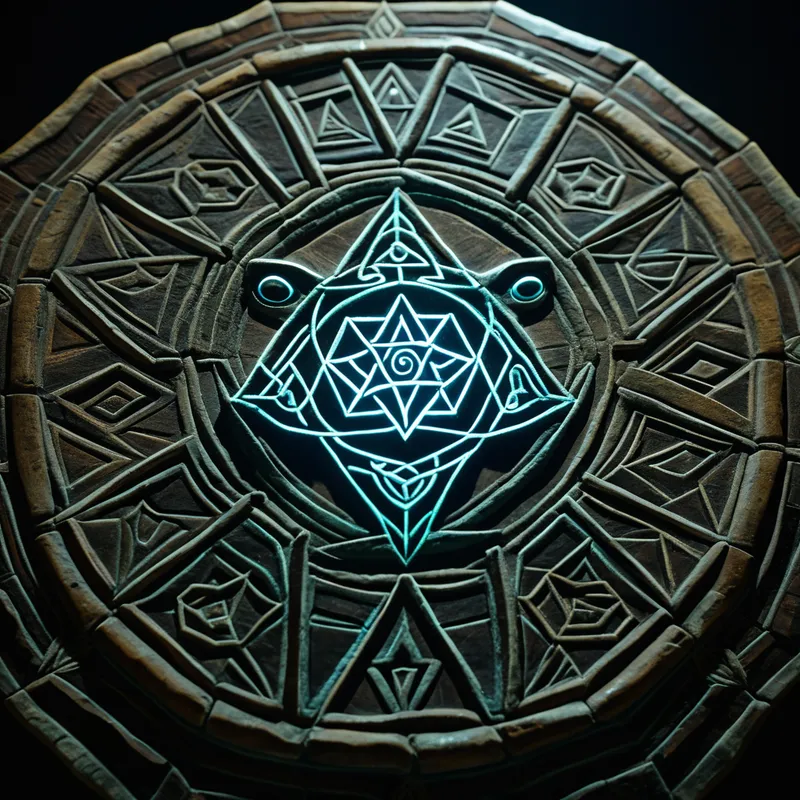
The I Ching’s roots are not in a single moment, but in the slow accretion of wisdom across millennia of early Chinese civilization. Its earliest layer, the hexagrams themselves, likely originated in the practice of pyromancy—reading the cracks in heated tortoise plastrons or ox scapulae during the Shang Dynasty (c. 1600–1046 BCE). These cracks were seen as messages from the ancestors and spirits. Over time, the patterns of cracks were standardized into the broken (Yin) and solid (Yang) lines.
The text as we know it coalesced during the Zhou Dynasty (1046–256 BCE), a period of immense philosophical ferment. It was compiled and edited by the Zhou literati, traditionally attributed to the figures in the myth. It functioned as a state oracle for kings and nobles, a guide for ethical governance and military strategy. However, its genius was its abstraction. It moved from specific spirit communication to a universal system of symbols describing the dynamics of any situation. It was passed down through a scholarly elite, its study considered essential for a cultivated mind, alongside the Confucian classics. Its societal function was dual: a practical tool for divination and a profound philosophical treatise on cosmology, ethics, and the nature of reality.
Symbolic Architecture
At its heart, the I Ching is a symbolic map of psychic reality. Its primary language is the binary of the Yin line (broken) and the Yang line (solid). These are not opposites, but complementary poles in a dynamic relationship.
The solid line is not superior to the broken; it is simply its necessary counterpart. True power lies in knowing when to be the mountain and when to be the valley.
The eight trigrams represent fundamental archetypal forces: Heaven, Earth, Thunder, Water, Mountain, Wind/Wood, Fire, and Lake. They are the elemental vocabulary. The 64 hexagrams are the sentences formed from this vocabulary, each describing a complex, archetypal situation or state of change—from The Creative to The Receptive, from Difficulty at the Beginning to Before Completion.
Psychologically, the act of casting the I Ching—using yarrow stalks or coins to generate a hexagram—is a ritualized engagement with synchronicity, a term later coined by Jung. It is a method to bypass the conscious, rational mind and allow the unconscious, through the seemingly random fall of coins, to project its contents onto the timeless symbolic matrix of the hexagrams. The resulting hexagram is not a prediction, but a snapshot of the psychic configuration of the moment.
The Dreamer's Resonance
When the patterns of the I Ching manifest in modern dreams, they rarely appear as literal books or trigrams. Instead, one dreams of being at a crossroads where every path is clearly marked yet their destinations are shrouded. One dreams of intricate, moving mosaics where black and white tiles shift to form momentary, meaningful pictures before dissolving. One dreams of being a vessel—a cup, a valley, a cave—being filled and emptied by a cyclical force.
Such dreams point to a somatic and psychological process of navigating a life transition where the old structures are breaking down and new patterns have not yet coalesced. The dreamer is in the "in-between" state, the space of potential that every hexagram ultimately describes. The body may feel this as tension between activity and rest (Yang vs. Yin), or a sense of being pulled in multiple directions (like the moving lines of a hexagram). The dream is the psyche’s own divination, attempting to image forth the hidden order within the chaos of change, urging the dreamer to consult their own inner "oracle" of intuition and bodily wisdom.
Alchemical Translation
The core alchemy of the I Ching is the transmutation of confusion into insight, and fate into conscious participation. The process models individuation perfectly. First, there is the Presenting Hexagram—the conscious situation, the ego’s dilemma, the "symptom." This is the ore, the raw, conflicted state.
The question posed to the oracle is the first crack in the ego’s certainty, an admission that one’s own light is insufficient to see the path.
Then, through the ritual of consultation (the opus), one discovers the Moving Lines. These are the points of tension, the aspects of the situation that are unstable and ready to change. They represent the unconscious complexes pushing for expression, the shadow elements demanding integration. As these lines change, they reveal the Resulting Hexagram—the potential state of being that will emerge if one integrates the change consciously.
This is the alchemical gold: not a predetermined future, but a vision of a more whole psychic configuration. The work of individuation is to hold both hexagrams in mind—the current self and the potential self—and to consciously enact the transformation indicated by the changing lines. It teaches that we are not passive subjects of fate (Ming), but active participants in a dynamic, relational cosmos. By understanding the pattern we are in, we can find the correct action, the "right timing" (Shi), and thus transform our relationship with destiny itself. The I Ching does not offer escape from change; it offers the profound peace that comes from understanding its flow and learning to swim within its eternal, archetypal currents.
Associated Symbols
Explore related symbols from the CaleaDream lexicon: