Hypnos Myth Meaning & Symbolism
The myth of Hypnos, the primordial god of sleep, reveals the unconscious as a sacred, generative realm of healing, prophecy, and profound psychic truth.
The Tale of Hypnos
Listen, and let your waking mind grow heavy. Let the noise of the day recede like a tide, and journey with me to the very edge of the world, where light bleeds into shadow and thought dissolves into quiet. Here, in the sunless, silent land of Erebus, lies a cave.
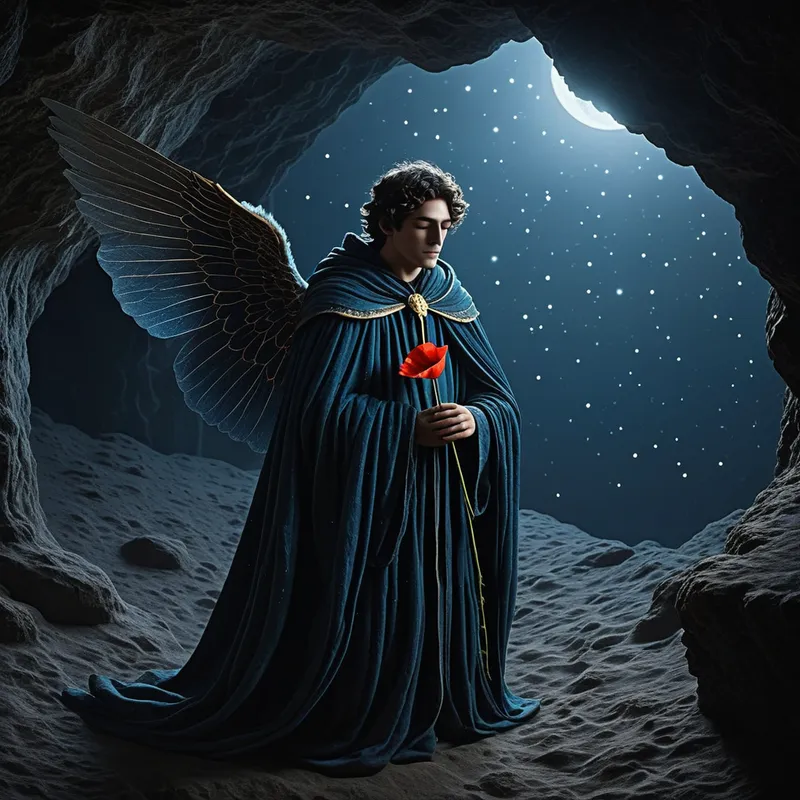
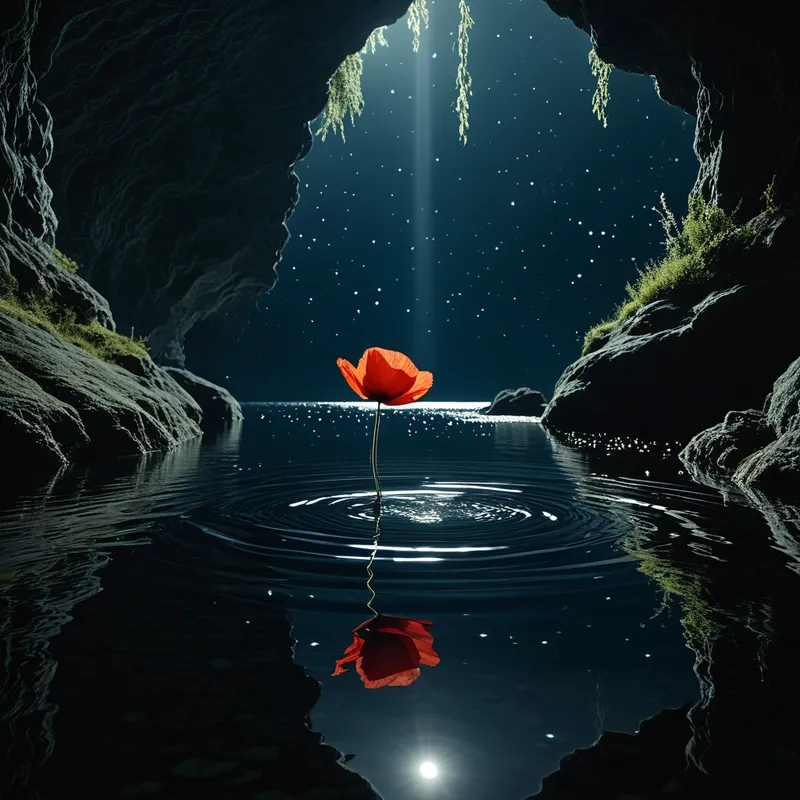
Its entrance is veiled by the whispering fronds of poppies, their heavy heads nodding in a breeze that stirs nothing else. No bird calls here, no insect hums. Only the soft, ceaseless murmur of the Lethe, the river of forgetfulness, as it slides past the threshold like a black silk ribbon. This is the domain of Hypnos.
He dwells within, a being of profound and gentle power. He is not old, but ancient; not stern, but infinitely calm. His form is that of a beautiful, youthful god, but his eyes are forever closed in serene slumber. From his shoulders spring great, downy wings, the color of twilight ash. In one hand, he carries a horn from which he pours the draught of sleep, and in the other, the inverted torch of extinguished consciousness. Around him, the very air is thick with unseen dreams, fluttering like moths against the cave walls.
His brother is Thanatos, and together they are the children of Nyx, the Night herself. While Thanatos’s touch is final, Hypnos’s is a reprieve, a daily little death that grants renewal. His power is so vast that even Zeus must bow to it. Once, when Hera plotted against her mighty husband, she came to this cave, past the murmuring Lethe. She begged Hypnos to cast the lord of thunder into a deep sleep, so she might work her will. Hypnos, at first, trembled at the thought, remembering a time he had dared such a thing and had been chased by a furious Zeus across the heavens.
But Hera, in her cunning, promised him one of the Graces for his own. And so, lulled by promise and his own inherent nature, Hypnos agreed. He ascended to Mount Olympus, invisible as a shadow, and stood beside the throne of the mightiest god. He did not strike or shout. He simply waved his wing, and the potent essence of slumber, drawn from the heart of his cave, enveloped Zeus. The Thunderer’s mighty head nodded. His lightning bolt slipped from his grasp, its crackle fading to a whisper. The ruler of the world succumbed to the gentle, inexorable power of the cave-dweller, proving that even the pinnacle of conscious will must, eventually, yield to the depths.
Cultural Origins & Context
The myth of Hypnos is a foundational strand in the vast tapestry of Greek theogony—the story of how the gods came to be. He is not an Olympian, but a Primordial, born from Nyx alone, placing him among the very first forces of the cosmos: Chaos, Gaia, Tartarus, and Eros. This lineage is critical. It tells us that the Greeks understood sleep not as a mere biological function, but as a fundamental, pre-existing cosmic principle, as elemental as the earth or the void.
His stories were passed down through the epic poetry of Hesiod’s Theogony and Homer’s Iliad, and later elaborated by poets and playwrights. In a society without the scientific vocabulary of neuroscience or psychology, Hypnos personified the profound, mysterious, and universal human experience of surrendering consciousness. His cult was not widespread like that of Apollo or Athena, for one does not worship sleep in temples; one experiences it every night. His societal function was explanatory and existential. He gave a face and a narrative to the daily journey every person took—a journey to a realm that was adjacent to death (Thanatos) and touched by prophecy (through dreams). He was the necessary counterbalance to the bright, active, rational world of the Olympians, representing the essential, restorative darkness from which all consciousness springs and to which it must regularly return.
Symbolic Architecture
Hypnos is the personification of the unconscious mind itself. His cave in Erebus is not a prison, but a sanctum—the inner chamber of the psyche where the noise of the ego is silenced. The poppies at its entrance symbolize the narcotic, boundary-dissolving nature of this descent, while the river Lethe represents the necessary release of daytime identity and trivial memory to access deeper, archetypal layers.
Sleep is not an absence of consciousness, but the presence of a different order of knowing.
His wings signify the soul’s capacity for travel beyond the confines of the physical body and linear time—the essence of dreaming. His closed eyes do not indicate blindness, but an inward vision. The most potent symbol is his victory over Zeus. This is not a tale of rebellion, but of natural law. It illustrates the ultimate sovereignty of the unconscious over the conscious ego. Zeus, the archetypal ruler, father, and symbol of focused willpower and light, must yield to Hypnos. This is the psyche’s non-negotiable requirement for balance. The ego, no matter how powerful, cannot maintain perpetual, tyrannical control. It must be periodically dissolved in the waters of Lethe to be reconstituted, refreshed, and informed by the wisdom of the deep.
The Dreamer's Resonance
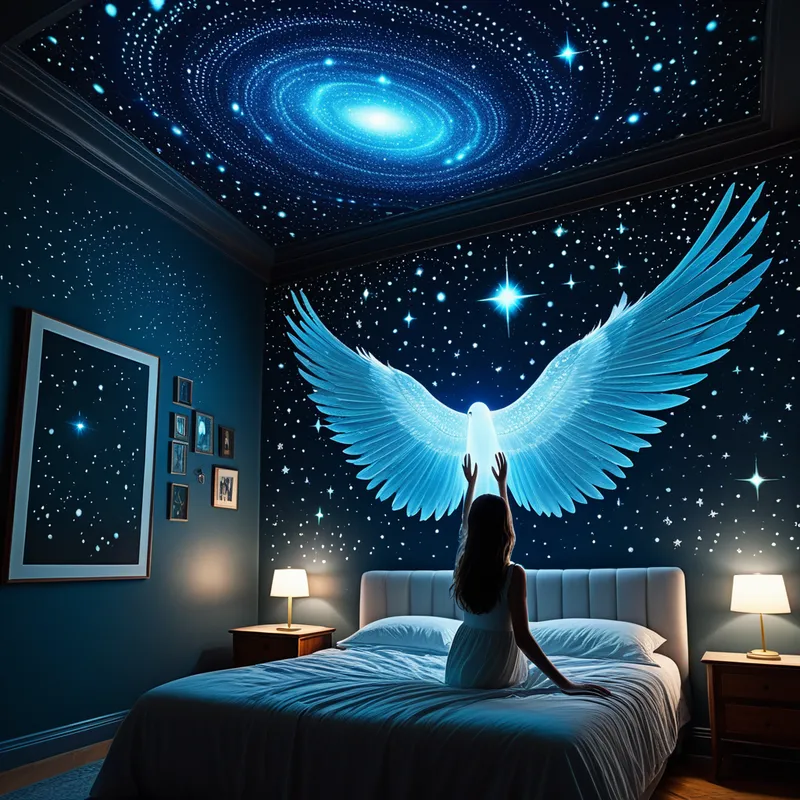
When the pattern of Hypnos manifests in modern dreams, it is rarely as a literal winged god. It appears as the somatic feeling of being irresistibly, peacefully pulled into sleep within the dream itself. It is the dream of finding a hidden, quiet room in a chaotic house. It is the sensation of sinking into incredibly soft, dark fabric or being gently carried by a silent, deep current.
Psychologically, this signals a critical process of psychic retreat and unconscious integration. The dreamer is likely overwhelmed by the "Zeus" aspects of their waking life: excessive control, relentless duty, hyper-vigilance, or inflated ego. The dream is the psyche’s innate healing mechanism, enforcing what the conscious mind resists: surrender. To dream of Hypnos’s realm is to experience the Self prescribing its own medicine. The somatic feeling of heaviness, warmth, and release is the nervous system discharging the accumulated stress of conscious striving, allowing the autonomic, intuitive, and restorative systems to take over. It is a direct encounter with the psyche’s self-regulating wisdom, saying, "Your current mode of being is unsustainable. You must come down to the cave, to the river, and be renewed."
Alchemical Translation
The alchemical journey of individuation is not a relentless ascent into light, but a rhythmic oscillation between the solar consciousness of the ego (Zeus) and the lunar consciousness of the unconscious (Hypnos). The modern individual, obsessed with productivity, optimization, and perpetual awareness, often views sleep and dream as downtime, a blank space in the ledger of achievement. The myth of Hypnos reframes this entirely.
The core struggle is the ego’s resistance to its necessary dissolution. The triumph is the graceful, or sometimes forced, surrender to it. The alchemical nigredo, the blackening, finds its parallel in the descent into the cave of Hypnos—into the fertile darkness where old identities are broken down by the waters of Lethe.
The transmutation of leaden consciousness into golden insight requires the crucible of unknowing.
The process modeled is this: First, the recognition of ego-fatigue (Zeus’s unyielding throne). Second, the courageous or desperate journey to the periphery (seeking the cave). Third, the voluntary ingestion of the poppy-draught—the surrender of control. This is the albedo, the whitening. In the silent cave, the chaotic contents of the psyche (the fluttering dreams) can reorganize. Insights incubate. Prophetic whispers from the deeper Self can be heard. Finally, one returns, not as the same rigid ruler, but refreshed, with the unconscious wisdom subtly integrated into conscious life—a step closer to the philosopher’s gold, the integrated Self. We do not become Hypnos; we learn, like Zeus, to honor his essential, periodic reign. In doing so, we acknowledge that true wholeness includes the sanctity of the shadow, the wisdom of the night, and the generative power of the dream.
Associated Symbols
Explore related symbols from the CaleaDream lexicon: