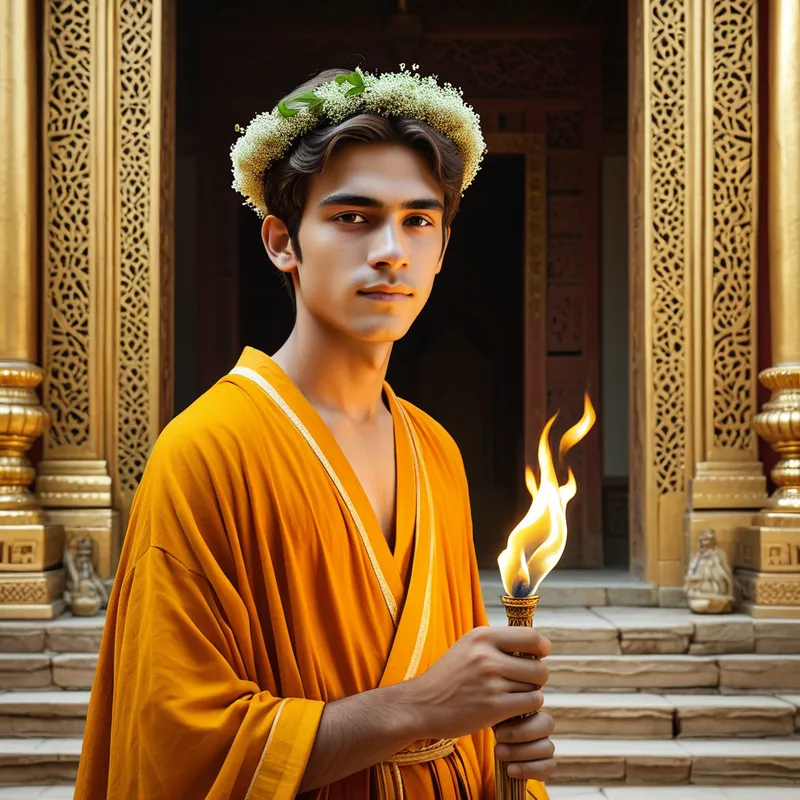
Hymenaios Myth Meaning & Symbolism
A mortal youth whose love and sacrifice transformed him into the divine, eternal spirit of the marriage hymn and the sacred wedding threshold.
The Tale of Hymenaios
Listen, and hear the song that is sung not with lyre, but with the very pulse of life. In the sun-blessed land of Attica, where the olive trees whisper ancient secrets, there lived a youth of surpassing beauty. His name was Hymenaios. He was not born of Zeus or Aphrodite, but of mortal blood, and his beauty was such that many mistook him for Eros himself. Yet his heart held a different fire—not the fleeting spark of passion, but the steady, consuming flame of a single, devoted love.
He loved a maiden of Athens, a daughter of the city, with a purity that was both his grace and his torment. For in the eyes of her family, he was unworthy; a youth of no great house, his wealth measured only in the depth of his feeling. He followed her at festivals, a shadow of longing, his voice joining the choruses in hopes she might hear the truth woven within the melody.
Then came the day of the great procession to Eleusis. The maidens of Athens walked in solemn grace, his beloved among them. As the sun began to sink, painting the sky in hues of sorrow, disaster struck from the wine-dark sea. Pirates, hearts hardened by salt and greed, descended upon the shore. Their shouts shattered the sacred peace; their rough hands seized the screaming maidens, his love foremost among them, and dragged them toward their waiting ship.
From his hiding place among the rocks, Hymenaios watched his world being stolen. Terror froze his limbs, but love, a force more ancient and terrible than the sea itself, melted the ice. Shedding his cloak, he cut his hair short in the manner of a bridegroom, and with a face now set in grim resolution, he ran. Not away, but toward the violence. He reached the ship as the last gangplank was hauled aboard. With a cry that was part plea, part command, he leapt.
He landed on the deck, a single, defiant figure amidst the brutish crew. He did not draw a weapon he did not possess. Instead, he offered himself. “Take me,” he said, his voice steady over the crash of waves. “Take me in her place. Let my hands be bound by your ropes, let my life answer for hers. Or take me as your slave beside her, for where she goes, I must follow.” The pirates, stunned by this madness, this absolute surrender, laughed—a harsh, barking sound. But something in his eyes, a light that refused to be extinguished, gave them pause. Perhaps they saw an omen, or perhaps simple curiosity stayed their knives. They took them both.
On the voyage, Hymenaios was a ghost of devotion. He tended to his beloved, shielding her from sight and scorn. And when the ship made landfall in a distant, barbarous port, he saw his chance. While the pirates drank themselves into a stupor, celebrating their haul, he moved with a silence born of desperation. One by one, he slew them where they lay, his weapon not strength, but the focused, terrifying will of love protecting its own. He freed the maidens, seized the ship, and turned its prow toward the only star he knew: home.
When the ship sailed into the harbor of Piraeus, a miracle was witnessed. Not just the return of the lost daughters, but the transformation of the one who brought them. As Hymenaios led his beloved ashore, the people saw not a blood-stained youth, but a figure illuminated. His love, tested in the crucible of sacrifice and violent redemption, had burned away the mortal dross. In that moment of reunion, as families wept and embraced, a hymn arose from the crowd—not a planned song, but a spontaneous cry of joy and relief. And Hymenaios’s voice led it, clear and divine.
From that day, no marriage in Athens was solemnized without the ritual invocation of his name. The mortal youth was gone, ascended. In his place stood Hymenaios, the god of the marriage threshold, his face forever young, his hand forever holding the torch that lights the way from one state of being to another.

Cultural Origins & Context
The myth of Hymenaios is not preserved in a single, canonical epic like those of Achilles or Odysseus. Instead, it flutters at the edges of greater tales, found in the fragments of lost poets like Theocritus and the compilations of later mythographers. His story was carried not by rhapsodes on the epic stage, but woven into the very fabric of social ritual. He was invoked, literally, at every wedding.
His primary function was liturgical. The cry “Hymen o Hymenaios!” was the essential refrain of the hymenaios, the processional song that escorted the bride from her father’s house to her new home. This was not mere decoration; it was a magical and religious act. By calling upon the god who was once a mortal who achieved a perfect union through trial, the community participated in a sympathetic ritual. They were not just celebrating a marriage; they were re-enacting the archetypal pattern of peril, devotion, and successful transition, thereby hoping to ensure its outcome for the couple.
This myth served a profound societal purpose in a culture where marriage was less about romantic love and more about social alliance, the transfer of property (proix), and the production of legitimate heirs. The story of Hymenaios injected the dangerous, unpredictable, and utterly necessary element of personal devotion into this contractual framework. It reminded all that the legal and social threshold being crossed was also a psychological and spiritual one, fraught with potential peril but capable of yielding divine reward.
Symbolic Architecture
Hymenaios is the god of the limen—the sacred threshold. He does not represent married life itself, which is the domain of Hestia and Hera. He is the spirit of the moment of crossing. His myth encapsulates the core alchemy of any true union: it requires a death of the old self.
The torch he carries lights the way forward, but its flame must first consume what came before.
His mortal journey is a map of this psychic process. His initial state is one of unrequited love—a longing without form or fulfillment. The pirate abduction represents the violent rupture necessary for transformation; the old, safe, but infertile world is shattered. His voluntary enslavement is the ultimate sacrifice of the ego. He offers his very freedom and identity for the sake of the connection. The slaughter of the pirates is not glorified violence, but the necessary, fierce action one must take to destroy the internal “pirates”—the fears, societal constraints, and internalized doubts—that hold the beloved (the potential for union) captive.
His apotheosis upon return signifies that the one who crosses the threshold is not the same as the one who approached it. The mortal lover “dies,” and the divine principle of Union itself is born. His androgynous beauty is key; he transcends gendered roles to represent the conjunctio, the sacred marriage of opposites within a single form.
The Dreamer's Resonance
When the archetype of Hymenaios stirs in the modern unconscious, it seldom appears as a clear figure. Instead, one dreams of thresholds: standing before immense doors that are both inviting and terrifying, of being in a procession one cannot leave, or of making a desperate, non-negotiable bargain for someone or something’s safety.
Somatically, this may manifest as a tightness in the chest—the feeling of the “bridal chamber” being both a sanctuary and a cage. There may be dreams of losing one’s voice or, conversely, finding one’s voice in a song that changes reality. These dreams often cluster around life transitions far beyond literal marriage: committing to a creative project, integrating a shadow aspect of the self, or forging a deep partnership of any kind. The psyche is signaling that you are at a liminal point. The dream of the pirate ship is the psyche’s recognition that this commitment feels like a kidnapping of your old autonomy; the dream of lighting a torch in darkness is the nascent courage to proceed anyway.
The emotional tone is typically mixed—a profound, aching love intertwined with a deep, sacrificial sorrow. This is the authentic feeling of true psychological union. It is not pure bliss, but the solemn, awe-full recognition that to gain everything, something of the isolated self must be willingly given up.

Alchemical Translation
The individuation process, the journey toward psychic wholeness, is a series of inner marriages. We must court and wed the neglected parts of ourselves—the anima or animus, the shadow, the divine child. The myth of Hymenaios provides the precise ritual for this internal ceremony.
First, one must identify the “beloved”—not a person, but the lost, golden potential within. This is the creative calling, the repressed passion, the un-lived life that we admire from a distance but feel unworthy to claim. Then comes the necessary rupture. The comfortable, familiar psyche (Athens) is invaded by disruptive, often painful forces (the pirates)—a crisis, a depression, a failure—that forcibly carries the beloved potential away into the unconscious (the distant sea). The ego is presented with a choice: cling to safety and mourn the loss, or pursue.
The alchemical work begins not with pursuit, but with the shocking, humble offer of the ego to be enslaved to the process of recovery.
The sacrificial offer is the critical stage. The conscious mind (Hymenaios) must agree to serve the deeper process, to be led by the needs of this inner union, even into the dark hold of the unconscious. The voyage and the slaughter represent the long, often obscure work of analysis, introspection, or creative struggle—confronting and dismantling the internalized “pirates” of parental complexes, societal expectations, and self-doubt that hold our wholeness hostage.
Finally, the return and apotheosis. When the work is done, the ego does not simply get its old wish. It is transformed. The personal longing for that specific creative work or integrated self becomes a permanent, divine function. The personal “I” who wanted to paint becomes the living principle of Creativity itself. The one who sought a partner becomes a vessel for the principle of Connection. The mortal goal is achieved, but in achieving it, the seeker dies and is reborn as the eternal spirit of the quest. This is the sacred marriage of the soul—not an end, but a everlasting beginning, forever standing at the threshold, torch in hand, singing the hymn of its own becoming.
Associated Symbols
Explore related symbols from the CaleaDream lexicon: