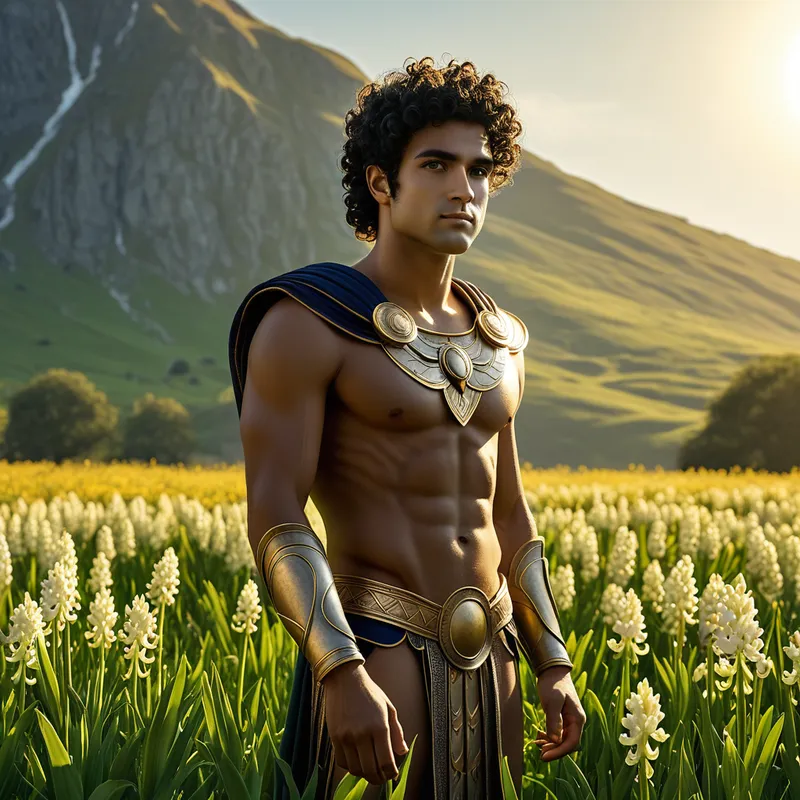
Hyacinthus Myth Meaning & Symbolism
A Spartan prince beloved by Apollo is accidentally slain, his spilled blood transformed into a flower bearing the god's cry of grief.
The Tale of Hyacinthus
Hear now the song of a beauty so piercing it drew the sun itself down from its chariot. In the land of Sparta, where the river Eurotas sang over smooth stones, there lived a prince. His name was Hyacinthus, and he was not merely handsome; he was a hymn made flesh. His form held the grace of a young deer, his laughter the clarity of spring water, and in his presence, the very light seemed to soften and adore.
It was this light, in its most potent form, that found him. Apollo, lord of the golden lyre, he who drives the sun-chariot across the dome of heaven, laid aside his radiance to walk as a man. He came to the grassy banks where Hyacinthus practiced with the discus, and in the youth’s effortless strength and vibrant joy, the god felt a longing deeper than any he had known on Olympus. A divine friendship was born, one of shared hunts, music that stilled the birds to listen, and a companionship that made the god forget his immortality.
But the gaze of heaven is never singular. From his cavern among the cliffs, Zephyrus, the west wind, watched. He too had loved the Spartan prince, his gentle breezes once caressing Hyacinthus’s hair. Now, he saw his affection ignored, eclipsed by the blinding favor of Apollo. Where once was a zephyr, a seed of bitter jealousy took root and grew into a gale.
On a day so perfect it ached—the sky a bowl of cerulean, the air sweet with thyme—Apollo and Hyacinthus went to the broad meadow for sport. To show his beloved the zenith of mortal and divine skill, Apollo took up the heavy bronze discus. He spun, a figure of perfect, coiled power, and let it fly. It tore through the air, a humming slice of sunlight, a testament to strength and love.
And Zephyrus, watching from his ridge, let his breath out in one sharp, vicious gust. It was not the gentle wind that guides ships, but the spiteful blast that wrecks them. The discus veered. The beautiful arc was shattered. It became a bolt, a tragic, unerring missile. It struck Hyacinthus a glancing blow on the temple, and the sound was not of metal on flesh, but of a vase shattering on marble.
The god was at his side in an instant, cradling the fading light of his world. He pressed his hands to the wound, his divine power, which could heal plagues and grant prophecies, flowing uselessly. The ichor of gods cannot restart a mortal heart. The life, that singular, irreplaceable beauty, seeped into the Spartan earth, as Apollo’s cries of “AI! AI!” rent the serene air.
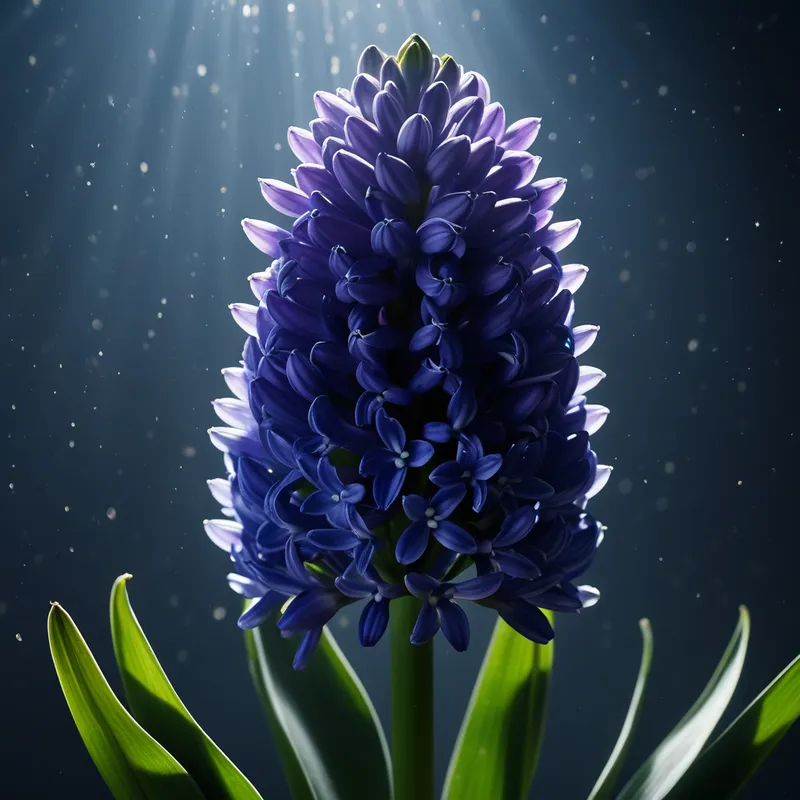
As the god wept, a miracle of grief occurred. Where the prince’s blood soaked the grass, where Apollo’s tears fell, the earth did not merely accept him; it transformed him. A slender stalk pushed forth, then another, until a cluster of exquisite flowers bloomed, their petals a deep, mournful purple or sanguine crimson. And upon those petals, as if inscribed by a god’s lament, were the very letters of his grief: AI AI. Apollo named the flower hyacinth, a living monument, a beauty born from a moment of ultimate loss.

Cultural Origins & Context
The myth of Hyacinthus is not a simple folktale but a foundational narrative deeply woven into the religious and social fabric of the ancient Greek world. Its primary teller was the poet Hesiod, and it was later elaborated by others like Ovid. The story was central to the Hyacinthia, a major three-day festival held in Sparta and Amyclae.
This festival performed a crucial societal function, embodying the complex Greek relationship with life, death, and the gods. The first day was one of profound mourning for Hyacinthus’s death, with dirges and offerings to the dead. The second day dramatically reversed this tone, becoming a joyous celebration of Apollo and Hyacinthus’s life, featuring music, dances, and a grand procession. This ritual structure served as a communal container for powerful, contradictory emotions—grief and joy, mortality and immortality, loss and renewal. It taught that beauty and sorrow are inextricably linked, and that from the most profound endings, new forms of remembrance and meaning can arise.
Symbolic Architecture
At its heart, the myth is a profound allegory of the collision between the eternal and the ephemeral. Hyacinthus represents the zenith of mortal beauty and potential—brilliant, captivating, and utterly fragile. Apollo embodies the divine realm: creative, luminous, and seeking connection with the vibrant, fleeting essence of life itself. Their union is the human aspiration to touch perfection and the divine desire to experience passionate, temporal love.
The flower is the alchemical vessel where mortal blood and divine tears undergo their sacred transformation; it is grief made beautiful, memory made perennial.
The true antagonist, Zephyrus, symbolizes the unconscious, shadowy forces of envy and possessiveness that can sabotage even the most sacred connections. His is not an evil act in a grand sense, but a petty, human one—the bitter wind that twists fate. The fatal discus, thrown by love and redirected by jealousy, becomes the instrument of tragic accident, representing how the best of intentions, when caught in the crosscurrents of unconscious emotion, can lead to destruction.
The hyacinth flower itself is the ultimate symbol. It is not a resurrection, but a transmutation. Hyacinthus does not return as himself; his essence is changed into a new form of life that carries the permanent stain—and story—of his passing. The letters AI AI are more than a cry; they are a sacred text written on nature, ensuring the lament and the love are never forgotten.
The Dreamer's Resonance
When this myth stirs in the modern unconscious, it often surfaces in dreams of poignant, doomed beauty or tragic accidents within moments of joy. To dream of a Hyacinthus figure—a radiant person, a project, a state of being that feels divinely inspired—is to encounter that part of the psyche which is brilliantly alive but acutely vulnerable. The dream may feature a sudden, shocking interruption: a falling object, a stray bullet, a car swerving inexplicably.
This represents a somatic and psychological process of confronting inevitable loss or the shattering of an ideal. The dreamer is not necessarily prophesying literal death, but working through the death of a hope, a relationship in its perfect form, or a phase of life characterized by innocent beauty. The emotional tone is one of piercing, unfair tragedy. The psyche is using this ancient pattern to process grief for something that felt eternal in its moment but was, by its nature, transient. It is the mind’s way of ritualizing a loss, moving it from private pain to the mythic realm where it can be witnessed and, ultimately, transformed.

Alchemical Translation
The individuation process modeled here is not one of heroic conquest, but of sacred mourning and creative sublimation. The modern seeker first experiences the “Apollo-Hyacinthus” phase: a connection to something that feels divinely inspired—a creative passion, a spiritual awakening, a profound love. This union brings the ego into alignment with a greater, luminous energy (the Self). But the psyche’s wholeness requires the inclusion of the shadow, the Zephyrus within.
The “accident” is the inevitable descent, the crisis, the failure, the betrayal, or the loss that shatters this perfect state. This is the nigredo, the blackening, of the alchemical process. The key is that Apollo—the conscious, creative principle—does not abandon the scene. He holds the dying form. He weeps. He engages fully with the grief.
Individuation requires the god to kneel in the mortal mud, to let his divine tears mix with human blood. The transformation happens not in spite of the grief, but within it.
The alchemical work is to not let the loss simply be a waste. It is to tend the ground where the blood fell. The “flower” that grows is the new creation born from this process: the book written after heartbreak, the compassion forged in pain, the new depth of character, the artwork that carries the stain of its origin. The letters “AI AI” etched on the petals are the acknowledgment, the story, the lesson learned that becomes part of the seeker’s eternal fabric. One does not “get over” such a loss; one learns to cultivate the unique, bittersweet, and beautiful flower that grows from its soil. The mortal part dies, but the essence is transmuted into a more complex, enduring, and meaningful form of life, achieving a different kind of immortality within the soul’s own landscape.
Associated Symbols
Explore related symbols from the CaleaDream lexicon: