Hushang and Fire Discovery Myth Meaning & Symbolism
The myth of the first Pishdadian king who, in a moment of divine accident, discovered fire, taming the primal world and founding human culture.
The Tale of Hushang and Fire Discovery
Hear now the tale of the dawn-time, when the world was young and raw, and humanity walked in the long shadow of the beasts. The air was thick with the scent of damp earth and untamed green, and the nights were a dominion of cold and fear, ruled by the yellow eyes that watched from the dark.
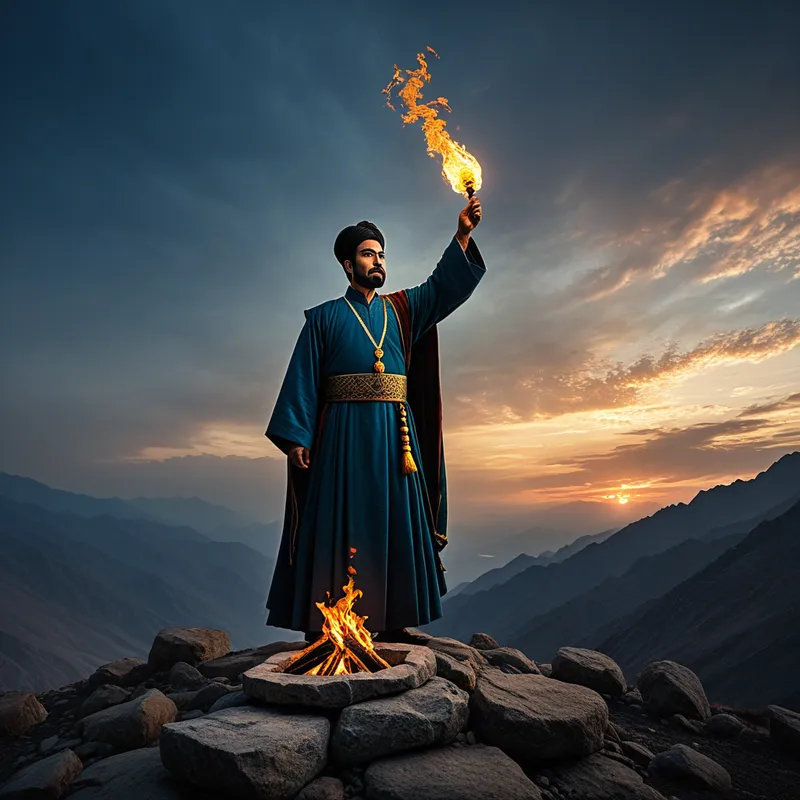
In those primal days, there ruled a king, the first of the Pishdadian. His name was Hushang, son of Gayomard, and his heart carried the weight of a people still trembling before the world. He was a hunter-king, his strength matched only by his watchful care for his tribe. One day, as the sun beat its golden hammer upon the stony shoulders of the mountains, Hushang led his people on a hunt. Their world was one of tooth and claw, of flight and pursuit, a great, breathing tapestry of instinct.
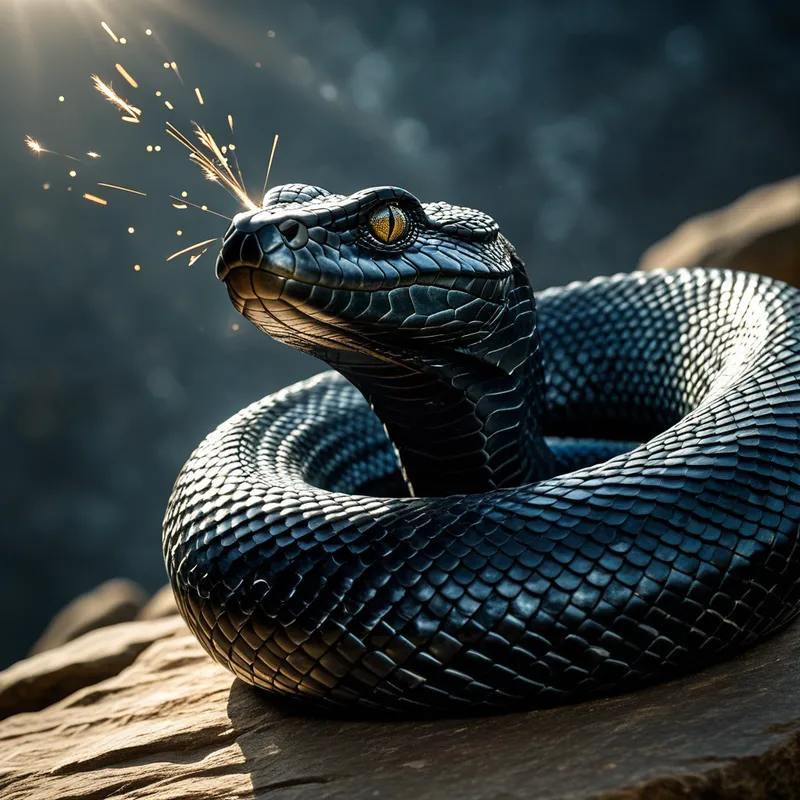
They climbed a rocky pass, where the stones were dark and sharp. Suddenly, from a crevice, a form uncoiled—a great, black serpent, a creature of the old, chthonic world. Its scales were like polished night, and its hiss was the sound of the earth itself warning them back. Fear seized the hunters. This was no ordinary beast; it was a manifestation of the untamed, chaotic wild that surrounded and pressed in upon their fragile order.
Hushang, protector of his people, did not flee. His kingly spirit flared. He bent his mighty strength, seized a heavy stone—a jagged piece of flint—and with a roar that echoed off the mountain walls, he hurled it at the glistening threat. His aim was true. The stone flew, a gray missile against the blue sky, but it did not strike the serpent’s head. It struck another stone on the ground with a crack that split the air.
And from that collision, a miracle was born.
Not blood, but light. A shower of brilliant, white-hot sparks erupted from the point of impact, cascading onto a patch of dry, sun-bleached grass. For a heartbeat, there was only the sharp, mineral scent of shattered rock. Then, a tiny, hungry tongue of flame caught. It flickered, tentative, then grew, feeding on the tinder, transforming it into a dancing, living thing of warmth and light.
The serpent, startled by the flash and crack, slithered away, vanquished not by violence, but by this new, terrifying wonder. The people fell silent, all hunt forgotten. They gathered, not around a slain beast, but around this new birth. They watched, mesmerized, as Hushang, his anger forgotten, knelt. He did not flee the flame. With careful hands, he fed it, nurtured it, built a hearth for it. He had sought to destroy one form of primal power, the serpent, and had accidentally called forth another, far greater: fire. The cold fear of the dark was met, for the first time, with a defiant, creative light.
Cultural Origins & Context
This foundational myth is preserved in the Shahnameh (The Book of Kings), composed by the poet Ferdowsi over a thousand years ago. Ferdowsi drew upon much older Zoroastrian and pre-Zoroastrian oral traditions, weaving the cosmic and the historical into a national epic. The story of Hushang is not mere folklore; it is a myth of origins, placed at the very beginning of human kingship and civilization.
In the Zoroastrian worldview, fire (Asha’s visible emblem) is sacred, the son of Ahura Mazda. Hushang’s discovery, therefore, is a divine gift, a moment of alignment with cosmic order. The myth was told to explain not just the practical use of fire, but the very transition of humanity from a state of nature to a state of culture. It served a societal function as a charter myth, legitimizing the role of the righteous king (Farr) as a civilizing force, a protector who brings the tools of mastery over chaos. It was a story told to gather around, literally and metaphorically, reinforcing the identity of a people as builders of order, not mere survivors in the wild.
Symbolic Architecture
The myth is a perfect symbolic drama of consciousness emerging from the unconscious. The Serpent represents the raw, instinctual, and potentially threatening energy of the undifferentiated psyche—the wildness within and without. Hushang, the Hero-king, represents the emerging ego, the part of the psyche that seeks to define, protect, and establish order.
The spark is not found by looking for light, but by courageously engaging with the dark.
The thrown stone is the forceful, directed action of consciousness. It is will applied to a perceived threat. But the psyche’s deepest treasures are not found through direct assault on the unconscious; they are revealed as by-products of that engagement. The Fire is the transformative symbol par excellence. It is the light of consciousness itself, the energy of culture, inspiration, and psychic transformation. It is the controlled power that replaces the uncontrolled threat (the serpent). Hushang’s subsequent actions—nurturing the flame, building a hearth—symbolize the crucial process of integrating this newfound energy into the structure of the psyche and society, moving from accidental discovery to conscious stewardship.

The Dreamer's Resonance
When this myth pattern stirs in the modern dreamer, it signals a profound moment of potential Individuation. To dream of confronting a serpent or a dense, threatening darkness, and then to discover or be startled by a sudden, illuminating fire, speaks to a somatic process of awakening.
Psychologically, the dreamer is in a state where an old, instinctual pattern (a fear, a rage, a primal anxiety—the serpent) has become too pressing to ignore. The ego feels compelled to act, to fight or flee. The discovery of fire in the dream indicates that the confrontation itself, however clumsy or fearful, has activated a latent potential. The dreamer is on the cusp of harnessing a previously unconscious energy—perhaps a creative drive, a clarified purpose, or a passionate truth—that can fundamentally alter their inner landscape. The somatic feeling is often one of sudden warmth, illumination, or awe following a spike of adrenaline or fear. It is the body registering the moment the psyche strikes its flint.
Alchemical Translation
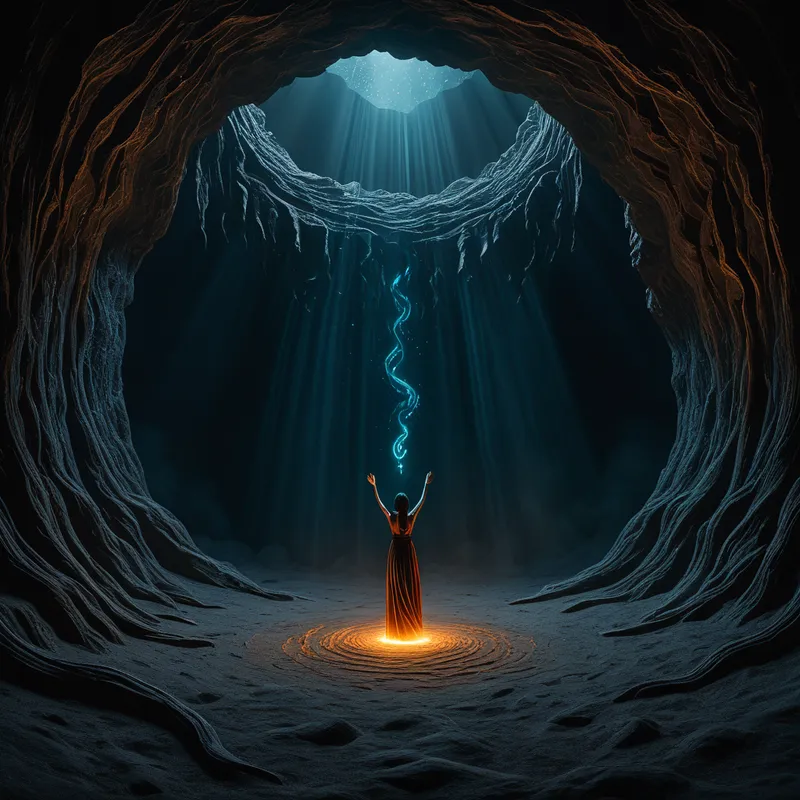
The alchemical journey mirrored in Hushang’s tale is the Nigredo giving way to the Albedo—the black chaos transforming into illuminating clarity. The initial state is one of identification with the primal, undifferentiated world (the massa confusa). The serpentine threat is the shadow content that forces the ego into action.
The first law of psychic alchemy is that the catalyst for transformation often wears the face of a monster.
The hurling of the stone is the separatio, the necessary but violent act of differentiation where consciousness asserts itself against the unconscious. The spark is the miraculous coniunctio, the sacred marriage of opposites (stone against stone, will against inertia) that produces a third, transcendent thing: the transformative spirit (fire). Hushang’s final act is the coagulatio: he does not let the fire rage wildly or burn out; he contains it, feeds it, makes it the center of a new order. For the modern individual, this models the full arc of psychological growth: confronting a deep, often frightening complex (the serpent), engaging with it through conscious effort (the thrown stone), accidentally accessing a liberating insight or energy (the fire), and then—critically—doing the work to integrate that energy into daily life, building a stable inner hearth where that transformative fire can safely burn, providing warmth, light, and the power to shape one’s world.
Associated Symbols
Explore related symbols from the CaleaDream lexicon:
- Fire — The core symbol of the myth, representing controlled transformative energy, the birth of consciousness, cultural foundation, and the sacred spark of Ahura Mazda.
- Serpent — The chthonic threat Hushang confronts, symbolizing the untamed unconscious, primal instinct, and the chaotic forces of nature that must be engaged to spur evolution.
- Stone — The flint rock Hushang throws, representing the tool of directed will, the catalyst of action, and the hard, enduring substance from which the spark of genius is struck.
- Hearth Fire — The nurtured and contained fire Hushang builds, symbolizing the civilized integration of wild energy, the center of community, safety, and sustained cultural warmth.
- Mountain — The setting of the discovery, representing the challenging terrain of the psyche, the place of trial and revelation, where one ascends to meet a transformative event.
- Discovery — The central action and theme, signifying the moment of accidental genius, the revelation of hidden potential, and the transition from ignorance to empowered knowledge.
- Hero — The archetype embodied by Hushang, representing the part of the self that ventures forth, confronts chaos, and returns with a boon for the greater community.
- Ritual Fire Pit — The structured, sacred space created around the fire, symbolizing the conscious, repeated practice of containing and honoring transformative energies.
- Flint Fire Starter — The essential tool of the myth, representing the combination of elements (stone, will, target) necessary to ignite the latent spark within the psyche.
- Fires of Creation — The cosmic implication of the discovered flame, linking Hushang’s act to the divine creative principle, the forging of order from chaos.
- Wildfire Resilience — The positive aspect of fire’s power referenced in the outcome, symbolizing the regenerative strength and new growth that follows a controlled, transformative burn.