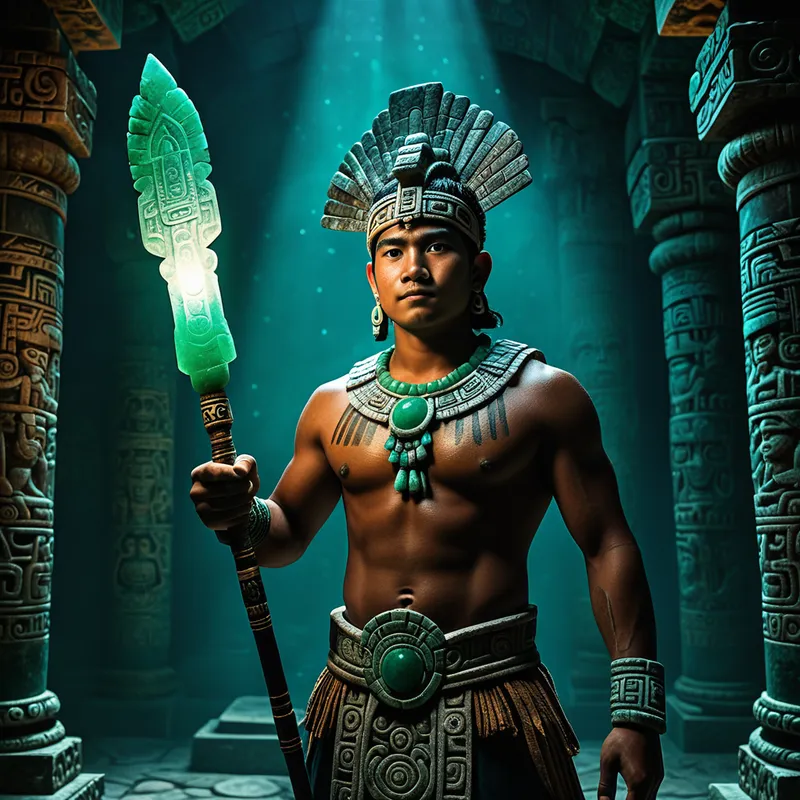
Hunahpu Myth Meaning & Symbolism
A Hero Twin descends into the underworld, defeats the Lords of Death through trickery and skill, and ascends to become the sun.
The Tale of Hunahpu
Listen. Before the sun and moon were fixed in the sky, when the world was young and shadowed, there was a game. The sound of the rubber ball, pok-ta-pok, echoed in the great stone courts, a sacred heartbeat. It was the sound that doomed the first players, Hun Hunahpu and his brother Vucub Hunahpu. Their play disturbed the Lords of Xibalba, the Place of Fright.
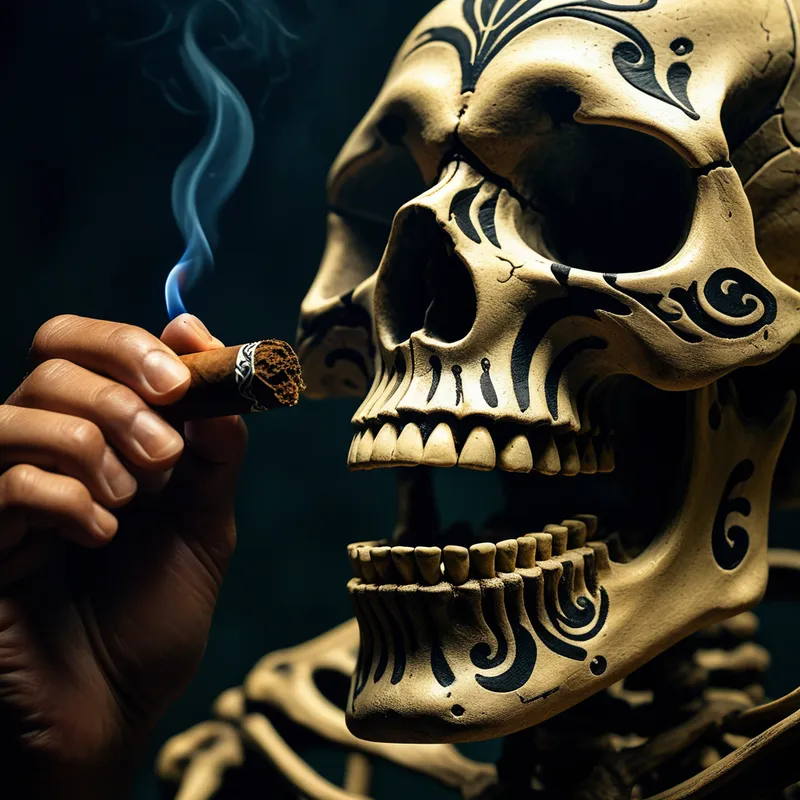
The Lords sent a summons, carved in darkness. The brothers descended the steep stairs into the underworld, passing rivers of blood and scorpions, their hearts brave but foolish. They failed the tests of the Lords—sitting on the burning hot stone, resisting the temptation of the offered cigars and torches. For their failure, they were sacrificed. The head of Hun Hunahpu was placed in the fork of a barren calabash tree.
And then, a miracle. The tree bore fruit. The skull of Hun Hunahpu spat into the hand of a maiden of Xibalba, Xquic. She conceived. Fleeing the wrath of her father, she ascended to the surface world, to the household of the mother goddess, where she gave birth to the Hero Twins: Hunahpu and Xbalanque.
The Twins grew, harassed by their jealous half-brothers, yet they flourished. They were masters of the wild, hunters with their blowguns. And they too heard the call of the ballgame. They took up their father's legacy and their fate. Deliberately, they played so loudly the Lords of Xibalba heard once more. Another summons came.
But these sons were not their fathers. Wise and cunning, they descended not as proud lords, but as tricksters. They sent a mosquito ahead to learn the true names of the Lords, unmasking their mannequin decoys. They survived the House of Gloom, the House of Knives, the House of Cold. They played the ballgame and, through ingenious deceit, allowed themselves to be defeated and sacrificed.
Their bones were ground and cast into a river. This was not an end, but a transformation. From the waters, they resurrected as catfish, then as poor, wandering beggars. In this guise, they returned to the courts of Xibalba as performers, masters of magic. They danced the dance of the sacrifice, killing and restoring each other to life. Enthralled, the Lords demanded to be part of this wonder. “Sacrifice us!” cried the greatest of them, Hun Came and Vucub Came.
The Twins obliged. But for the Lords of Death, there was no resurrection. The rule of fear was broken. The Twins then pronounced their judgment: the power of Xibalba would be diminished, its lords reduced to receiving only the refuse of the world. Then, the brothers ascended from the darkness. At the world’s edge, they rose into the sky—one becoming the sun, the other the moon—and finally, their father Hun Hunahpu was revived. The first true dawn broke over a world freed from the tyranny of meaningless death.
Cultural Origins & Context
This epic narrative is the heart of the Popol Vuh, the “Book of the Community.” It is not merely a story but a foundational charter, recorded in the 16th century by K’iche’ Maya scribes to preserve their cosmology in the face of colonial cataclysm. It was likely recited by trained keepers of tradition during ceremonies, its rhythm mirroring the sacred cycles of time it describes.
The myth functioned as an explanation of cosmic order—why the sun and moon move as they do, why maize is the substance of life, and why death, while present, is not the final word. It validated the sacred nature of the ballgame, pok-ta-pok, which was a ritual reenactment of this celestial struggle, a game where the movement of the ball represented the journey of the sun through the underworld and its triumphant return. The story served as a model of ideal kinship, cleverness over brute force, and the ultimate victory of cyclical life over static decay.
Symbolic Architecture
At its core, the journey of Hunahpu is an allegory of the seed. His father, the Maize God, is sacrificed, buried (in the tree), and gives rise to new life. The myth maps the agricultural cycle onto the human soul.
The underworld is not a place of punishment, but the necessary dark earth where the seed of consciousness must be buried to germinate.
Hunahpu and Xbalanque represent complementary psychic forces: focused, solar consciousness (Hunahpu the hunter) and intuitive, lunar cunning (Xbalanque the shapeshifter). Together, they form a complete psyche capable of navigating the unconscious. The Lords of Xibalba symbolize the autonomous, often terrifying complexes of the unconscious—our fears, obsessions, and inherited psychological patterns (“the fathers’ sins”) that demand sacrifice. The Twins do not defeat them through force, but through awareness (learning their true names) and integration. They allow themselves to be dismembered, their old identities ground down, to be reborn in a more fluid, authentic form.
The final act—becoming the celestial bodies—signifies the ultimate achievement: the illumination of the entire psychic landscape. The conscious mind (sun) and the unconscious (moon) are set in an eternal, life-giving dance.
The Dreamer's Resonance
When this myth stirs in modern dreams, it often announces a profound confrontation with the “underworld” of the psyche. You may dream of being lured into a complex game with impossible rules, of descending into basement labyrinths, or of facing a council of ominous, shadowy figures.
The somatic experience is one of initiatory pressure—a feeling of being tested, ground down, or dismembered. This can parallel life crises: the loss of a job, the end of a relationship, or a deep depression. The psyche is forcing a confrontation with its own Xibalba—the repressed material, the inherited traumas, the “lords” of fear and shame that rule from the shadows. The dream is not a prophecy of doom, but a signal that the heroic, integrative function of the Self is activating. It is a call to stop fleeing the darkness and, like the Twins, to descend with cunning and purpose, to learn the true names of your demons.
Alchemical Translation
The alchemical journey of the Popol Vuh is a perfect map of individuation. It begins with the nigredo, the blackening: the sacrifice of the fathers, the descent into Xibalba. This is the necessary dissolution of the old, naive ego.
The first death is literal; the second death is psychological—the end of who you thought you were.
The Twins’ journey through the deadly houses represents the albedo, the whitening—the series of ordeals that purify. Surviving the House of Cold is the development of emotional resilience; passing the House of Knives is the refinement of discernment. The grinding of their bones is the ultimate mortificatio, reducing the personality to its essential components.
Their resurrection as catfish and beggars is the citrinitas, the yellowing—the emergence of a new, humble, and fluid identity from the waters of the unconscious. Finally, their return as divine performers who master life and death symbolizes the rubedo, the reddening—the creation of the Philosopher’s Stone. This is the integrated Self, the conscious ego now in service to a greater totality, capable of transforming base experience (suffering, fear) into gold (meaning, wisdom). You are no longer played by the complexes; you perform them, understand them, and ultimately transcend them. You ascend not to escape the world, but to illuminate it, becoming a source of life-giving light where once there was only the sterile fear of the end.
Associated Symbols
Explore related symbols from the CaleaDream lexicon: