Huascar and Atahualpa Myth Meaning & Symbolism
A myth of the Sapa Inca's sons, whose catastrophic civil war shattered the Tawantinsuyu, mirroring the psyche's struggle between order and chaos.
The Tale of Huascar and Atahualpa
Listen. The cord is cut, the empire bleeds.
The Inti had smiled upon Huayna Capac, the great Sapa Inca. His realm, the Tawantinsuyu, stretched from the hummingbird valleys to the condor's crag, bound by stone roads and the sacred word. But a shadow, carried on the breath of strange men from the sea, touched him in the north. He died in Quito, far from the navel of the world, Cusco. And with his last breath, he did not speak one name, but two: Huascar, the son of the Coya, the queen of Cusco; and Atahualpa, the son of a Quitan princess, his favored warrior.
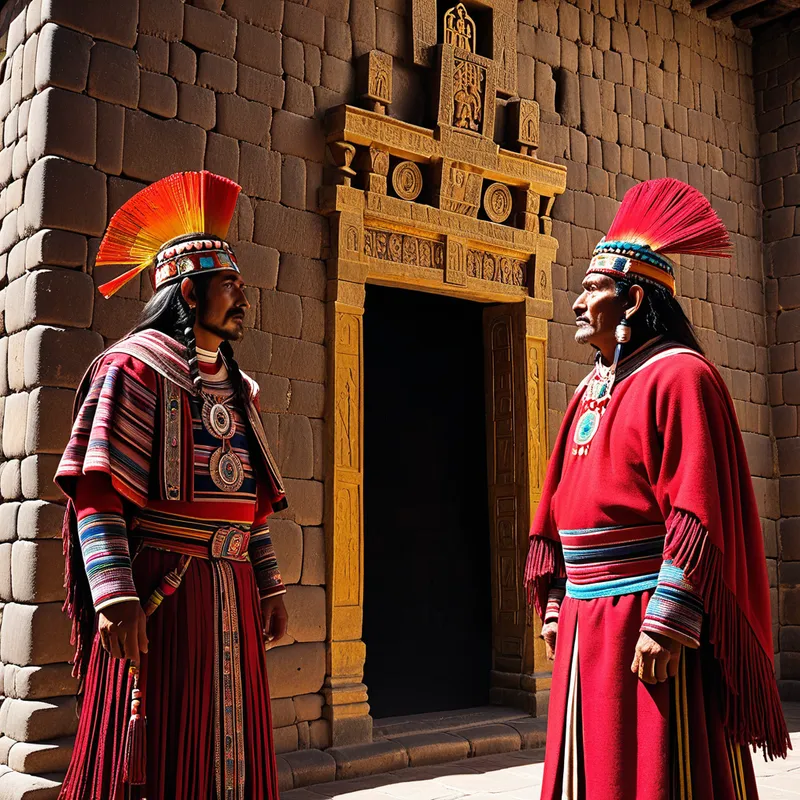
Huascar, in the Coricancha, felt the sun’s lineage solidify upon his brow. The crimson mascapaicha, the fringe of sovereignty, was placed. He was the center, the order, the keeper of the ancestors’ ways. The law was clear: one Sapa Inca, one lineage, one sun. Yet from the north, a rival sun rose. Atahualpa, raised in the camp, beloved by the battle-hardened generals of his father’s northern campaigns, saw not a brother on the throne, but a challenge unmet. He sent gifts—fine cloth, golden ornaments—but they were the gifts of a subject, and Huascar, sensing the insult in their perfection, cast them into the mud and demanded his brother’s presence.
The demand was a spark in a dry field. Atahualpa’s generals, Chalcuchimac and Quisquis, sharpened their spears. They whispered of a stronger lineage, of a king forged on the frontier, not softened in the temple. Huascar marshaled the armies of Cusco, the heartland’s sons. The first clash was not of armies, but of essence: the structured, ceremonial power of the center against the raw, adaptive will of the periphery.
War, the unthinkable sin against ayni, consumed the land. The battles were not mere fights; they were a rending of the cosmic fabric. Atahualpa’s forces, cunning and ruthless, swept south. They fought not just men, but the order itself. At the pivotal battle, they captured Huascar himself, dragging the Sapa Inca from his litter, stripping him of the sacred fringe. The tales say the very stones of Cusco wept when he was paraded in chains, the sun hiding its face in shame.
In his prison, Huascar was a ghost of order. Atahualpa, now the power in the land, held his brother’s life in his hands. But as Atahualpa savored his hard-won dominance, a new and unimaginable shadow fell across the beaches. Men with faces of moonlight and beards like moss arrived on floating mountains, bearing thunder and sickness. Atahualpa, the victor of the civil war, turned to face this omen. And in a final, bitter act to secure his throne against all claim, he gave the order. The messengers ran to Cusco. The sentence was carried out. Huascar, the last legitimate son of the sun in Cusco, was cast into the Andamarca River, his line extinguished. The cord of succession was severed. The empire, bled white by fraternal strife, now stood hollow, a magnificent body awaiting a foreign blade.
Cultural Origins & Context
This is not a myth from the deep, misty past, but a historical tragedy that crystallized into foundational myth almost as it happened. The conflict between Huascar and Atahualpa occurred on the eve of the Spanish conquest in the early 16th century. Its transmission is unique: it is the shattered origin story of the cataclysm itself, told by the surviving Inca nobility to Spanish chroniclers like Pedro Cieza de León and Garcilaso de la Vega.
Societally, the story functioned as a profound etiological narrative explaining the unthinkable: how the unassailable Tawantinsuyu fell. The answer lay not solely in Spanish steel or disease, but in a prior, internal sin. The war violated the core Inca principle of order and unity under the Sapa Inca. It was a catastrophic failure of ayni (reciprocity) at the highest level, a cosmic imbalance that left the world vulnerable to chaos. The story served as a warning about the dangers of dynastic discord and the sacred responsibility of the ruler to maintain harmony, lest the entire world-order collapse.
Symbolic Architecture
At its heart, this is not a story of good versus evil, but of a necessary wholeness torn asunder. Huascar and Atahualpa represent the split archetypal poles of the Ruler.
Huascar is the Principle of Order: the legitimate center, tradition, law, structure, and the sacred past. He is Cusco, the stable sun, the temple. His power is institutional and derives from his position within the cosmic hierarchy.
Atahualpa is the Principle of Force: the emergent will, pragmatism, the martial spirit, and the adaptive energy of the frontier. He is Quito, the ambitious shadow, the camp. His power is personal and derives from action and capability.
Psychologically, they are two halves of a complete sovereign psyche that have turned against each other. The conscious identity (Huascar, the recognized ego) is challenged by the shadow complex (Atahualpa, the unrecognized strength and ambition). The civil war is the psyche in a state of catastrophic civil war, where the ego’s rigid order is besieged by the shadow’s raw power, and neither can integrate the other. The resulting deadlock destroys the psyche’s capacity to respond to a new, external reality (the Spanish conquest).
The Dreamer's Resonance
When this myth plays out in the modern dreamscape, it manifests as profound inner conflict at the level of identity and authority. The dreamer may experience:
- Dreams of Fraternal Betrayal or War: Fighting with a sibling or a double who is both self and other. This is the psyche wrestling with a split in its own ruling principle.
- Dreams of a Hollow Victory: Achieving a long-sought goal (winning a battle, gaining a title) only to find it meaningless or immediately threatened by a new, overwhelming external force. This echoes Atahualpa’s empty triumph.
- Somatic Sense of Being "Hollowed Out": A feeling of internal civil war so draining it leaves the dreamer feeling like a vacant shell, a Cusco with no sun—the empire of the self laid waste by its own divided factions.
The psychological process is one of ego-shadow disintegration. The conscious self’s ordered world is under siege by repressed aspects of power, ambition, or instinct that it cannot legitimize. The dream signals that the current ruling attitude is unsustainable and that a costly, perhaps devastating, reorganization of psychic authority is underway.

Alchemical Translation
The alchemical process modeled here is the nigredo—the blackening, the putrefaction, the necessary death of an old, rigid order so that a new consciousness might eventually arise. The myth shows us the catastrophic result of failed integration.
The alchemical gold of the mature, individuated Ruler is not pure Huascar nor pure Atahualpa. It is the sovereign who can hold the temple and the camp, law and adaptation, legitimacy and potency, in a dynamic, conscious tension.
For the modern individual, the myth instructs through negative example. The "Huascar" within is our rigid identification with title, role, or "the right way." The "Atahualpa" within is our disowned ambition, our ruthless pragmatism, our shadow competence. The civil war begins when we exile Atahualpa to the frontier of our awareness, where he gathers strength and resentment. The conquest—the neurosis, the life crisis—occurs when this internal strife has exhausted us, making us vulnerable to external overwhelm.
The path of transmutation requires the terrifying act of recognizing the "brother" in the shadow. It means allowing the legitimate structure (Huascar) to be confronted and challenged by the raw, adaptive power (Atahualpa) before it leads to total war. The goal is not for one to obliterate the other, but for a dialogue that might have prevented the fall. The sacrifice demanded is the sacrifice of the ego’s absolute, unquestioned authority. Only through this death of the old, singular rule can a more complex, resilient, and integrated sovereignty of the self be born—a sovereignty that could potentially meet the conquistadors of fate not with a divided house, but with a whole spirit.
Associated Symbols
Explore related symbols from the CaleaDream lexicon:
- Crown — The mascapaicha fringe, representing legitimate sovereignty and cosmic order, becomes the ultimate prize in the fraternal war, its sanctity shattered by the conflict.
- Shadow — Atahualpa embodies the psychological shadow: the disowned, ambitious, and potent aspects of the royal self that rise up to challenge the conscious ego's rule.
- Blood — The spilled blood of Inca by Inca, representing the ultimate taboo broken, the catastrophic waste of inner resources, and the pollution of the familial and state body.
- Order — The principle embodied by Huascar and Cusco: structure, tradition, law, and the cosmic hierarchy whose collapse is the central tragedy of the myth.
- Chaos — The force unleashed by the war and represented by Atahualpa's martial rise; the disruptive, adaptive energy that destroys the old order but fails to establish a viable new one.
- Sacrifice — Huascar's execution is the final, futile sacrifice, an attempt to secure a throne that is already doomed, mirroring the psyche's sacrifice of its identity to a doomed pattern.
- River — The Andamarca River that receives Huascar's body, symbolizing the final, flowing away of legitimate order and the dissolution of the old lineage into the waters of time and chaos.
- Tower — The symbolic height of the Inca state and the ego's citadel, which is undermined from within by fraternal strife before it is assailed from without.
- Gold — The Incan Gold Nugget represents the divine legitimacy and immense value of the empire, which becomes a curse as brothers fight over it, attracting the covetous gaze of the foreign conqueror.
- Warrior — The archetype fully embodied by Atahualpa and his generals, representing the potent, martial aspect of the self that is necessary for defense but catastrophic when turned inward against the psyche's own center.
- Fate — The inescapable destiny set in motion by the split inheritance and the civil war, leading inexorably to the collapse before the conquest, a lesson on the consequences of internal fracture.
- Death — Not just physical death, but the death of an era, a world-order, and a way of being, making way for a painful and unknown rebirth.