House of Wisdom Myth Meaning & Symbolism
A luminous sanctuary where divine knowledge is gathered, guarded, and bestowed upon the worthy seeker in a timeless spiritual journey.
The Tale of House of Wisdom
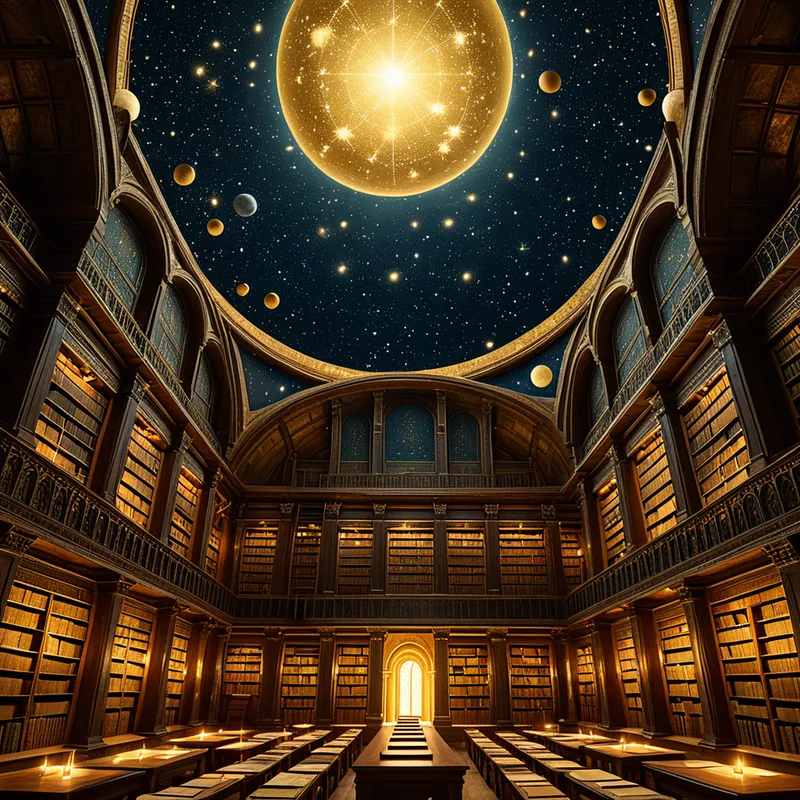
Listen, and let the veils of time grow thin. There is a place not found on any map drawn by mortal hand, a sanctuary woven from the first light of dawn and the silence between thoughts. It is the Bayt al-Hikmah, the House of Wisdom.
Its foundations were laid not with stone and mortar, but with the first question whispered by a human soul gazing at the stars. Its walls rose with every truth wrestled from the chaos of ignorance. Its domed ceiling is the very firmament, charted with constellations of understanding. Within, the air hums with the perfume of aged parchment, saffron ink, and something else—the scent of pure knowing.
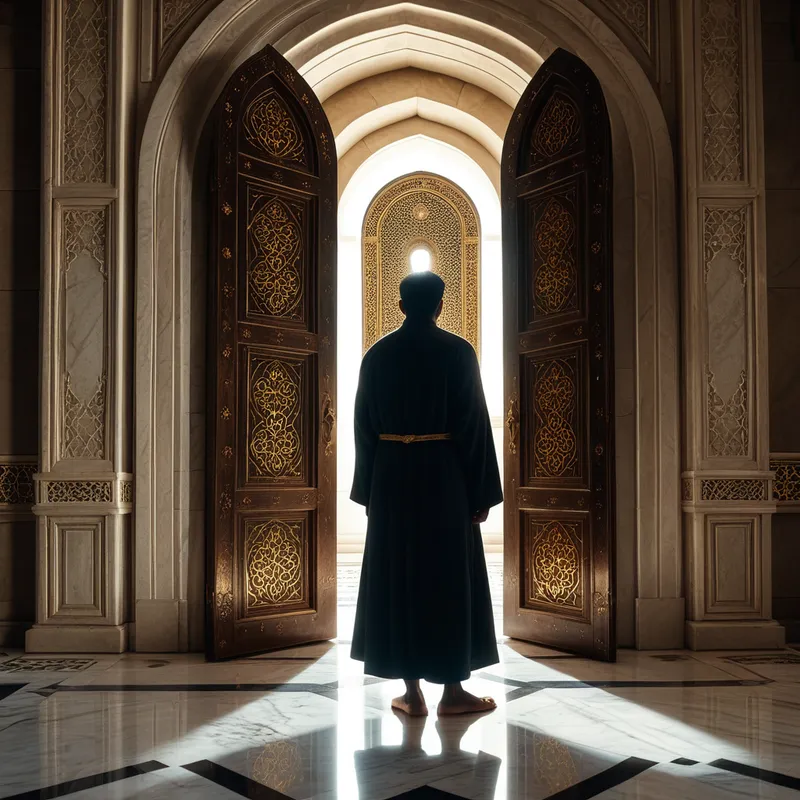
This is no silent tomb of books. Here, the Salik, the wayfarer, does not come to merely read, but to witness. The seeker arrives after a journey that has stripped them of certainty, their heart a hollow vessel ready to be filled. They stand before gates that are not locked, but which open only to the resonance of sincere intention.
Inside, light does not fall from windows but emanates from the knowledge itself. Scrolls glow with a soft, interior radiance. Astrolabes of impossible complexity turn of their own accord, tracing the orbits of hidden truths. The seeker wanders aisles that seem to rearrange themselves, presenting not what is sought, but what is needed.
The guardian of this place is not a stern figure with a sword, but the very atmosphere of profound reverence. The conflict is internal—the seeker’s own Nafs, the ego, clamors for ownership, for a single, definitive answer to clutch and possess. The House answers with a gentle, overwhelming plurality. To grasp one truth is to see ten more branches unfolding. The rising action is the quiet, terrifying dissolution of the self in an ocean of illumination.
The resolution is not an exit, but a transformation. The seeker does not leave with a scroll under their arm. They leave with their perception altered. The world outside the House is now seen as another volume in its infinite library—every leaf, every human face, every falling star is a line of sacred script. The seeker becomes a living page, inscribed by their journey, carrying a silent, luminous fragment of the House within their chest.
Cultural Origins & Context
The mythic House of Wisdom is a profound archetypal elaboration born from a historical jewel: the great Bayt al-Hikmah of Baghdad. Established in the 8th century during the Golden Age of Islam, this historical institution was a vibrant center for translation, scholarship, and the synthesis of knowledge from Greek, Persian, Indian, and other traditions. It was a tangible manifestation of the Quranic imperative to seek knowledge, “from the cradle to the grave.”
From this fertile historical ground, the mystical and philosophical imagination cultivated the myth. In the works of Sufis like Rumi and Ibn 'Arabi, and in the philosophical traditions of the Ikhwan al-Safa, the House transcended its physical walls. It became a metaphysical reality—the repository of al-Hikmah al-Ilahiyyah. It was passed down not as a single story, but as a pervasive motif in poetry, allegory, and spiritual discourse, serving to illustrate that the ultimate goal of learning is not information, but transformation and nearness to the Divine.
Symbolic Architecture
At its core, the House of Wisdom symbolizes the structured totality of the cosmos and the human psyche as a legible text authored by the Divine. It represents the ordered, intelligible universe (al-'Alam al-Shahadah) that points toward the unseen (al-Ghayb).
The seeker is the question that wanders the library of existence, and the House is the silent, all-encompassing Answer that rewrites the questioner.
The labyrinthine interior mirrors the structure of the mind and the cosmos—complex, interconnected, and seemingly infinite. The act of seeking within it is the journey of the intellect ('Aql) guided by the heart (Qalb). The key that opens its doors is not intellectual prowess alone, but the combined key of sincere intention (Ikhlas) and love (Ishq). Psychologically, it represents the anima mundi or the world soul—the objective psyche where all knowledge and archetypes reside, awaiting conscious engagement.
The Dreamer's Resonance
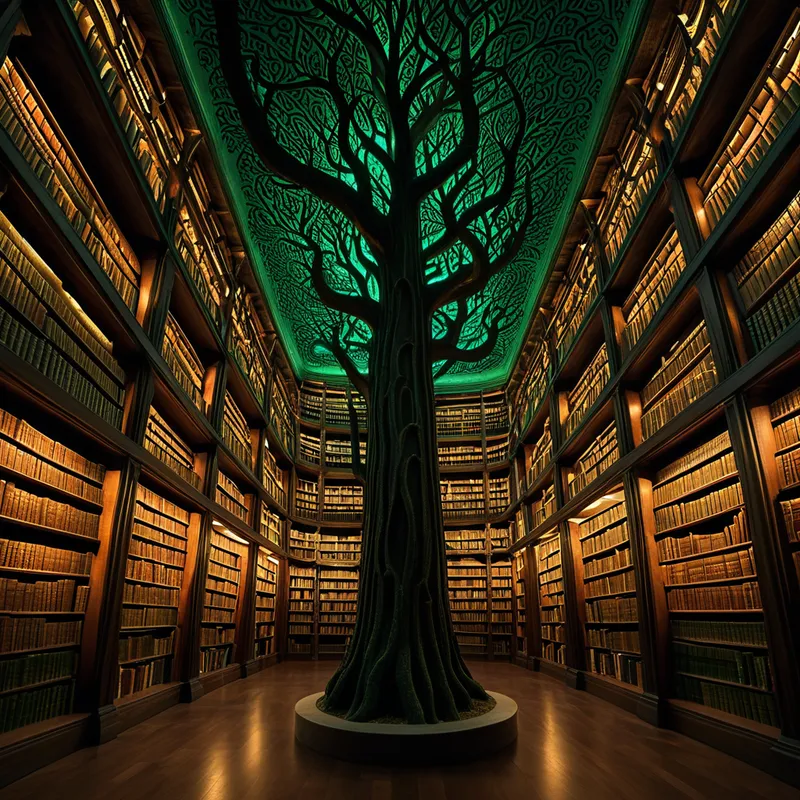
When this myth stirs in the modern dreamscape, it often manifests as dreams of vast, personal libraries, archives, or data centers. The dreamer may find themselves in a familiar yet impossibly large bookstore, a server room with endlessly scrolling code, or a museum containing artifacts of their own life.
The somatic feeling is one of awe mixed with anxiety—the thrill of potential discovery coupled with the dread of being overwhelmed or lost. This signals a psychological process where the conscious ego is being confronted by the sheer volume and complexity of the unconscious. The dreamer is at a threshold where accumulated life experiences, forgotten memories, and latent potentials are organizing themselves into a coherent, but daunting, internal structure. The dream is an invitation to stop seeking out there and begin the respectful, patient curation of the wisdom within.
Alchemical Translation
The myth models the alchemical opus of individuation—the process of forming a conscious relationship with the totality of the Self. The historical gathering of texts from diverse cultures parallels the psychological work of reclaiming and integrating disparate parts of the personality: the rejected, the foreign, the forgotten.
The alchemy occurs not in the acquisition of the book, but in the stillness required to hear its contents speak.
The initial journey to the House is the nigredo, the darkening, where one’s old knowledge proves insufficient. Wandering its halls is the albedo, the whitening, a purification through exposure to overwhelming truth without premature judgment. The internal conflict with the possessive Nafs al-Ammara is the crucial separatio, distinguishing the ego’s desire for ownership from the soul’s capacity for witness.
The resolution—becoming a living page—is the rubedo, the reddening or enlightenment. It signifies the birth of the Khidr within. The integrated individual no longer has wisdom as a possession; they embody it as a quality of being. Their consciousness itself becomes a localized House of Wisdom, a microcosm where the inner and outer worlds are seen as continuous expressions of a single, intelligible, and sacred reality. The quest ends where it began, but the seeker and the world are now forever, and gloriously, translated.
Associated Symbols
Explore related symbols from the CaleaDream lexicon: