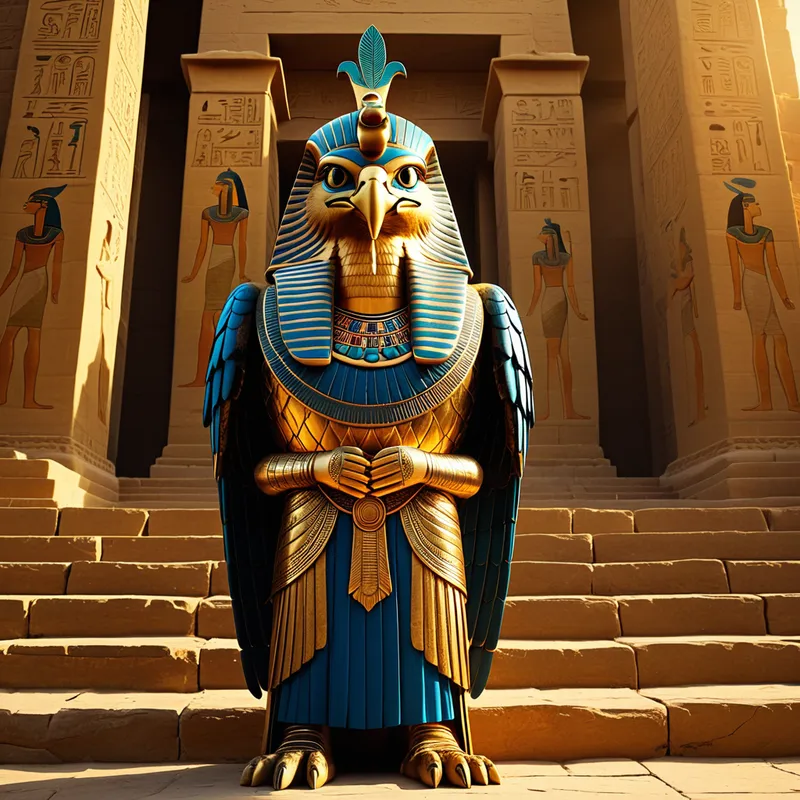
Horus Myth Meaning & Symbolism
The story of the falcon god Horus, who battles his uncle Set for the throne of Egypt, embodying the struggle for order, justice, and rightful inheritance.
The Tale of Horus
Hear now the tale of the Two Lands, a story painted on temple walls and whispered in the reeds of the Nile. It begins in darkness, with a throne empty and a sky weeping.
The great king Osiris, the Green One who taught men to sow, was betrayed. His brother Set, whose heart was a tempest and whose voice was thunder, crafted a box of scented cedar and ebony. With deceitful words, he invited Osiris to lie within it as a game. The moment the noble king reclined, Set slammed the lid shut, sealed it with molten lead, and cast it into the Nile’s cold embrace. The box floated out to the Great Green Sea, carrying the dead king to distant shores.
Isis, the Great of Magic, her wings beating with grief, searched the world. She found the casket entangled in the roots of a tamarisk tree that had grown into a mighty pillar in a foreign land. She brought her husband’s body back to the hidden marshes of the Delta. But Set, hunting by the light of a wicked moon, found them. With a roar, he dismembered Osiris into fourteen pieces, scattering them to the farthest nomes of Egypt.
Undeterred, Isis, with her sister Nephthys, searched again. They gathered every fragment save one, which was consumed by the Nile’s fish. Using her potent magic, Isis fanned the air with her wings, weaving a temporary resurrection. In that sacred moment of reunion, she conceived a son. A falcon of vengeance was seeded in the womb of sorrow.
In the hidden safety of the papyrus thickets, the child Horus was born. The air itself grew still to hear his first cry. Scorpions stood guard; the very reeds bent to hide him from Set’s jealous gaze. He was nursed on the milk of gods and fed on the knowledge of his mother’s spells. He grew not as a boy grows, but as a purpose grows: sharp, focused, and inevitable.
When his wings could blot out the sun, Horus emerged. He stood before the Ennead at Heliopolis, his voice the screech of a hunting raptor. “The throne of my father is mine by right. I am his living image, the seed that survived the storm.” Set, with a laugh like cracking stone, countered, “I am Strength itself! The throne belongs to power, not to a child hiding in the swamps.”
Thus began the great contention, a struggle that lasted eighty years. It was not one battle, but a cosmos of conflicts. They turned into hippopotami and wrestled in the muddy Nile, churning the waters to blood. They raced in stone boats, each trying to sink the other’s. In the most infamous clash, Set tore out the left eye of Horus—the Wedjat eye, the moon itself—and shattered it. But the cunning Thoth, the ibis-headed scribe of the gods, found the pieces. With spells of great healing, he made the eye whole again, stronger, seeing more than it ever had.
The gods were divided, weary of the endless strife. The earth groaned under their indecision. Finally, a letter arrived from the very depths of the Duat. It was from Osiris, speaking from his eternal kingdom. His message was a cold wind that silenced the hall: “Why should my son, the rightful heir, be barred while my murderer is judged? Without my son upon the throne, all your offerings are dust, and order itself will crumble.”
His words carried the final, undeniable weight of truth. The Ennead placed the Double Crown upon the head of Horus. He became Horus, Lord of the Two Lands, the living king on earth. As for Set, he was not destroyed. Bound and subdued, he was taken into the solar barque of Ra to serve as a defender, his chaotic strength harnessed to repel the serpent Apep. The restored Wedjat eye was offered to Osiris, completing the cycle of loss and return. And so Ma’at—truth, justice, cosmic order—was restored, balanced upon the wing of a falcon.
Cultural Origins & Context
The myth of Horus is not merely a story; it is the metaphysical blueprint for Egyptian kingship and statehood. Its origins are as ancient as the unification of Upper and Lower Egypt itself (c. 3100 BCE), where the victorious king was seen as the earthly embodiment of Horus, subduing the chaotic forces (represented by Set) that threatened the nation. The myth was the central narrative justifying pharaonic rule. Every living pharaoh was Horus; his deceased father was Osiris.
This story was not contained in a single, canonical text but was woven into a tapestry of sources: the Pyramid Texts, the Book of the Dead, temple reliefs at Edfu and Abydos, and later Greek accounts. It was performed in annual festivals and coronation rituals, making the myth a lived, enacted reality. The societal function was paramount: it explained the world order (Ma’at), validated the royal lineage, and illustrated the eternal struggle between fertile order (the Nile valley, Osiris/Horus) and chaotic disorder (the desert, Set).
Symbolic Architecture
At its heart, the myth is a profound drama of psychic integration. Horus represents the conscious, legitimate ego—the “rightful heir” to the throne of the self. Set is not simply an evil uncle; he is the embodiment of the necessary shadow, the untamed, disruptive, and potent psychic energy that challenges stagnant order.
The true throne is won not by banishing the shadow, but by wrestling it into a new form of service.
The mutilation and restoration of the Wedjat eye is the central symbol. The lost eye is the cost of engagement with the shadow—a piece of our naïve wholeness is shattered. Its restoration by Thoth (divine wisdom and magic) signifies that the reconstituted self sees more deeply; it gains insight (in-sight) through the wound. The offered eye to Osiris completes the cycle: the integrated consciousness (Horus) nourishes and validates the ancestral, foundational layer of the psyche (the personal and collective unconscious, Osiris).
The Dreamer's Resonance
When this myth stirs in modern dreams, it often manifests as a prolonged, exhausting conflict. The dreamer may find themselves in a decades-long legal battle, an unending competition with a sibling or rival, or a visceral, shape-shifting physical fight. The somatic feeling is one of righteous exhaustion—a fight that is necessary but depleting.
Psychologically, this signals a critical stage of differentiation. The dream-ego (Horus) is asserting its rightful place, its unique identity and purpose, against an internalized force (Set) that may represent a domineering parent, a societal expectation, or a raw, chaotic aspect of one’s own nature that has been projected onto an external “enemy.” The dream is the psyche’s arena for this essential, brutal, and ultimately integrative contest.

Alchemical Translation
The Horian struggle is a masterclass in the alchemy of individuation. It begins with the mortificatio: the murder and dismemberment of Osiris, the death of the old, perhaps naive, ruling principle (a former identity, a parental complex). From this decay, the new potential (Horus) is conceived in secret.
The long contention is the nigredo, the blackening—the dark, confusing, and painful stage of confronting the shadow (Set). This is not a battle to be won by annihilation, but by engagement. The goal is coagulatio, the coagulation of a new, more resilient form.
Individuation is the process of becoming the legitimate ruler of your own inner kingdom, which requires claiming your inheritance from the past while transforming the chaotic forces within into defenders of your sovereignty.
The restoration of the eye is the albedo, the whitening—the illumination and healing that comes from applying wisdom (Thoth) to the wounds of conflict. Finally, the crowning of Horus and the integration of Set into the solar barque represent the rubedo, the reddening or culmination. The conscious self is firmly established on the throne, and the once-destructive shadow energy is redeemed, harnessed as a vital force (defending against total chaos, Apep) within a larger, ordered psychic system. The modern individual undergoing this process moves from being a hidden child of potential to a sovereign adult, capable of wielding both order and creative chaos in the service of their wholeness.
Associated Symbols
Explore related symbols from the CaleaDream lexicon: