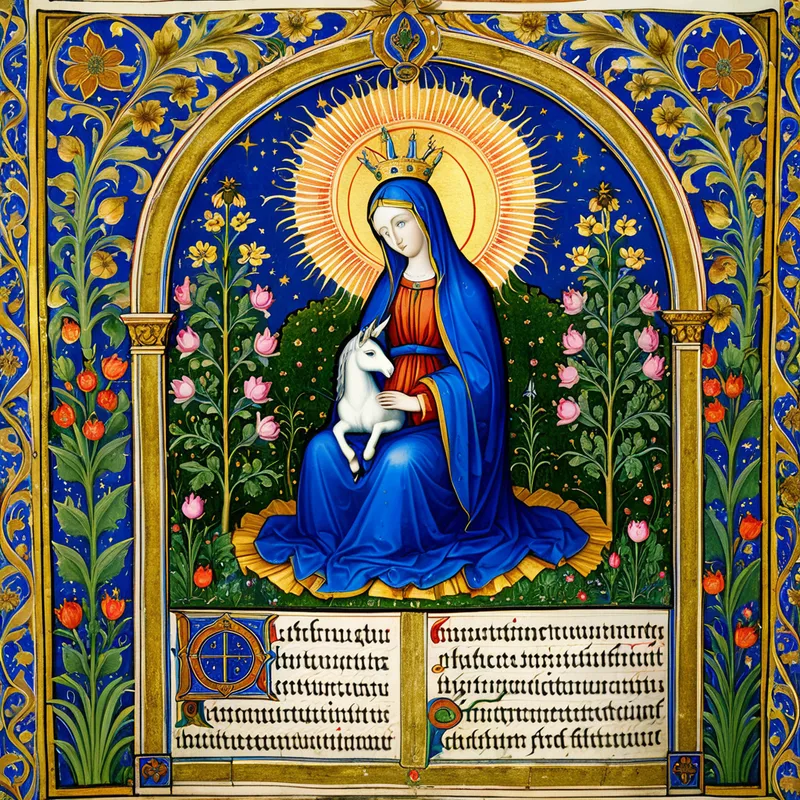
Hortus Conclusus Myth Meaning & Symbolism
A sacred, sealed garden symbolizing the inviolate soul, divine conception, and the alchemical vessel where the self is made whole through a profound, inward marriage.
The Tale of Hortus Conclusus
Listen, and let the walls of the world grow thin. There is a garden that was planted not by human hand, but by a sigh of the divine. It is a place of impossible geometry, a perfect square of fertile earth bounded by a wall of ancient, silent stone. No gate mars its continuity; no path leads to its threshold. It is the Hortus Conclusus, and it exists outside of time, bathed in a perpetual, gentle sun that knows no setting.
Within, the air is thick with the scent of mysteries. Lilies stand like silent sentinels, their white bells holding echoes of angelic annunciations. Roses, crimson and white, climb the inner face of the wall, their thorns a promise of fierce protection. A fountain sings at the garden's heart, its waters clear as thought, springing from a source unseen, watering the roots of a cedar tree that reaches for a sky only it can see.
This garden is not empty. She is there, seated on a low bench of emerald moss. She is the Custodian, the living soul of the place. Her gaze is turned inward, listening to the fountain's song, the hum of bees among the clover, the rustle of leaves that speak an old, green language. She tends no plot, for the garden tends itself; her presence is the tending. She is the stillness at the center, the fertile void awaiting a word.
The conflict here is not of clashing swords, but of profound potential. It is the tension of the sealed vessel, the charged silence before the first note of a sacred hymn. The world outside—a realm of scattering, of division, of endless seeking—presses against the wall, but finds no purchase. The garden’s defense is its perfect integrity; its loneliness is its fullness.
Then, the resolution arrives not as an invasion, but as a permeation. A light descends, not from the sun, but from a point within and beyond the garden itself. It is a golden ray, subtle as a thought, that touches the crown of the cedar, glints on the fountain's spray, and comes to rest upon the Custodian. It is the Spiritus, the divine breath. In this moment, the enclosure is not breached, but fulfilled. The garden, already whole, receives its meaning. The fountain’s song rises in pitch; the roses bloom with sudden, impossible fragrance. Conception occurs—not of flesh alone, but of a cosmos within a wall. The garden remains sealed, yet now it contains everything. The marriage of heaven and earth has been solemnized in the most secret of chapels, and the fruit of that union begins its silent, inevitable growth in the sheltered dark.
Cultural Origins & Context
The Hortus Conclusus is not a myth with a single narrative, but a potent symbolic image that blossomed in the fertile soil of medieval Christian thought, particularly from the 12th century onward. Its primary textual root is the Song of Songs (4:12): "A garden locked is my sister, my bride, a spring locked, a fountain sealed." Medieval theologians, employing allegorical interpretation, saw in this passionate poetry a prefiguration of the Virgin Mary—her perpetual virginity, her soul as the inviolate vessel for the divine.
This symbol was propagated not by bards, but by scholars, mystics, and artists. It became a central icon in Marian altarpieces and Books of Hours, owned by nobility and the rising merchant class. Its societal function was multifaceted: it was a doctrinal illustration of a theological mystery (the virgin birth), a focus for contemplative prayer, and an idealized model of feminine purity and sacred space in a world often perceived as chaotic and profane. The walled garden became a visual and conceptual anchor, a map of the soul's ideal state—protected, fertile, and awaiting divine grace.
Symbolic Architecture
The symbolic power of the Hortus Conclusus is an architecture of paradox. It represents the ultimate temenos, a sacred precinct.
The most profound growth requires an inviolate boundary. The soul, to become itself, must first become an island.
The wall is not a prison, but the definition of the self. It signifies distinction, autonomy, and the necessary separation from the collective and the chaotic unconscious that must precede any true integration. The sealed fountain within represents the soul's own deep, undisrupted wellspring of life and creativity, protected from pollution and dissipation.
The Custodian (Mary, in the explicit tradition) symbolizes the ego or the conscious self in its most perfected, receptive state. She is not actively searching outwardly, but maintaining the inner space, practicing a via negativa—a knowing through stillness. The divine permeation represents the irruption of the Self (in the Jungian sense), the transcendent function, or the numinous archetype of the divine into the prepared human vessel. The garden's fertility signifies the psychic product of this union: the birth of the "divine child" archetype, which is the nascent, whole personality, the potential for a new consciousness.
The Dreamer's Resonance
When the Hortus Conclusus appears in modern dreams, it rarely comes with medieval iconography. Instead, the dreamer may find themselves within a strangely peaceful, walled backyard they never knew their house possessed; discover a locked, overgrown greenhouse full of vibrant life; or stand before a formidable, beautiful gate in a hedge, knowing something essential lies beyond but feeling no need to enter.
This dream image signals a critical phase of enclosure in the individuation process. Psychologically, the dreamer is likely establishing healthy boundaries, retreating from the demands of the outer world to cultivate an inner life. Somatically, it can correlate with a sense of gathering energy, of pulling one's vital forces inward for protection and gestation. The emotion is often one of deep, quiet calm tinged with anticipation—not the anxiety of imprisonment, but the peace of intentional solitude. It is the psyche building its vas hermeticum, its alchemical vessel, for a coming transformation. The conflict felt is the tension between this necessary withdrawal and the external pressure to remain engaged and scattered.
Alchemical Translation
The myth of the Hortus Conclusus is a perfect map for the alchemical opus, the work of psychic transmutation. The entire garden is the Hermetic Vessel.
The first stage, nigredo (blackening), is implied in the very act of enclosure—the separation from the familiar, the facing of one's own solitude. The cultivation within the walls is the albedo (whitening), the purification and meticulous ordering of complex psychic contents—emotions, thoughts, memories—symbolized by the careful arrangement of symbolic flora. The Custodian's receptive stillness is the essential work of mortificatio, the dying to the outer world to live for the inner.
Individuation is not an expansion into everything, but a deepening into one thing: the authentic self. The sealed garden teaches that the universal is found only at the center of the particular.
The divine influx is the coniunctio oppositorum (conjunction of opposites)—the sacred marriage of the human and the transpersonal, consciousness and the unconscious. This sparks the rubedo (reddening), the final stage, symbolized by the blooming roses and the conceived divine child: the birth of a living, embodied wisdom, a personality that is both fully human and paradoxically connected to the eternal. The garden remains "conclusus," for the true self, once realized, is a coherent, self-sustaining system. It does not collapse back into the world; it relates to the world from a place of unassailable, fertile wholeness. The modern individual's journey is thus modeled: one must build the wall, tend the inner space, wait in faithful silence, and ultimately allow the transformative union to occur from within, bearing fruit that nourishes both the soul and the world it now engages with from a place of centered power.
Associated Symbols
Explore related symbols from the CaleaDream lexicon: