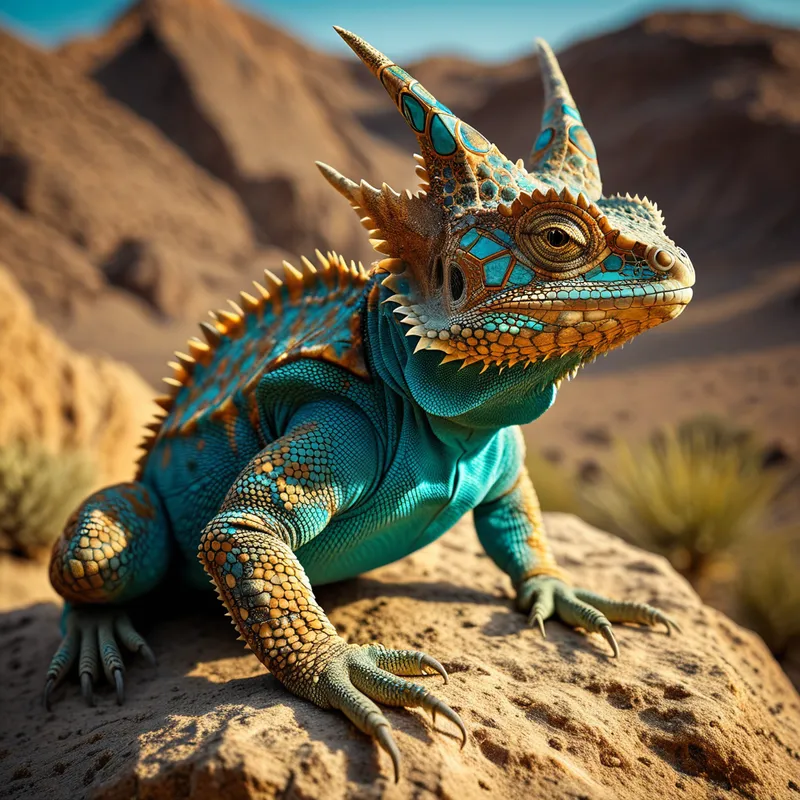
Horned Lizard Myth Meaning & Symbolism
A myth where a small, clever lizard outwits a powerful, arrogant monster, teaching that true strength lies in wit and adaptation, not brute force.
The Tale of Horned Lizard
In the time before time, when the world was still soft and the sun was a young, fierce hunter, there lived a creature of terrible power. He was Piasa, the Devourer of All. His wings blotted out the sun, casting the land into a cold, trembling shadow. His cry was the sound of cracking bones, and his hunger was a bottomless canyon. The People and the animals alike lived in fear, for Piasa demanded tribute, and his tribute was life itself.
In this world of giants and terror, there lived a being so small he was often overlooked. This was Horned Lizard. He was the color of the red earth, a speck upon the vast, sun-scorched plain. While others had strength or speed, Horned Lizard had patience. He knew the intimate secrets of the land: the coolness under a stone, the path of the tiniest ant, the whisper of the wind shifting direction. He watched as Piasa’s shadow grew longer, as the cries of the taken echoed across the mesas.
One day, the shadow fell upon Horned Lizard’s own family. The great wind from Piasa’s wings stirred the dust, and the Devourer’s eye, cold and yellow as a dying sun, fixed upon them. Horned Lizard’s heart, small but fierce, drummed against his ribs. He did not roar. He did not flee. He stood his ground upon his warm rock and spoke, his voice a dry rustle like shifting pebbles.
“Great Piasa,” he said. “Before you take us, grant me one boon. A contest. If I win, you leave this land forever. If you win, we are yours.”
Piasa let out a sound that was half-laugh, half-screech, shaking the cacti. “You? A speck! Contest what? I can crush you with a breath.”
“A contest of seeing,” whispered Horned Lizard. “You who see from so high, tell me. What do I hold in my mouth?”
Piasa swooped lower, his vast head tilting. He saw only the tiny, closed mouth of the lizard. He peered, his vision sharp enough to spot a rabbit from a mile away, but he could not see inside. Arrogance swelled within him. “It is nothing! You hold only air and trickery!”
Horned Lizard opened his mouth. Upon his tongue rested a single, perfect flake of obsidian, blacker than the void between stars, reflecting the terrified face of the giant bird. “I hold a piece of the night itself,” said the lizard. “You who see all, saw only what you expected to see. You have lost.”
A rage hotter than the desert core filled Piasa. He shrieked, vowing to devour the lizard anyway, to break the pact. But as he dove, Horned Lizard did the only thing he could. He did not run toward shelter, but toward the Devourer. He scrambled into the vast, cavernous shadow of the onrushing beak, and with a final, desperate act, he leapt into the monster’s gaping nostril.
Inside, it was a world of thunderous breath and damp darkness. Piasa roared, shaking the sky, trying to dislodge the tiny irritant. Horned Lizard crawled deeper, into the sacred, vulnerable passages of the giant’s head. And there, in the resonant chamber near the brain, he began to sing. He sang the song of the small things: the song of the growing root, the song of the patient stone, the song of the enduring earth. It was a song Piasa had never heard, a vibration that filled his skull, not with pain, but with a terrifying, unfamiliar truth—the truth of his own fragile place in the web.
Maddened by this internal, unconquerable music, Piasa flew higher and higher, trying to escape the sound inside his own head, until he vanished beyond the highest clouds, never to cast his shadow on the land again. Horned Lizard, covered in the dust of that epic journey, crawled out from the monster’s discarded skull, which had fallen to earth as a new mountain range. He returned to his sun-warmed rock, smaller than ever, yet having remade the world.

Cultural Origins & Context
The myth of Horned Lizard finds its roots among various Pueblo and Southwestern tribes, including the Hopi and other desert-dwelling peoples. It is a classic “trickster tale” and a “monster-slayer” story, though the slaying here is achieved not by force but by ingenious psychological invasion. These stories were not mere entertainment; they were foundational teaching narratives, told by elders around fires during the long desert nights.
The societal function was multifaceted. For a people living in a harsh, arid environment where large predators and existential threats were a reality, the story validated the power of intellect, local knowledge, and spiritual cunning over brute strength. It taught children that size is not synonymous with power, and that the overlooked being—much like the community itself in the face of drought or conflict—could prevail through cleverness and an intimate connection with its environment. The storyteller’s voice, imitating the dry rustle of the lizard and the terrifying shriek of Piasa, served as a visceral, oral map of the world’s dangers and its hidden strategies for survival.
Symbolic Architecture
At its core, the myth is an allegory of consciousness confronting the unconscious shadow. Piasa represents the archetypal Devouring Father or the Tyrannical Spirit—that which demands total sacrifice, feeds on fear, and operates through overwhelming, non-negotiable force. He is the inflated ego, the unchecked hunger, the trauma so large it blots out the sun of awareness.
The greatest monster is often the one whose shadow we have allowed to grow so vast it seems to be the only reality.
Horned Lizard symbolizes the emergent Ego-Self, but in its most humble, grounded form. His horns are not for goring, but perhaps for channeling—a connection to subtle energies and truths. His power lies in his position: close to the earth, patient, observant. He does not oppose the monster on its own terms (a battle of size and strength) but changes the paradigm entirely. The contest of “seeing” is a contest of perception versus projection. Piasa projects his own reality (“it is nothing”) and loses. The lizard’s victory is the victory of precise, inner knowing over arrogant, outer assumption.
The most profound alchemical act is the lizard’s entry into the monster’s head. This is the ultimate act of “individuation”: the conscious element must enter into the very structure of the oppressive complex. By singing his earthy, enduring song inside the chaos, he transmutes the monster’s own psychic space. The monster is not destroyed from without, but is compelled to flee from the unbearable truth now resonating within its own being.

The Dreamer's Resonance
When this myth pattern stirs in the modern dreamer, it often manifests as confronting an overwhelming, devouring force—a looming deadline personified as a beast, a suffocating relationship felt as a giant shadow, or an internal critic of monstrous proportions. The dreamer may feel like the tiny lizard, paralyzed on their rock.
The somatic experience is one of constriction in the chest (the shadow falling) followed by a paradoxical, desperate calm (the lizard’s decision to speak). The psychological process underway is the nascent gathering of a deeply personal, often overlooked inner resource. The dream is not advocating for a grand, heroic battle. It is hinting at the “contest of seeing.” It asks: What tiny, essential truth are you holding in your mouth that the monstrous problem cannot see? The healing movement suggested by the myth is not fighting the shadow head-on, but finding a way to “get inside its head”—to understand the underlying mechanism of the oppressive force so intimately that you can disrupt its logic with your own authentic vibration.
Alchemical Translation
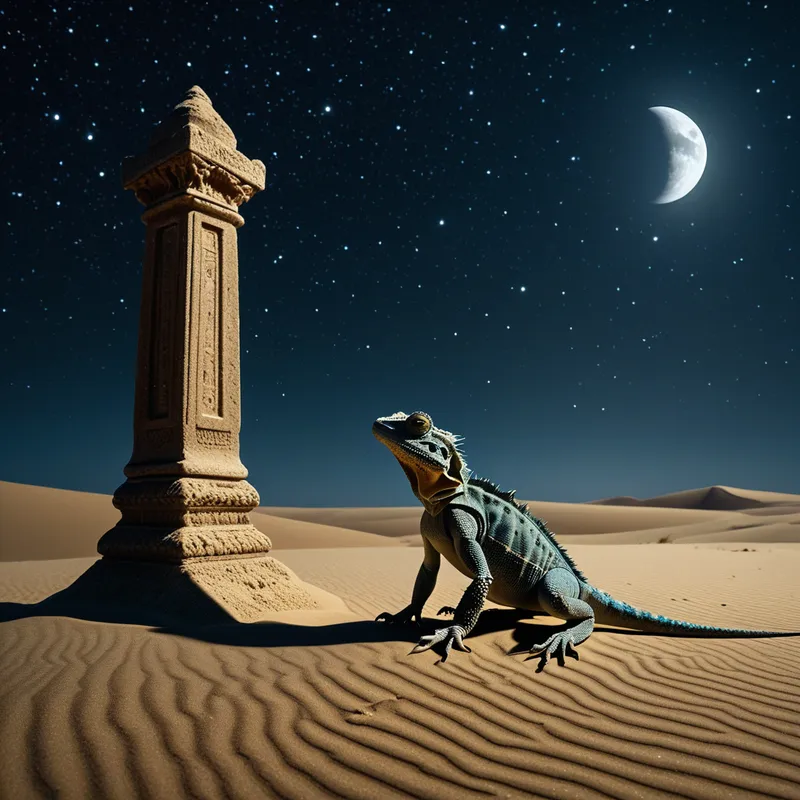
For the individual on the path of individuation, the Horned Lizard myth models a critical, non-violent revolution. The first step is the Recognition of Scale: accepting that one’s conscious self feels insignificantly small compared to the inherited, cultural, or traumatic complexes (the Piasas) that govern one’s life. The ego must humble itself, becoming the Horned Lizard on its rock, not a would-be giant-killer.
The second is the Crafting of the Boon: the conscious mind must formulate a challenge based on its own native intelligence—its “obsidian flake.” This is the unique insight, the personal truth, the small but irrefutable piece of evidence that the complex has overlooked. It is saying, “My reality is not nothing.”
The alchemical vessel is not the battlefield; it is the interior of the monster’s own skull. Transformation occurs when we dare to inhabit the logic of our oppression with the song of our soul.
The final, daring stage is Internal Migration. This is the psychotherapeutic, shadow-work stage. One must voluntarily enter the uncomfortable, dark, resonant space of the complex (the anger, the fear, the addiction) not to be consumed, but to introduce a new vibration. This is the “song” of the authentic self—a persistent, truthful narrative sung from within the wound itself. The complex, unable to integrate this foreign, grounding frequency, loses its cohesive power. It may flee, or it may simply collapse, its energy becoming inert raw material—the “mountain range” of new, solid psychological terrain.
The individual emerges, like Horned Lizard, not enlarged, but solidified. The victory is not in becoming a monster-slayer, but in becoming an unshakable, singing presence within one’s own once-terrifying psyche. The power is no longer out there, looming. It is in here, patient, close to the earth, and enduring.
Associated Symbols
Explore related symbols from the CaleaDream lexicon: