Hoop Dance Myth Meaning & Symbolism
A mythic tale of a wounded dancer who, through sacred hoops, weaves a broken world back into a harmonious whole.
The Tale of Hoop Dance
Listen. The world was out of tune. The seasons grumbled against each other; the rivers spoke in harsh whispers to the stones. The people walked with heads bowed, their hearts heavy with a silence that was not peace, but a forgetting. They had lost the song that connected the wing of the eagle to the root of the corn, the breath of the child to the sigh of the mountain.
Into this fractured harmony walked a person. Some say they were a warrior whose body was broken in a great struggle. Others whisper they were a dreamer who had wandered too long in the spirit lands and returned with a limp in their soul. Their name is not sung, for it is the condition that matters: they carried a wound that would not close, a crack through which the world’s dissonance poured in like a cold wind.
One evening, as the violet dusk bled into the black of night, this wounded one sat by a lonely fire. The ache was a drumbeat in their bones. In despair, they took a slender branch of willow, still green with life, and bent it into a circle, tying the ends with a strip of their own clothing. They held the empty circle before the flames. It was nothing. It was a zero, a symbol of the void within.
But as they stared, the firelight danced through the hoop and cast a ring of shadow and gold upon the earth. A memory stirred—not their own, but an older memory, the memory of the world when it was whole. They saw the hoop of the horizon, the circle of the sun, the cycle of the moon. The ache in their body shifted from a pang of loss to a pulse of recognition.
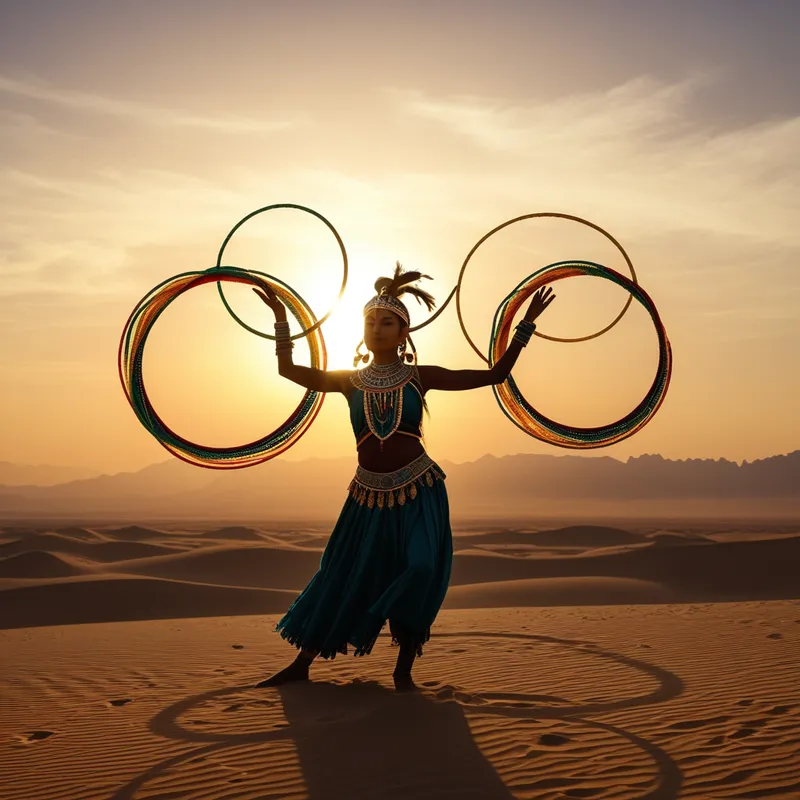
They made another hoop. And another. With each one, they painted a prayer: red for the blood of life, blue for the flowing waters, yellow for the sun’s wisdom, white for the cleansing snow, black for the fertile night. They gathered them, these fragile rings of intention, their weight a promise.
Then, they began to move. Not a dance of celebration, but a dance of desperate remembering. At first, the hoops were clumsy, clattering to the dry earth. Their wounded leg screamed in protest. But they persisted, bending, weaving, stepping through. They caught a hoop on their arm, then their ankle, then their neck. The hoops became extensions of their own hurting form.
And then, the moment of transmutation. As they spun, the hoops no longer fell. They began to orbit. One became the path of the seasons. Another, the circle of the clan. A third, the cycle of birth and death. They wove them into a living, clicking, whirling galaxy around their body—a shield, a web, a vibrating model of existence. The dancer was no longer a person with hoops, but the still center of a moving universe. The crack in their soul became the axis upon which the world turned.
The people, drawn by a sound they had not heard in generations—the sound of everything fitting together—came and watched. They did not see a performance. They saw a revelation. They saw the broken made whole through motion. They saw their own fragmented lives in the separate hoops, and they saw the possible pattern that could unite them. The dancer, drenched in sweat and illuminated by the rising sun, collapsed as the last hoop settled on the ground, forming a perfect, interconnected mandala. The silence that followed was different. It was the silence of awe, the silence of a prayer answered. The world breathed in, and for the first time in a long age, it was a single breath.

Cultural Origins & Context
The Hoop Dance, as a living tradition, is a vibrant practice among many Native American nations, including the Ojibwe, Plains tribes, and Southwestern Pueblos. While the specific mythic tale of its origin varies, its essence is a shared cultural property, passed down not as a frozen scripture but as an embodied story. It is taught through demonstration, from elder to youth, with the understanding that the dance itself is the narrative.
Its societal function is multifaceted. On one level, it is a spectacular display of skill and endurance, a celebration at powwows and gatherings. On a deeper, ceremonial level, it is a profound act of storytelling and cosmology. The dancer becomes a narrator, using the hoops to create shapes of animals, plants, and celestial forms—the eagle, the butterfly, the flower, the world itself. This act is not mere mimicry; it is an invocation and a reminder of the interconnected web of life. The dance functions as a ritual of healing and restoration, visually and kinetically mending the symbolic tears in the community’s and the individual’s relationship with the cosmos.
Symbolic Architecture
At its heart, the Hoop Dance myth is a masterclass in the symbolism of the circle and the transformative power of embracing fragmentation.
The hoop itself is the primary symbol. It is the Sacred Hoop, the unbroken cycle of life, the shape of unity with no beginning and no end. Yet, in the dance, there are many hoops. This is the genius of the myth: wholeness is not a singular, monolithic perfection, but a dynamic, ever-reconfigured unity of diverse parts. Each hoop represents a distinct aspect of existence—a tribe, a species, an element, an emotion, a season.
The path to wholeness is not the elimination of difference, but the conscious, creative weaving of many singularities into a sustaining pattern.
The wounded dancer is the archetypal wounded healer. Their personal fracture is not a disqualification but the very qualification for the task. Their pain attunes them to the world’s pain. Their journey is not one of conquering the wound, but of using its sensitivity, its raw openness, as the loom upon which a new pattern can be woven. The dance is the act of taking one’s own brokenness and the world’s disparate elements and, through disciplined, sacred movement, making them cohere.
The Dreamer's Resonance
When the imagery of the Hoop Dance arises in modern dreams, it signals a profound psychological process underway. It often appears during periods of overwhelming fragmentation—when one feels pulled apart by competing roles (parent, professional, partner), by unresolved past traumas, or by a sense of disconnection from meaning.
To dream of clumsily handling many hoops, dropping them, or being tangled in them, reflects the somatic feeling of life’s demands being unintegrated and unmanageable. The dream-ego feels like the wounded dancer at the beginning of the myth: burdened by the very tools of wholeness.
Conversely, to dream of successfully, gracefully weaving the hoops into a beautiful, flowing form indicates the unconscious is actively working on synthesis. It is a dream of empowerment, showing the dreamer that the disparate pieces of their identity, history, and aspirations can be unified. The body in the dream is learning the new posture of integration. This is not an intellectual understanding, but a kinesthetic, somatic knowing being downloaded from the deep psyche—a blueprint for wholeness expressed as movement.

Alchemical Translation
For the modern individual navigating the chaos of contemporary life, the Hoop Dance myth models the alchemical process of individuation—the Jungian journey toward psychic wholeness.
The initial state is the nigredo, the blackening: the experience of the wound, the fracture, the “world out of tune.” This is the necessary, painful stage of confronting one’s own fragmentation and the shadow aspects of the personality. The dancer’s despair by the fire is this stage.
The gathering and painting of the hoops represent consciousness raising. It is the act of identifying the constituent parts of one’s self and one’s life—the passions (red), the emotions (blue), the intellect (yellow), the spirit (white), the unconscious (black). To “paint” them is to acknowledge their unique value and sacredness.
The alchemy occurs not in the hoops themselves, but in the courageous, repeated motion of weaving them. The ego must become the still center that orchestrates the motion of the complexes.
The dance itself is the alchemical wedding (coniunctio oppositorum). It is the sustained, disciplined effort of holding opposites in tension and finding the rhythm that allows them to orbit in harmony. The wounded leg does not vanish; it becomes the pivot. The psyche’s conflicting elements—ambition and rest, logic and intuition, independence and relationship—are not eliminated. They are brought into a dynamic, moving relationship where each supports the whole.
Finally, the completed mandala of hoops on the ground symbolizes the lapis philosophorum, the philosopher’s stone. It is the achieved, if temporary, state of integrated Self. It is not a static trophy, but a pattern laid down, a testament to the process. It shows that wholeness is a verb, a dance that must be continually recommenced. The modern individual’s triumph is not a life without hoops, but the hard-won skill to pick them up again and again, and through the sacred movement of conscious living, weave a world that holds.
Associated Symbols
Explore related symbols from the CaleaDream lexicon: