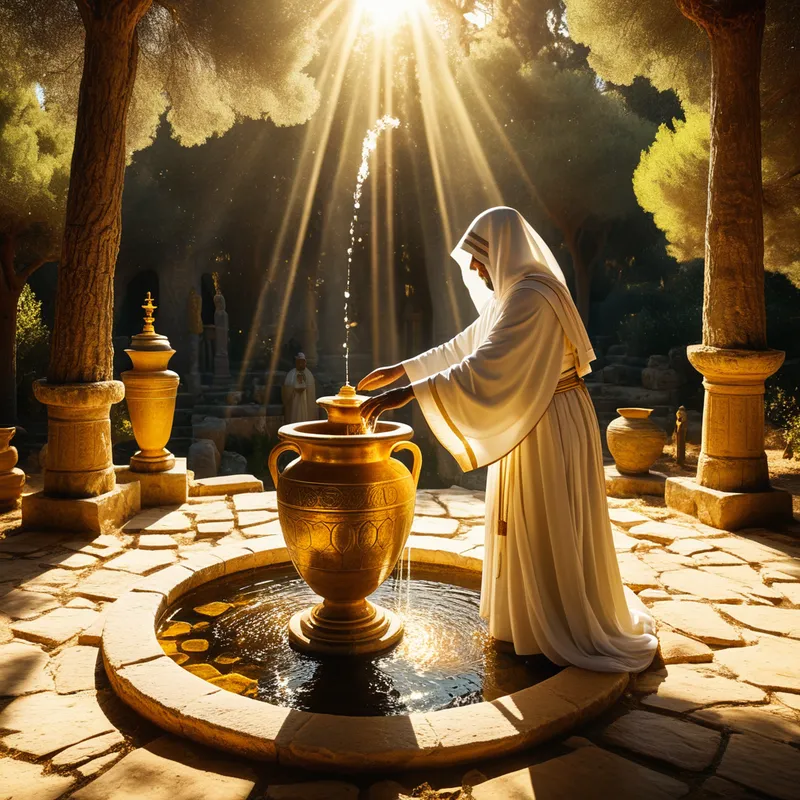
Honey in Ritual Myth Meaning & Symbolism
A myth of divine bees, stolen sweetness, and the sacred pact that binds sacrifice to ecstasy, forging a bridge between the human and the eternal.
The Tale of Honey in Ritual
Listen, and let the scent of thyme and sun-warmed stone carry you back. The world was younger, and the gods walked closer, their breath in the wind, their voices in the thunder. In that time, sweetness was not a given; it was a secret, fiercely guarded. It belonged to the Melissae, the divine bees, children of the sun itself. Their hives were not of wood and straw, but were hidden in the clefts of sacred mountains, in the hollows of ancient oaks where the veil between worlds grew thin. Their honey was not mere food; it was liquid light, solidified song, the distilled essence of a thousand flowering souls.
The people below knew hunger of a kind no grain could satisfy—a thirst for the nectar of the divine. Their rituals were dry, their offerings of smoke and blood felt incomplete, failing to reach the high, bright dwellings of the gods. A bold one, often a priestess with eyes the color of a stormy sky, was chosen. Her name is lost, for in the telling, she becomes every seeker. Her task was not to conquer, but to petition; not to steal, but to initiate a sacred exchange.
She climbed where the air grew thin and eagles circled. She found the humming cleft in the rock, a gateway thrumming with a golden warmth. She did not bring a knife or a net. She brought an empty clay jar, her own bare hands, and a heart full of the people’s longing. As she approached the shimmering, living fortress of wax and gold, the guardian of the hive emerged. Not a monster, but a being of terrible beauty: the Basileia, the Queen, whose form flickered between woman and insect, her eyes holding the intelligence of the ages.
“You seek the light we guard,” the voice buzzed, a vibration felt in the bones. “What do you offer for the sun’s captured tears?”
The priestess had no gold, no grand sacrifice. She offered the only thing that was truly hers: her stillness, her vulnerability. She stood, allowing the first curious workers to alight on her skin. Then, she did not flinch as the first sting pierced her flesh. A gasp, sharp and clean. Then another, and another. A sacred pain, a burning offering. She did not raise a hand in violence, but in acceptance, as the venom, the pharmakon—both poison and cure—flowed into her. As her body trembled with the fiery gift, her consciousness began to shift. The buzzing was not noise, but language; the pain was not an end, but an opening.
Witnessing this willing sacrifice, the Basileia relented. The stinging ceased. The priestess, now an initiate marked by sacred pain, was guided to the comb. With hands that shook not from fear but from awe, she gathered the flowing gold, letting it drip into her jar. The honey that filled it was different now; it contained the memory of her offering, the alchemy of poison transformed into pact.
She returned to the people, her skin marked with the seals of the bargain, carrying the jar that glowed as if with its own inner dawn. At the next ritual, this honey was mixed with water, milk, and sacred herbs. It was not merely consumed; it was communed with. Those who drank of it tasted not just sweetness, but the sharp, clean truth of the sting that preceded it. They felt the bridge form—a golden thread connecting their mortal thirst to the immortal source. Ecstasy was born, not from mere pleasure, but from the profound, earned communion of sacrifice and gift.

Cultural Origins & Context
This is not a myth from a single scroll or epic, but a pattern woven into the ritual fabric of countless ancient Mediterranean, Near Eastern, and Indo-European cultures. We hear its echoes in the Melissae of Ephesian Artemis, in the honey-based Soma and Kykeon, in the mead of the Norse gods brewed from the blood of the wise being Kvasir. It was a story told not in grand amphitheaters, but in the hushed spaces of mystery cults and apiarists’ lore, passed from priestess to initiate, from beekeeper to child.
Its societal function was foundational. It provided a metaphysical blueprint for the most human of dilemmas: how to approach the sacred. It taught that the divine was not a trophy to be seized, but a relationship to be entered, requiring a transformative exchange. It sanctified the work of the beekeeper, making them not just farmers, but mediators between realms. The ritual use of honey in libations, embalming, and initiation rites was the lived enactment of this myth, a technology of connection that said the gods desired not only our awe, but our authentic offering—even, and especially, the offering of our own painful vulnerability.
Symbolic Architecture
The myth’s power lies in its stark, alchemical symbolism. Honey is the symbol par excellence of transformed essence. It is sunlight, pollen, and flower-soul processed through the mysterious inner workshop of the hive—a perfect metaphor for the unconscious process that transmutes raw experience (the flowers of life) into the nourishing gold of wisdom and soul.
The sting is the price of admission to the hive-mind of the Self; the honey is the wisdom earned by enduring the burn of consciousness.
The Basileia, the Bee-Queen, represents the archetypal ruler of the inner, instinctual world—the organizing, generative principle of the psyche. She is the guardian of the treasure because the treasure is the integrated Self, which cannot be taken by force of ego. The priestess represents the conscious mind or the ego, tasked with relating to this profound inner authority. Her climb is the journey inward; her stinging is the inevitable, painful confrontation with aspects of oneself that are defended, complex, or “venomous.”
The ritual consumption of the honey symbolizes assimilation. It is not enough to retrieve the treasure; it must be integrated, made part of the communal and individual body. This turns a personal ordeal into a sacramental act that feeds the whole community, illustrating how individual psychological work ultimately serves the collective.
The Dreamer's Resonance
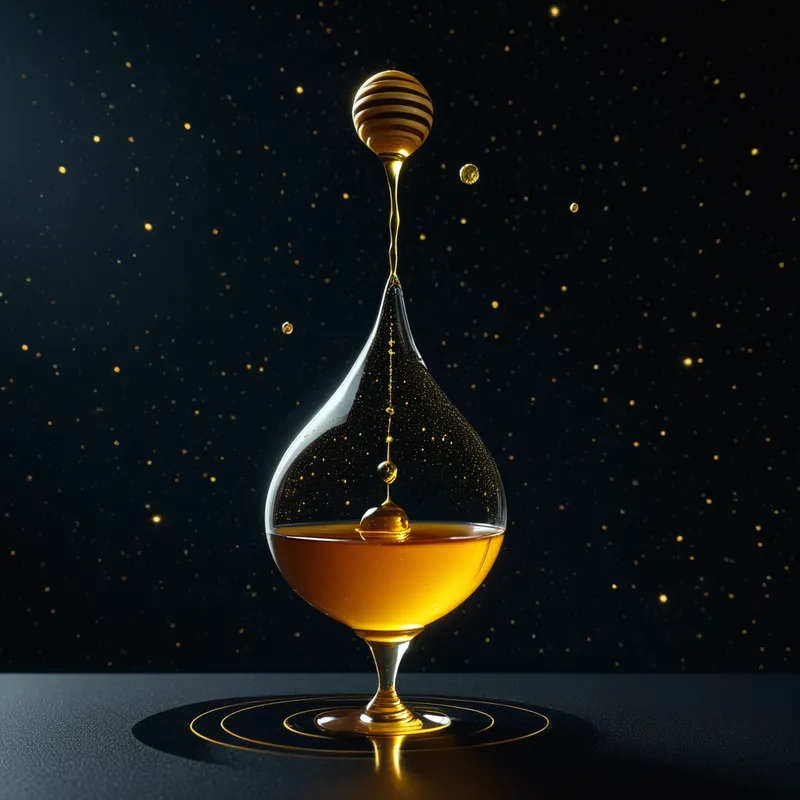
When this myth stirs in the modern dreamer, it often manifests as dreams of bees, hives, sticky golden substances, or of being stung in a context that feels strangely significant or ritualistic. Somatic sensations of humming, vibrating, or a sweet taste upon waking may accompany it.
Psychologically, this signals a profound process of psychic metabolism. The dreamer is likely in a phase where raw, perhaps painful, life experiences are being worked on by the unconscious (“the hive”). The “sting” in the dream points to a necessary, acute confrontation with a truth that is initially painful—a betrayal realized, a difficult responsibility accepted, a shadow aspect acknowledged. This is not meaningless suffering, but the sacred sting of the Basileia, the price for accessing a deeper layer of nourishment. The dream is an assurance that the process, though painful, is alchemical. The sweetness—the insight, the emotional resolution, the creative inspiration—is being prepared. The dreamer is the climbing priestess, enduring the ordeal to broker a new pact between their conscious life and the deep, instinctual wisdom within.
Alchemical Translation
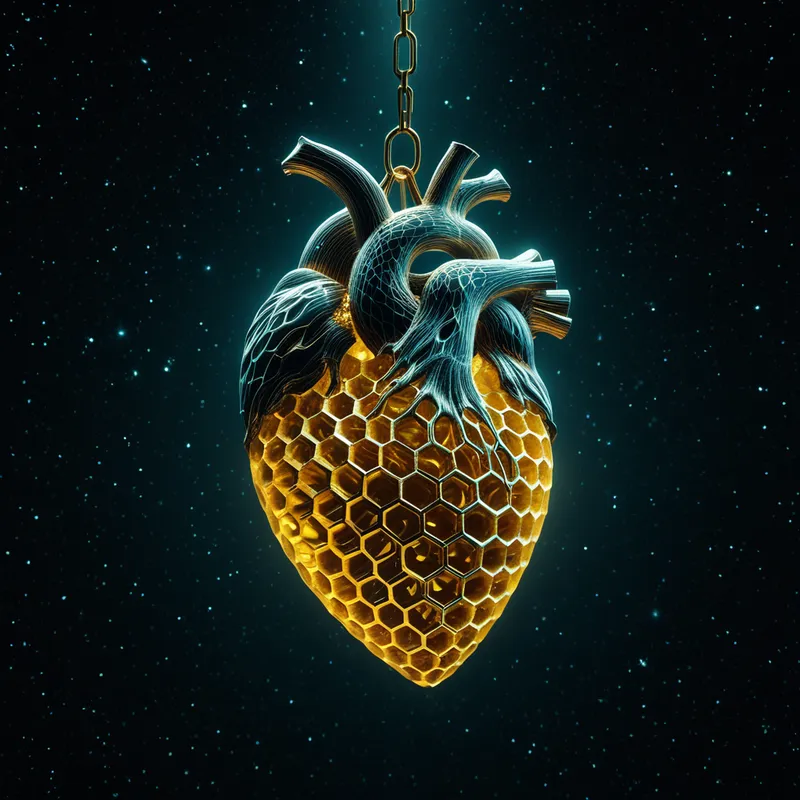
The myth of Honey in Ritual is a masterful map of the individuation process. The ego’s initial state is one of lack, sensing a sweetness (wholeness, meaning) it cannot reach. Its first impulse—to steal or conquer—must be abandoned for the path of sacrificial petition.
The alchemical stages are clear:
- Nigredo (The Climb & The Sting): The conscious undertaking of the difficult inner work (the climb). The confrontation with the shadow, with complex emotions, or with the autonomous power of the unconscious (the stings). This is the darkening, the painful dissolution of old attitudes.
- Albedo (The Pact & The Gift): The moment of surrender and recognition. The ego, by enduring the sting without retaliation, proves its worth. It is no longer a thief, but a worthy petitioner. The Basileia relents, symbolizing the inner authority granting access to the treasure. This is the whitening, the washing clean, the establishment of a new relationship between conscious and unconscious.
- Rubedo (The Return & The Communion): The integration. The retrieved honey (the new insight, the transformed affect) is brought back to the “community” of the psyche and shared. It is ritualized—consciously made sacred and applied. This is the reddening, the achievement of a new, embodied level of being that is both personally fulfilling and connects one to a sense of the transpersonal.
The ultimate alchemy is this: the poison of isolation is transmuted, through conscious suffering, into the honey of communion.
For the modern individual, the myth teaches that our deepest wounds, our personal “venoms,” are not merely pathologies to be eliminated. They are the very agents of our initiation. By consciously engaging with them, offering them up in the ritual container of self-reflection or therapy, we undergo the sting. And from that process, we distill a unique, personal honey—a hard-won wisdom, a capacity for sweetness that is resilient, deep, and truly our own, capable of nourishing not only ourselves but the world around us.
Associated Symbols
Explore related symbols from the CaleaDream lexicon: