Holy Trinity Myth Meaning & Symbolism
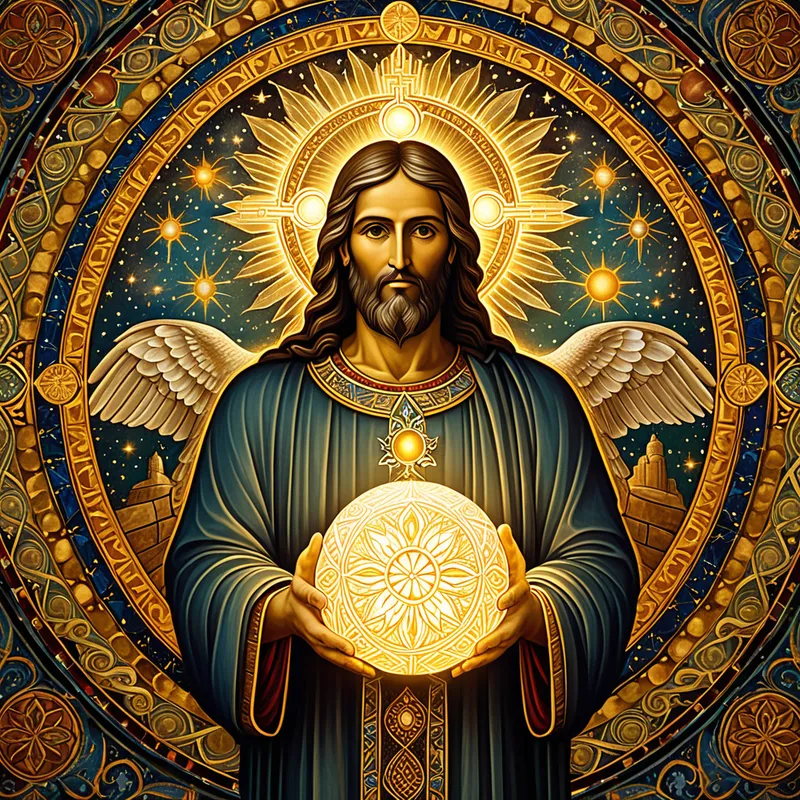
A mystery of one God in three co-eternal persons: the originating Source, the embodied Word, and the animating Breath, in an eternal dance of love and being.
The Tale of Holy Trinity
In the beginning, before the foundations of the mountains were laid, there was not solitude, but a conversation. A Word, echoing in the heart of the Uncreated Light. A Breath, moving upon the face of the boundless Deep. This was the eternal dance—the Father speaking forth his beloved Son, and the love between them breathing forth as a living, fiery Spirit. One God, not in lonely majesty, but in a communion of radiant persons, a circle of giving and receiving that had no start and knows no end.
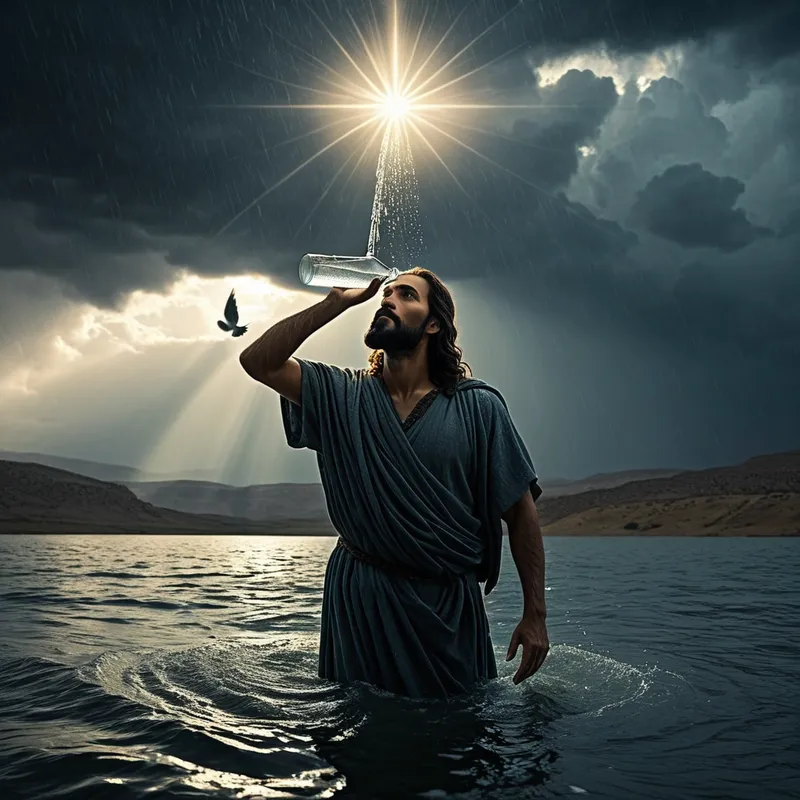
This mystery, hidden in the heart of eternity, stepped into time at a river’s edge. The waters of the Jordan flowed brown and cold. A man named John, clothed in camel’s hair, called a nation to repentance. And then He came—the Son, now wearing the dust of the earth, the fatigue of muscle, the humility of a seeker. He entered the water, not to be cleansed, but to sanctify the very element of creation. As he rose, the heavens, which had held their breath since the first sin, were torn asunder.
A sound like the sigh of the universe was heard, not with ears, but in the soul. The Spirit descended—not in wrath or storm, but as a dove, gentle and irrevocable, alighting upon him. And then the Voice, from the very heart of the unseen Father, thrumming through the fabric of reality: “This is my beloved Son, in whom I am well pleased.” Here, at this moment, the flowing water, the human form, the descending dove, and the echoing voice—the Trinity was unveiled. The Father’s love, the Son’s embodiment, the Spirit’s anointing, all present in one act of glorious self-revelation.
The story of this God walked among us. The Son spoke with the authority of the Source from which he came. He healed with the compassionate power of the Spirit that filled him. He prayed to the Father in the lonely watches of the night, their conversation the axis upon which the world turned. In his final hour, he commended his spirit into the hands of the Father, and with his last breath, he gave up his spirit to the world. In death, the bond was not broken but entered the darkest place to shatter it from within.
Then, on the first day of a new creation, the Breath returned as a rushing, mighty wind, filling a room with tongues of fire. The Spirit, promised by the Father and sent in the name of the Son, fell upon the fearful and made them bold. The circle, once glimpsed at the Jordan, was now poured out. The love that flowed between Father and Son became the very lifeblood of a new community, a temple not made with hands, where the triune God makes his dwelling.
Cultural Origins & Context
The doctrine of the Holy Trinity did not emerge fully formed. It was lived and experienced before it was formulated. The earliest followers of Christ were monotheistic Jews, grappling with the shattering experience of the resurrection and the ongoing, palpable presence of the Spirit. They worshipped Jesus as Lord, prayed to the Father in his name, and were empowered by the Spirit—all while fervently believing in one God. This experiential tension between unity and plurality demanded a language.
That language was forged in the fires of controversy and deep contemplation across the first few centuries. Church councils, like Nicaea and Constantinople, were not dry academic exercises; they were desperate attempts to preserve the mystery of salvation as it had been received. To call Jesus a mere creature or the Spirit an impersonal force was, to them, to break the bridge between God and humanity. The Trinity became the foundational grammar of Christian faith, articulated in creeds recited in worship, embedded in the ritual of baptism “in the name of the Father, and of the Son, and of the Holy Spirit,” and depicted in the sublime iconography of the Eastern Church. Its function was to protect a reality too dynamic for simple definitions: a God who is, in essence, relational love.
Symbolic Architecture
At its core, the Trinity is a radical symbol of unity-in-diversity and relationship-as-essence. It dismantles the image of God as a solitary, monolithic monarch. Instead, it presents divinity as a perpetual, dynamic flow.
The Father is the deep, silent wellspring of being; the Son is the perfect image and expression of that being; the Spirit is the bond of love that eternally unites them. One is not before the other; they coexist in a timeless perichoresis, a divine dance of mutual indwelling.
Psychologically, this is a map of a whole consciousness. The Father represents the transcendent ground of the psyche, the unconscious source from which all potentials arise. The Son symbolizes the incarnated ego, the “I” that emerges from that ground, becomes conscious, and engages with the world. The Spirit is the animating principle that connects the two—the intuition, the synchronicity, the energy that moves between the depths of the self and the conscious personality, facilitating dialogue and transformation. A psyche in harmony is not a monolithic ego, but a differentiated yet integrated relationship between these three “centers” of being.
The Dreamer's Resonance
When this trinitarian pattern stirs in the modern dreamscape, it rarely appears as biblical figures. It manifests as a profound somatic and psychological process of integration. One might dream of three identical rooms connected by archways, feeling a compulsion to move freely between them. Or perhaps three distinct voices speaking in unison—one commanding, one compassionate, one whispering—yet belonging to a single presence. The dreamer may encounter a symbol of three-in-one: a triangle that is also a circle, a tree with three trunks from one root, a single light refracting into three distinct colors.
These dreams often surface during periods where one feels fragmented—the intellect divorced from emotion, the spiritual longing disconnected from bodily life, the inner child alienated from the adult self. The Trinity dream is the psyche’s blueprint for reconciliation. It is the somatic feeling of a tension between different parts of oneself beginning to resolve not by one part conquering the others, but by recognizing their essential belonging to a larger, more complex whole. The anxiety of the dream is the labor of this new structure being born.

Alchemical Translation
The alchemical work mirrored in the Trinity is the opus contra naturam: the work against our fallen, fragmented nature. Our default state is often one of identification with a single, isolated ego (a false unity) or a chaotic swarm of competing complexes (a false plurality). Individuation, the process of becoming whole, requires a trinitarian operation.
First, one must confront and relate to the Father—the vast, often terrifying unconscious, the internalized authority, the numinous source of one’s being. This is the solutio, a dissolving of rigid ego boundaries. Then, one must consciously incarnate the Son—taking responsibility for one’s unique life, suffering its limitations, and giving it concrete form in the world. This is the coagulatio, the embodiment. The process that unites these two is the Spirit—the transcendent function, the symbol that arises spontaneously to bridge the conscious and unconscious, creating a new, third position that is neither pure instinct nor rigid ego.
The goal is not to become the Father, the Son, or the Spirit, but to become a vessel where their divine dance can occur. The transformed Self is not a simple point, but a living relationship—a center that acknowledges its source, engages its world, and is animated by the connecting breath between them.
Thus, the myth of the Trinity offers a sacred model for psychic transmutation. It invites us out of the tyranny of the “either/or” and into the liberating mystery of the “both/and.” It suggests that ultimate reality—and therefore, our deepest, truest self—is not a static noun, but a dynamic, loving verb. To engage this myth is to begin the lifelong work of weaving the transcendent, the personal, and the connective into the singular, holy tapestry of a soul.
Associated Symbols
Explore related symbols from the CaleaDream lexicon: