Holy Spirit Myth Meaning & Symbolism
The mysterious third person of the Trinity, a divine wind and living fire that descends to awaken, guide, and unite the human soul with the sacred.
The Tale of Holy Spirit
Listen. There is a silence that is not empty, but full. A breath held in the heart of the cosmos. After the great sorrow, after the beloved teacher vanished from sight, a small band huddled in a hidden room. The air was thick with grief and fear, the scent of old wood and unwashed linen. They were a body with its head severed, lost.
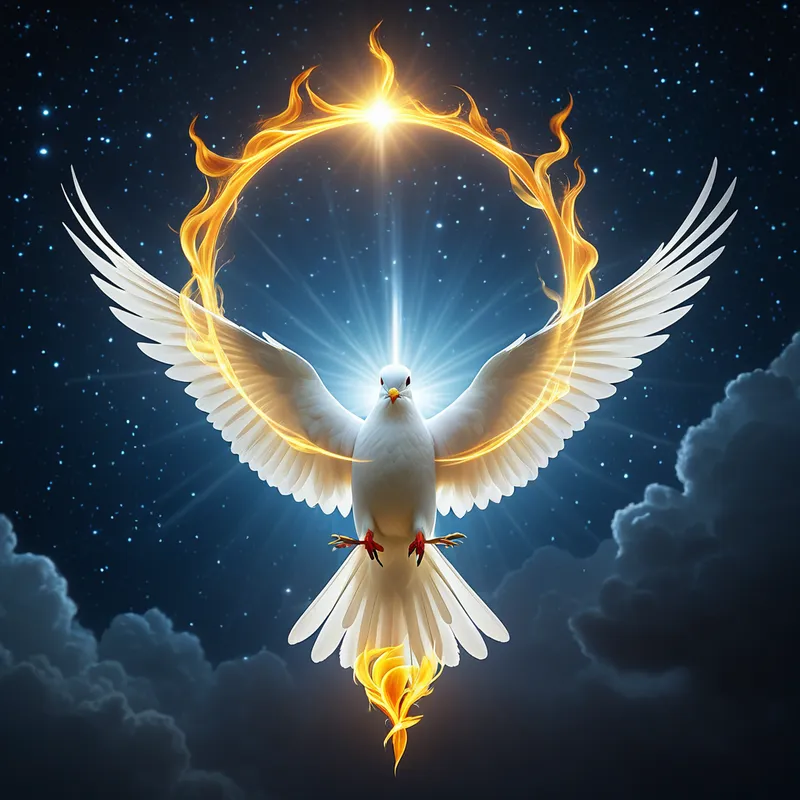
Then, without warning, the silence broke. Not with sound, but with its essence—a roar like a rushing, mighty wind that filled the entire house, yet touched not a single thread of the tapestry on the wall. It was a sound felt in the bones, a vibration of pure potential. And then, fire. Not the fire that consumes, but the fire that reveals. Divided tongues, as of flame, rested upon each of them. It did not burn; it baptized. It seeped into the crown of the head, a liquid warmth flooding the chest.
And the sealed lips burst open. A torrent of languages not their own poured forth—words of ancient lands and distant markets, psalms and prophecies spilling into the Jerusalem air. The fear melted, not into calm, but into a fierce, unshakeable joy. The fisherman stood, his voice now a clarion call. The hidden room was a womb no longer; they spilled into the streets, a river of fire and word, and the city gathered, bewildered, hearing the majesty of God each in their own tongue. The breath had become voice. The ember had become a blaze. The scattered flock was now a living body, animated by one Pneuma.
Cultural Origins & Context
This myth, chronicled in the Acts of the Apostles, erupted within the nascent Jesus movement a few decades after the death of its founder. It was not an isolated tale but the culmination of a deep, evolving theology within a Second Temple Jewish milieu. The storytellers were the community itself, passing down the account of their own mystical founding moment—their "birthday" as the Church.
Its societal function was paramount: it explained their radical unity and missionary fervor. This was the legitimizing event that transformed frightened disciples into empowered apostles. It provided the divine authority for their global mission, breaking perceived barriers of language and ethnicity. The myth served as the foundational charter, establishing the Paraclete as the continuing, indwelling presence of God, replacing the physical absence of Jesus. It was the answer to the question: "How is he still with us?"
Symbolic Architecture
The symbols here are not mere decoration; they are the very anatomy of the numinous experience. The wind (Ruach) is the primal, uncontainable force of life and change—the same breath that hovered over the primordial waters in Genesis. The fire is the archetype of purification, illumination, and transformation. It burns away the dross of fear without destroying the essential self. The tongues signify communication shattered and remade—the reversal of Babel—not into uniformity, but into a harmony where difference is transcended through understanding.
The Spirit is the breath that animates the body of belief, the fire that forges individual souls into a communal heart, and the voice that translates the divine whisper into human action.
Psychologically, the Holy Spirit represents the autonomous, guiding force of the collective unconscious made personal. It is the inner daimon, the compulsion toward wholeness that arrives unexpectedly, disrupts comfortable despair, and empowers the ego to serve a purpose greater than itself. It is the symbol of inspired consciousness—the moment when deep, unconscious content breaks through into articulate expression and purposeful life.
The Dreamer's Resonance
When this myth stirs in the modern dreamer, it often manifests not as biblical pageantry, but as core sensations and images of sudden, benevolent empowerment. One might dream of a silent, powerful wind that lifts them effortlessly, a symbol of being carried by a supportive psychic current beyond one's own strength. Another may dream of a soft, internal light that begins to glow in their chest, illuminating a dark path—a somatic experience of inner guidance awakening.
To dream of speaking fluently in a foreign language you do not know, or of others understanding you perfectly, points to the integration of previously unconscious parts of the self, achieving a new, profound internal communication. The dream of a gentle, non-consuming flame resting on the head or hands signifies a calling or a vocation being ignited, a recognition of one's unique "gift" or creative spark. These dreams mark a psychological Pentecost: the end of a period of incubation and confusion, and the birth of a new, more authentic and connected way of being in the world.

Alchemical Translation
The alchemical process mirrored here is the solve et coagula—dissolve and coagulate. First, the ego's isolated, fearful state is dissolved by the rushing wind of the unconscious. Old structures of identity based on limitation are broken apart. Then, the fiery essence coagulates a new, more complex self around a divine center—the lapis or philosopher's stone of the indwelling spirit.
For the modern individual, the myth models the journey from the orphan archetype (abandoned, hiding in the upper room) to the sage (speaking with wisdom and clarity). It is the process of individuation, where the transcendent function—symbolized by the Spirit—mediates between the conscious mind and the vast unconscious, creating a new, unifying perspective.
The descent of the Holy Spirit is the internal event where grace becomes agency, where inspiration becomes respiration, and the individual soul discovers it is also a cell within a greater, breathing Body.
The ultimate transmutation is from passive believer to active vessel. The sacred is no longer a distant father figure or a historical teacher, but an imminent, indwelling fire. The work is to consent to the wind, to let the tongue of flame alight, and to courageously speak the new language of one's own deepest, truest life into the waiting world.
Associated Symbols
Explore related symbols from the CaleaDream lexicon: