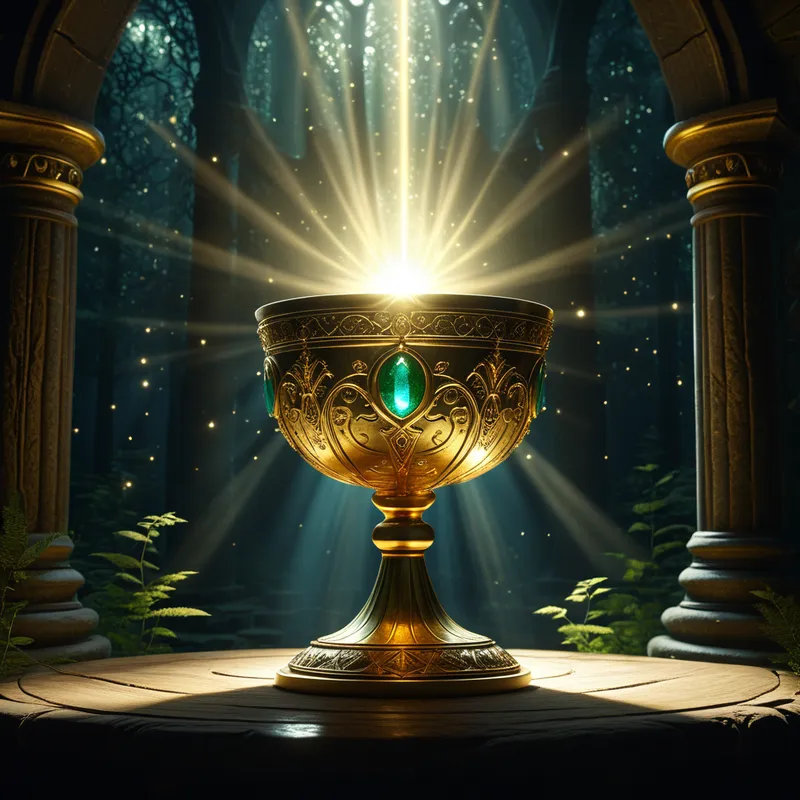
Holy Grail Myth Meaning & Symbolism
A sacred vessel of divine grace, sought by knights on a perilous quest that tests purity of heart over martial prowess, promising ultimate healing.
The Tale of the Holy Grail
Listen, and hear a tale not of conquest, but of a question. In the twilight of Camelot, when the ideals of chivalry shone brightest and cast the longest shadows, a silence fell over the great hall. The feast was laid, but the knights were restless. The quests for land and glory had grown hollow. Then, as the last light of day failed, a miracle pierced the mundane.
A searing beam of light, not of sun or torch, split the air above the Round Table. Within it, veiled in a shimmering haze, drifted the Holy Grail. It was not as they imagined—no gaudy treasure, but a vessel of heartbreaking simplicity, radiating a peace that was also a profound accusation. It offered no words, only a presence that filled the room with the scent of rain-washed stone and blooming roses in deep winter. As swiftly as it came, it vanished, leaving not darkness, but a deeper kind of seeing.
A great cry went up! The knights, sworn to the highest service, saw their purpose re-forged in that instant. The greatest of them—Galahad, the seasoned Gawain, the noble Percival, and the flawed Lancelot—vowed to seek the vessel, to bring its grace back to a wounded land. King Arthur, with a heavy heart, blessed their quest, knowing it would scatter his fellowship and herald the end of his dream.
Their journeys led them not across mapped kingdoms, but into the Forest of Adventure, a place where the landscape mirrored the soul. Bridges tested humility, hermits posed riddles that were keys, and fierce beasts were manifestations of their own unchecked passions. Each knight traveled alone, for the Grail path is ultimately solitary. Lancelot, bound by his earthly love, could only glimpse the Grail from a threshold, writhing in an agony of unworthiness. Gawain, brave but impatient, turned back. Percival, through innocence and perseverance, came close.
But it was Galahad, the knight "with whom there is no fault," who walked the path without stumbling. Guided by visions and a heart free of guile, he came to the mystical city of Corbenic. There, in a chamber that was both tomb and womb, he witnessed the Grail Procession. He saw the lance that dripped eternal blood, the dish that held the sacred feast. And when the ancient, wounded Fisher King asked the healing question, "Whom does the Grail serve?", it was Galahad who answered, "It serves the King of Kings."
With those words, the wound was healed, the land sighed in relief, and the Grail revealed its full glory. Galahad, his quest complete, was taken up into heaven, his soul passing from this world not with a warrior's cry, but with the quiet sigh of a man returning home. The Grail itself, its work done for that age, vanished from the sight of men, leaving behind a memory of light and a legend that would haunt the human heart forever.

Cultural Origins & Context
The Grail myth is a shimmering tapestry woven from many threads. Its deepest roots tap into ancient Celtic cauldrons of plenty and regeneration, like the Cauldron of Annwn. These pagan vessels of life and death were baptized, so to speak, into the Christian imagination of medieval Europe, primarily through the work of 12th and 13th-century poets like Chrétien de Troyes, Robert de Boron, and in the grand compilation of Le Morte d'Arthur.
These writers were not mere recorders; they were myth-makers for a warrior aristocracy undergoing a spiritual crisis. The Crusades had exposed the limits of martial glory. Chivalry needed a higher purpose. The Grail provided it, transforming the knight from a protector of land into a seeker of divine grace. The stories were told in courts and sung by minstrels, serving as both entertainment and profound spiritual instruction. They functioned as a societal mirror, asking the ruling class: is your heart pure enough to wield power justly? Is your strength dedicated to a holy cause? The myth thus served as the ultimate critique and refinement of the feudal ideal, pointing the way from brute force to spiritual sovereignty.
Symbolic Architecture
At its core, the Grail is the symbol of the unattainable attained, the divine made immanent. It is not a trophy to be won, but a state of being to be received.
The Grail does not represent the goal, but the wholeness that makes the quest possible.
Psychologically, it represents the Self, the complete and integrated psyche. The wounded Fisher King and his barren land symbolize the individual—and the culture—suffering from a spiritual sickness, a disconnection from the sacred source. The quest is the journey of individuation. Each knight represents a different aspect of the psyche embarking on this journey: Lancelot is the brilliant but divided ego, bound by shadow and passion; Percival is the developing consciousness learning through naive inquiry; Galahad is the transcendent function, the aspect capable of unifying opposites in perfect purity.
The critical moment is not the finding, but the asking of the healing question. This shifts the paradigm from one of conquest ("I will take the Grail") to one of service and relationship ("Whom does it serve?"). The answer reveals the true order: the divine (the Grail) serves the divine (the King of Kings), and the individual must align with that hierarchy to be healed.
The Dreamer's Resonance
When the Grail appears in modern dreams, it rarely manifests as a medieval chalice. It may be a simple bowl of startling beauty, a source of inexplicable light in a dark room, or even a profound sense of an answered question one did not know they had asked. To dream of seeking it is to experience the somatic restlessness of a soul feeling its incompleteness. There is often a feeling of being tested, of navigating a maze (career, relationship, identity) where the rules are obscure but the stakes feel ultimate.
Dreaming of finding the Grail is often accompanied by sensations of profound peace, warmth, or healing light—a somatic experience of integration. Conversely, dreaming of failing the quest, of being unable to ask the question or being turned away at the threshold (like Lancelot), manifests as dreams of shame, paralysis, or being mute at a critical moment. These dreams signal a psychological process where the ego recognizes a higher calling but is still entangled in its own attachments, fears, and unintegrated shadows. The dream Grail challenges the dreamer: what in you must be sacrificed to approach wholeness?

Alchemical Translation
The Grail quest is the alchemical opus mapped onto the landscape of the soul. The knight leaves the known world (Camelot, the conscious ego) and descends into the massa confusa of the Forest of Adventure (the unconscious). His adventures are the stages of nigredo—confronting beasts (repressed instincts), facing hermits (inner wisdom), and enduring failures (the ego's dissolution).
The Fisher King's wound is the prima materia of the soul; the quest is the slow, painful application of the heat of attention that leads to transmutation.
The Grail castle, Corbenic, is the vessel of transformation itself. The pivotal question—"Whom does the Grail serve?"—is the moment of albedo, the illuminating insight that reorders everything. It reveals that the seeker is not the master of the process, but its servant. The healing that follows is the citrinitas, the integration of this insight into the fabric of the personality.
Finally, Galahad's ascension represents the rubedo—the creation of the philosophical gold, the fully realized Self. For the modern individual, this is not a call to literal celibacy or perfection, but to a sacred orientation. It is the process of aligning one's life—work, relationships, creativity—not with the ego's desires for status or security, but with a deeper, often ineffable calling toward authenticity and service. The quest asks us to heal our own Fisher King, to make our inner landscape whole, so that we too might, in our own way, answer the question and be made complete.
Associated Symbols
Explore related symbols from the CaleaDream lexicon: