Holi Festival Myth Meaning & Symbolism
A prince's unshakable faith in Vishnu triumphs over a demonic aunt's fiery arrogance, birthing a festival of color, fire, and renewal.
The Tale of Holi Festival
Listen, and let the scent of woodsmoke and crushed blossoms carry you back. To a time when the world was ruled not just by kings, but by a hunger that could swallow the sun. In the demonic court of Hiranyakashipu, arrogance was the only law. He had wrested a boon from Brahma: he could not be killed by man or beast, inside or out, by day or by night, with any weapon, on land or in the air. Swollen with this power, he declared himself the sole god of the three worlds. The very air in his palace grew heavy with fear, tasting of metal and cold stone.
But in the heart of this darkness, a tiny flame refused to be extinguished. His son, the prince Prahlad. While the court trembled, Prahlad’s heart beat only to the rhythm of a different name: Vishnu. He saw the divine not in his father’s terrifying splendor, but in every pillar, every courtyard, every breath of wind. Hiranyakashipu’s rage was a storm. He tried to poison the boy, to have him trampled by elephants, thrown from cliffs into the sea. Yet each time, Prahlad emerged unscathed, his quiet chant unbroken, a serene smile on his lips. The very elements seemed to bend in reverence around his innocence.
The king’s fury curdled into a cold, calculated plot. He summoned his sister, Holika. She possessed a cloak, a gift of immunity from the bite of flame. “Sister,” the king hissed, “take the boy onto your lap. Sit with him in the center of a pyre. Your cloak will shield you. Let the fire cleanse this devotion from our bloodline.” Holika agreed, her eyes gleaming with cruel certainty.
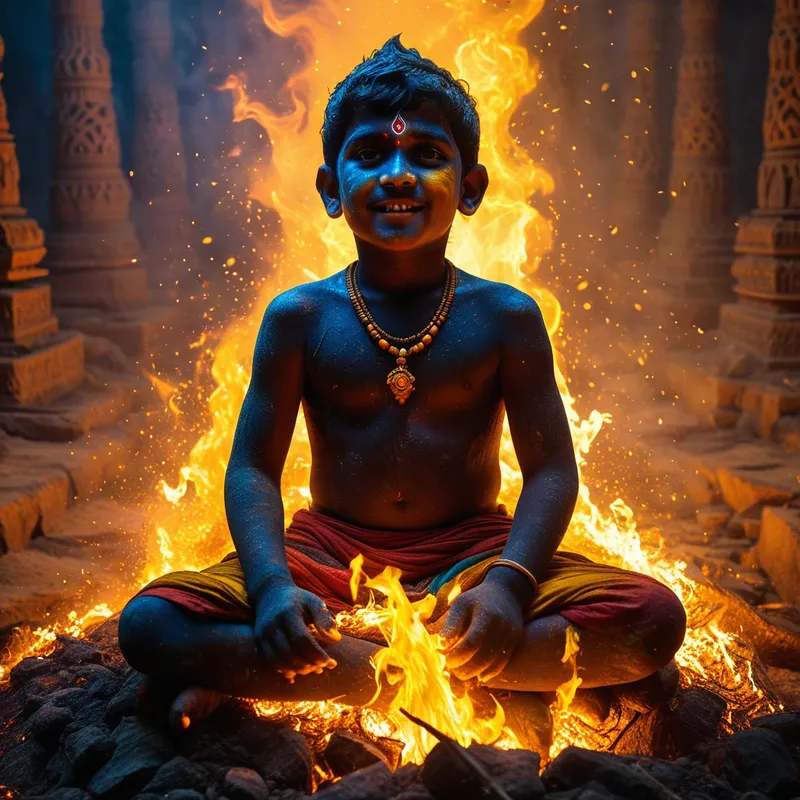
The pyre was built in the central square, a mountain of sandalwood and thorn. The court gathered, a silent tapestry of dread and morbid curiosity. Holika, wrapped in her fateful cloak, took her seat upon the heap. She beckoned to Prahlad. The child, with a trust that pierced the heavens, walked calmly through the jeering crowd and settled in her lap. The torch was thrown.
Fire roared to life, a hungry, orange beast. Heat shimmered the air. The crowd gasped, expecting the boy’s cry. But Prahlad sat still, his eyes closed, his lips moving in silent prayer to Vishnu, the preserver who dwells everywhere. And then, a divine wind arose. It did not fan the flames; it danced with them. The protective cloak, woven from arrogance, fluttered—then tore itself from Holika’s shoulders and wrapped instead around the devoted child. Holika’s immunity shattered with her certainty. Her screams were swallowed by the crackle of the blaze as she was consumed, reduced to ash and memory. Prahlad sat unharmed, a cool, untouched lotus in the heart of a blazing lake.
At that moment, at the twilight threshold between day and night, a form emerged from a palace pillar. Neither man nor beast, but both and more. It was Narasimha, the man-lion, furious and divine. He took the demon-king upon the threshold of the courtyard (neither in nor out), placed him upon his lap (neither land nor air), and at dusk (neither day nor night), with his own claws (no weapon), he delivered justice. The tyranny of the absolute self was torn asunder. And from the ashes of Holika and the shattered ego of the king, a new promise was born: that the purest faith is an unassailable fortress, and that the old, burning structures of arrogance must fall so that life, in all its riotous color, may begin again.
Cultural Origins & Context
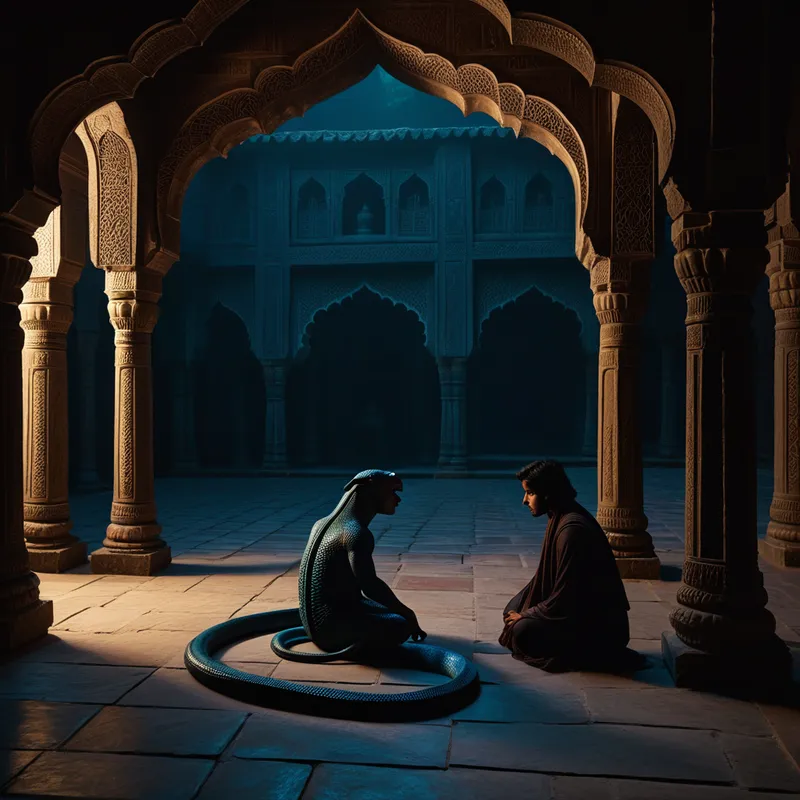
The myth of Prahlad and Holika is embedded in the Vishnu Purana and other Puranic texts. It was not merely a priestly tale but a folk narrative, told and retold in village squares and by household fires on the eve of the full moon in the lunar month of Phalguna. Its societal function was multifaceted. For the agrarian community, it marked the end of winter and the beginning of spring, with the burning of Holika symbolizing the destruction of dormant pests and the cleansing of the fields. Sociologically, it served as a powerful allegory for the triumph of devotional faith (bhakti) over autocratic, ritualistic authority, a theme that would echo through centuries of Indian spiritual history. The communal bonfire (Holika Dahan) became a participatory re-enactment, a way for the community to collectively cast its fears, conflicts, and the "old" into the flames, preparing the ground for the anarchic, egalitarian play of colors the next day.
Symbolic Architecture
At its core, this is a myth of inversion and the indestructibility of the essential Self. Hiranyakashipu represents the totalitarian ego, the psyche that has gained immense power (through effort, boons, success) and subsequently declares itself the absolute ruler, denying any authority higher than its own will. His boon is the logic of the inflated ego, creating a labyrinth of conditions where it believes itself safe from dissolution.
Prahlad is not the hero who fights, but the innocent who remembers. He symbolizes the irreducible core of the Self, the Atman, which remains conscious of its source in the greater divine matrix (Brahman). His faith is not blind belief, but an unshakeable somatic knowing.
Holika and her cloak are the perfect symbol of corrupted protection. The cloak is a boon—a skill, a defense mechanism, an identity—that is misused. It represents how we can use our strengths (immunity) to harm our own inner truth (the child-Self). The fire is the agent of truth and transformation. It does not discriminate; it reveals. It burns away what is inauthentic (the cloak of arrogance) and cannot touch what is real (the devoted Self).
The emergence of Narasimha at the liminal space—the threshold—is the psyche’s ultimate corrective. When the ego constructs an impossible fortress of logic, the Self responds from the impossible place, the "third space" that the ego’s rules cannot conceive. It is the eruption of the numinous from within the very structures we build to keep it out.
The Dreamer's Resonance
When this myth stirs in the modern unconscious, it often manifests in dreams of paradoxical survival. You may dream of being in a burning building yet feeling calm, even cool. You may dream of a toxic figure—a boss, a family member, a shadow aspect of yourself—trying to envelop you, only to have their form disintegrate as you hold fast to a simple, powerful truth or feeling. Somatic sensations might include a sudden, profound calm in the midst of a waking-life crisis, or a tightening in the chest (the constriction of the Holika-cloak) that suddenly releases.
Psychologically, this dream pattern signals a process of immersion in the transformative fire without identification with the burning. The dreamer is facing a situation meant to consume their integrity, their values, or their true voice. The mythic resonance suggests the ego is being tempted to make a pact with a "protective" arrogance or cynicism (Holika’s deal). The dream affirms that the core, innocent knowing—the Prahlad-self—can survive this immersion if it remains connected to its transpersonal ground (Vishnu). The burning away is not of the Self, but of the false contracts and identities that have promised safety at the cost of soul.
Alchemical Translation
The alchemical journey modeled here is the *nigredo to albedo, the blackening to the whitening, but through the medium of fire. The first step is the recognition of the Hiranyakashipu complex: the ego’s tyrannical rule, which creates a sterile, fearful inner kingdom. The invitation is to become Prahlad—not to overthrow the king by force, but to cultivate an inner devotion to what is truly preserver and real.
The bonfire of Holika Dahan is the conscious, ritualized act of placing one’s false protections, old grudges, and burning arrogance into the transformative flames. It is an active participation in one’s own nigredo.
Sitting in the fire with faith is the crucial phase. It is the willingness to endure the heat of conflict, shame, or fear without abandoning the core Self. This is where the miraculous inversion occurs: the cloak of our old identity, our "how I have always survived," burns away, revealing it was always suffocating us. What remains is the whitened, purified essence, the Prahlad who walks unscathed from the ashes.
The final stage is the integration of Narasimha—the fierce, protective, boundary-setting power of the Self that emerges precisely when the ego’s loopholes have trapped it. This is not brute force, but divine, intelligent force, acting at the liminal moment (dusk) in the liminal space (the threshold). It represents the psyche’s innate capacity to create a revolutionary solution from a place outside the problem’s own logic. The resulting festival of color (Rangwali Holi) is the rubedo, the reddening: the liberated, embodied, joyous, and communal expression of the life that bursts forth after the fire of truth has done its work. The individual, having faced the inner conflagration, can now play in the world of form and relationship with the vibrant, messy, and beautiful palette of a reborn Self.
Associated Symbols
Explore related symbols from the CaleaDream lexicon: