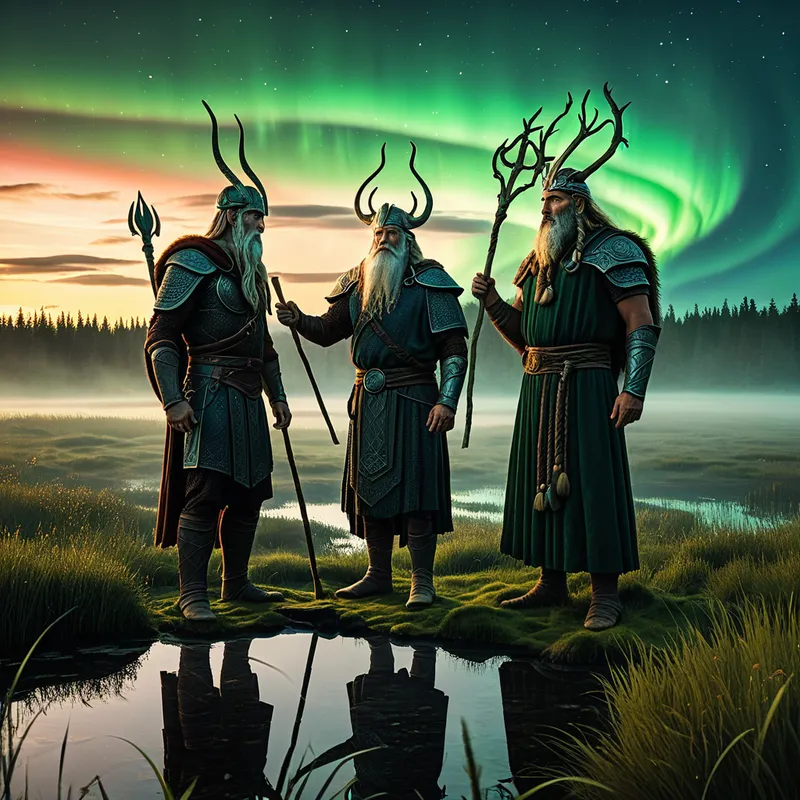
Hoenir and Lodurr Myth Meaning & Symbolism
Two shadowy gods bestow breath, sense, and form upon the first humans, a foundational act of creation that defines the mortal condition.
The Tale of Hoenir and Lodurr
In the time before time, when the great tree Yggdrasil was young and the ashes of the giant Ymir still cooled, the gods walked the newly shaped shores. They came upon two forms, washed up by the tide of fate onto the strand. Not creatures of flesh, but of the land itself: Ask, a piece of sturdy ash wood, and Embla, a supple length of elm. They were inert, potential trapped in timber, waiting in the silence of the not-yet-alive.
The three wanderers—Odin, the one-eyed seeker; Hoenir, the long-legged and thoughtful; and Lodurr, whose essence was warmth and hue—paused. Odin’s breath was the first gift. He leaned close to the wooden forms and blew into them the wind of spirit, önd. It was the gift of the ineffable, the divine spark, the restless urge that seeks and questions. The wood shuddered, but it was a shudder without sense, a spirit adrift in a vessel with no rudder.
Then stepped forward Hoenir. Where Odin’s gift was a rushing gale, Hoenir’s was a settling clarity. He placed his hands upon the ash and the elm and bestowed óðr. It was the gift of inward movement, of thought taking shape from the chaos of spirit. It was the capacity to reflect, to hesitate, to choose. The light of awareness flickered behind the yet-unseeing wood. Now they had breath and mind, but they stood like beautiful statues, rooted to the spot, unable to engage the world.
Finally, Lodurr approached. His touch was not of air or mind, but of the very stuff of life. To them he gave lá and litr góða—goodly form and radiant hue. This was the final, crucial alchemy: the gift of embodiment. Sensation flooded the forms. The grain of the wood softened into warm skin, the rough bark smoothed into flowing hair. They felt the salt spray on new cheeks, the cool sand under new feet. They saw the dazzling light of the world for the first time with eyes given color by Lodurr’s hand. They were no longer Ask and Embla the logs, but Ask and Embla the humans, complete.
The three gods looked upon their work. A being of spirit, mind, and flesh. A creature capable of soaring thought and bound to earthly decay, infused with divine breath and doomed to lose it. They had not created perfection, but possibility. The first man and woman looked back at their makers, their eyes filled with the wonder and terror of a consciousness that now knew it was alive, and that one day, it would end.
Cultural Origins & Context
The myth of Hoenir and Lodurr is preserved primarily in the Prose Edda of Snorri Sturluson, specifically in the Gylfaginning. Its origins are far older, echoing in the sparse, potent verses of the Völuspá ("The Prophecy of the Seeress"). This was not a myth for common retelling around every hearth, but a foundational mystery held within the poetic and priestly traditions. It answered the primal question: "What are we?"
Its societal function was profound. It established humanity’s place in the Nine Worlds—not as accidents, but as intentional, if flawed, creations of the gods themselves. This bestowed a certain dignity, but also a defining limitation. We are of the gods, but not gods. Our components are gifts on loan: breath from Odin, mind from Hoenir, form from Lodurr. This framed the human condition as inherently borrowed and temporary, a core concept that shaped the Norse worldview of fate, honor, and the inevitable journey to Valhalla or Hel.
Symbolic Architecture
The triad of Odin-Hoenir-Lodurr represents a complete ontological blueprint for a conscious being. Odin’s önd is the transcendent spark, the connection to the numinous, the source of inspiration and madness. Hoenir’s óðr is the mediating principle. It is consciousness itself—the faculty that receives the divine spark and attempts to structure it into thought, language, and decision.
Hoenir is the moment between impulse and action, the sacred pause where choice becomes possible.
Lodurr’s gifts are the immanent ground. Lá and litr are not merely "good looks," but the entire phenomenon of having a body that feels, perceives, bleeds, and blossoms. It is our animal vitality, our sensory engagement with the world, the beautiful and tragic fact of our physicality.
The profound psychological truth here is the necessary incompleteness of each gift alone. Spirit without mind is chaos. Mind without body is abstraction. Body without spirit is inert matter. Humanity is the crucible where these three forces meet in a dynamic, often conflicted, union. Hoenir and Lodurr, often overshadowed by Odin, symbolize the essential but overlooked partners in the act of becoming: the capacity for reflective thought and the courage to fully inhabit a mortal form.
The Dreamer's Resonance
When this myth stirs in the modern unconscious, it often manifests in dreams of profound self-creation or unsettling incompleteness. To dream of being carved from wood or finding oneself as a moving statue speaks to the óðr aspect—the mind awakening to its own existence, feeling intelligent but disconnected from the pulse of life (Lodurr’s missing gift). It is the somatic experience of being "in your head."
Conversely, dreams of overwhelming sensory flood, of being all raw feeling and instinct with no controlling thought, may reflect a Lodurr-dominated state lacking Hoenir’s mediating clarity. The most potent resonance, however, is the dream of receiving a gift from shadowy figures. This signals a psychological process where the dreamer is integrating a previously disowned part of themselves—perhaps embracing mindful pause (Hoenir) or reclaiming passionate embodiment (Lodurr). The dream is an internal re-enactment of the primal creation, assembling a more complete Self.
Alchemical Translation
The individuation process, the journey toward psychic wholeness, is mirrored perfectly in this myth. We begin, psychologically, as "driftwood"—shaped by parental complexes, cultural norms, and unconscious impulses (our personal Ask and Embla). The first step, Odin’s breath, is the call of the Self, the sudden, often disruptive awakening to a deeper purpose or question that shakes our foundations.
The subsequent and more arduous work is the integration of Hoenir and Lodurr. To cultivate Hoenir-consciousness is to develop the inner witness, the capacity for non-reactive observation of one’s own spirit and emotions. It is to bestow upon oneself the gift of mindful pause.
The alchemy occurs in Lodurr’s forge, where abstract insight is tempered in the blood and heat of lived experience.
To integrate Lodurr-energy is the ultimate act of self-creation: to fully incarnate. It is to give "goodly form" to one’s spirit and mind by living them out in the world—through creative acts, through vulnerable relationships, through the acceptance of pleasure and pain in the physical vessel. It is to stop being a walking mind (a spirit trapped in wood) and to become a fully sensate human.
The myth teaches that creation is a collaborative act, even within the individual psyche. We are not made whole by transcendent insight alone, but by the marriage of that insight with clear thinking and courageous embodiment. To honor Hoenir and Lodurr is to honor the parts of ourselves that turn the raw material of existence into a conscious, felt, and vibrant life.
Associated Symbols
Explore related symbols from the CaleaDream lexicon: