Hod Splendour Myth Meaning & Symbolism
A myth of divine intellect's descent, where the Splendour of Hod is shattered, scattering sparks of consciousness to be gathered through human understanding.
The Tale of Hod Splendour
Listen, and hear the tale of the Eighth Light, the Sefirah known as Hod, whose name is Splendour.
In the beginning, before beginnings were counted, the Ein Sof breathed a thought of manifestation. From the crown of that thought, a river of light descended, crystallizing into vessels of divine attribute. The eighth vessel was Hod, and its substance was the pure, undiluted splendour of intellect. It was not the raw force of Chesed, nor the fierce structure of Gevurah. Hod was the echo of their union—the glorious, intricate pattern that emerges when boundless love meets defining law. It was the architecture of prophecy, the logic of the stars, the sacred geometry of the soul.
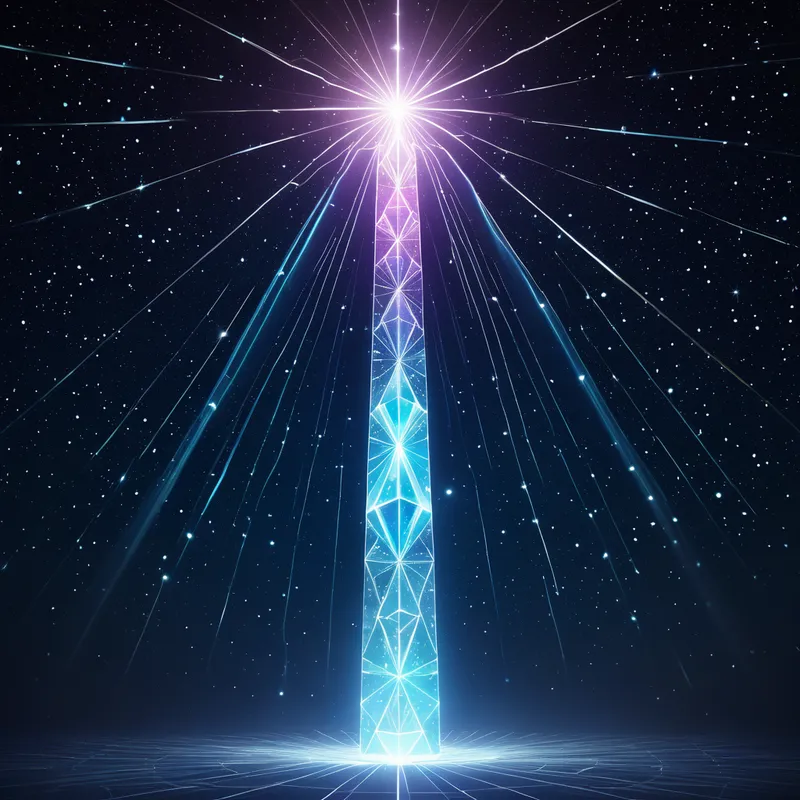
This vessel shone with a cool, silver-blue radiance. Its light did not warm like the sun, but illuminated like the moon, revealing the hidden connections between all things. Within its crystalline walls danced the perfect forms, the letters of creation not yet spoken, the music of the spheres not yet heard. It was the divine mind in its most pristine state, a reservoir of flawless understanding.
But the light pouring into it was too pure, too potent. The vessel of Hod, designed for reflection and reception, could not contain the full force of the emanation. A tremor passed through its perfect form. A soundless cry echoed in the supernal realms. And Hod, the Splendour, shattered.
It did not explode in fury, but fractured with a sound like a universe of ice cracking. Its luminous substance broke into ten thousand thousand sparks—shards of intellect, fragments of understanding, splinters of divine logic. These sparks did not die. They fell, a glittering, silent rain, through the lower realms. They fell into the clay of the earth, into the chaos of matter, into the confusion of the human heart. Each spark carried a sliver of the original pattern, a note of the lost music, a glyph of the sacred script.
And in the wake of the shattering, a profound silence fell over the place where Hod had been. Not an empty silence, but a pregnant one—a silence that hummed with the memory of order and the promise of a task. For the scattered sparks now slept, buried in the world and in us, waiting. The myth whispers that the cosmos itself, and the human soul within it, became a map of this fracture. Our longing for understanding, our drive to name and systemize, our moments of sudden, clear insight—these are the echoes of Hod’s splendour, calling its fragments home.

Cultural Origins & Context
The narrative of Hod’s shattering is not a single, isolated story but is woven into the grand metaphysical epic of the <abbr title="The primordial "shattering of the vessels," a central Kabbalistic myth of cosmic catastrophe and repair">Shevirat HaKelim, the "Breaking of the Vessels." This foundational mythos was crystallized in the 16th century by Rabbi Isaac Luria and his circle in Safed, synthesizing earlier mystical strands from the Zohar.
It was transmitted not as a folktale for the masses, but as a profound esoteric teaching, passed from master to initiated disciple in hushed study halls. Its societal function was dual. On a cosmic level, it explained the origin of evil and imperfection in a world created by a perfect God—flaws arose from this cataclysm in the divine structure itself. On a human level, it provided a sacred, empowering purpose: humanity’s role in <abbr title="The cosmic process of "repair" or "restoration," the human-divine partnership to mend the world">Tikkun Olam is intrinsically linked to gathering these scattered sparks of holiness, these fragments of divine intellect, through righteous action and intentional understanding.
Symbolic Architecture
Hod represents the principle of intellect in its highest form—not dry rationality, but the splendour of a mind that perceives the underlying order, symmetry, and logic of existence. It is the faculty that analyzes, communicates, and systematizes the raw influx of experience and emotion from other Sefirot.
The shattering of Hod is the myth of the fragmented mind—the moment pure understanding meets the resistant complexity of manifestation and breaks into specialized knowledges.
The myth symbolizes the inevitable descent of pure, unified consciousness into the realm of duality and differentiation. The intact vessel is the dream of a complete, systematic knowledge of the Divine. The shattered sparks are the myriad disciplines, sciences, languages, and philosophies—all true in part, yet incomplete alone. The human being, possessing a spark of this divine intellect, thus experiences a fundamental inner tension: a memory of wholeness and a reality of fragmentation. Our intellect is both our glory, allowing us to map the cosmos, and our curse, capable of creating isolating systems that forget the living whole.

The Dreamer's Resonance
When this myth stirs in the modern psyche, it often manifests in dreams of intricate, broken systems. One might dream of a vast, beautiful clockwork mechanism that has sprung apart, its gears scattered. Or of a library where every book is perfectly written, but each is missing crucial pages. There is a somatic quality of frustration coupled with a deep, compelling urge to sort, to catalogue, to solve the puzzle.
Psychologically, this signals a process where the dreamer’s intellectual or analytical faculties—which may have been over-extended, rigidly applied, or felt disconnected from feeling and intuition—are undergoing a necessary deconstruction. The dream is not condemning the intellect but revealing its current state of "shattered splendour." The conscious mind’s neat categories are failing to contain the complexity of a life situation or an emerging inner truth. The dream invites a gathering, not a domination—a humble re-collection of insights from the scattered places (relationships, forgotten studies, bodily wisdom) where they have fallen.

Alchemical Translation
The individuation process modeled by Hod’s myth is the transmutation of analysis into wisdom. It begins with the recognition of one’s own "shattered intellect"—the realization that our thinking is partial, biased, and often serves to defend a fragile ego-structure rather than seek truth. This is the nigredo, the darkening, where one’s prized understanding feels inadequate.
The alchemical work is to become a gatherer of sparks, not a builder of fortresses. One must descend from the tower of pure theory to the messy ground of experience to find the lost fragments.
The albedo, the whitening, involves the patient, meticulous work of gathering these fragments without forcing them into a pre-conceived order. This is the practice of mindful observation, of listening, of studying diverse perspectives without immediate judgment. It is the development of Yesod-like receptivity.
The final stage, the rubedo or reddening, is the integration. It is not the re-creation of the original, perfect vessel—that belongs to the divine realm alone—but the fashioning of a new, personal vessel of understanding. This is a wisdom that has passed through the fire of lived experience. It is an intellect humbled by its own fragmentation, now resilient, adaptable, and radiant not with the cold light of certainty, but with the warm luminescence of a comprehension that includes its own shadows and gaps. The individual becomes a living site of Tikkun, where a personal spark of Hod’s splendour is restored to conscious, purposeful service in the world.
Associated Symbols
Explore related symbols from the CaleaDream lexicon:
- Mirror — The shattered mirror reflects the fragmented state of divine intellect after the breaking, where each piece holds a true but partial reflection of the whole.
- Light — The pure, structured light of Hod represents divine intellect and understanding before its descent into the complexity of the material world.
- Order — The innate, sacred geometry and logic that defines Hod's splendour, which humans instinctively seek to restore through systems, laws, and patterns.
- Star — Each scattered spark of Hod's light is like a fallen star, a point of divine consciousness buried within the darkness of matter and the unconscious.
- Temple — The human mind and soul become the temple where the scattered sparks are gathered and reassembled through study, contemplation, and righteous action.
- Key — Intellectual insight and understanding act as the key that can unlock the meaning hidden within the fragmented world, beginning the process of restoration.
- Silver — The cool, reflective, lunar quality of Hod's radiance, associated with the intellect, communication, and receptive wisdom.
- Dream — The realm where the fragments of lost understanding often surface, presenting themselves as puzzles, patterns, and symbols for the dreamer to integrate.
- Circle — The symbol of the original, whole vessel of Hod and the ultimate goal of restoring fragmented consciousness to a state of cohesive, enlightened wholeness.
- Root — The deep, archetypal origin of our cognitive structures and our longing for systematic truth, which traces back to the primordial fracture in the divine mind.