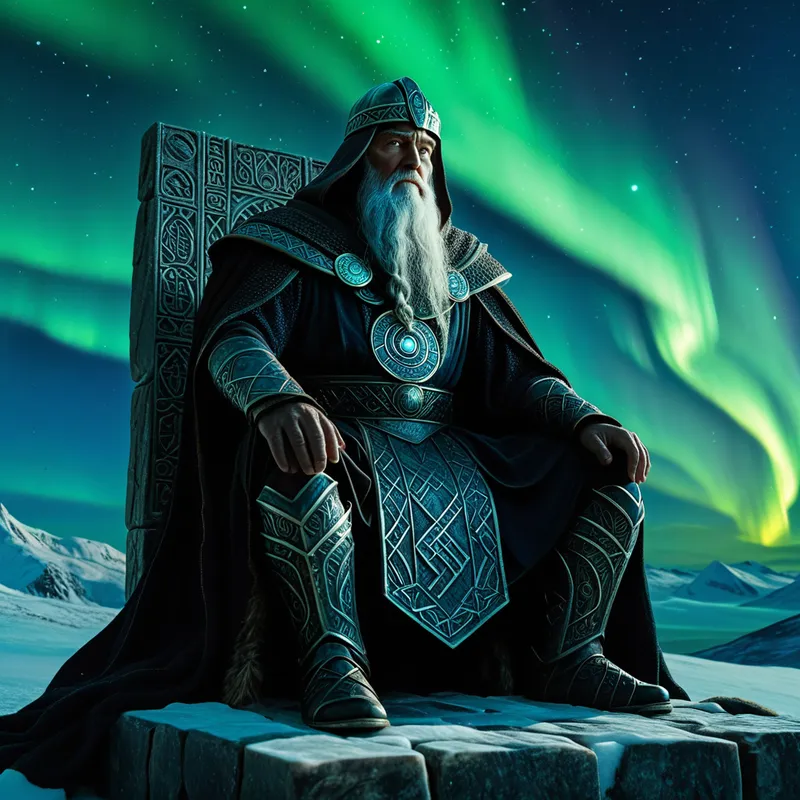
Hnefatafl Myth Meaning & Symbolism
A myth of a sacred board game where a king, besieged by attackers, must navigate to sanctuary, mirroring the soul's struggle for sovereignty against chaos.
The Tale of Hnefatafl
Hear now, by the hearth-fire’s crackling tongue and the mead-hall’s smoky breath, a tale not of blade-song or dragon’s gold, but of silence and strategy. It is the tale of Hnefatafl.
In the beginning, there was the Grid—a world squared in wood, a kingdom of intersecting lines. At its heart, a throne: the Hnefi, the King-piece, carved from the pale heartwood of an ancient ash. He sat, a sovereign of ivory stillness, upon his central citadel. But sovereignty is a beacon, and beacons draw shadows.
From the four corners of the world, from the realms of uttermost Ginnungagap, they came. The Húnn—the attackers—pieces of dark-stained oak, like a host of grim warriors emerging from a deep forest. They were many, a ring of iron and intent closing upon the one. Their purpose was singular: to encircle the pale king, to trap him upon his own throne, to extinguish his light and let the grid fall into uniform shadow.
The King’s defenders were few, a slender ring of pale pieces like loyal hearth-companions standing shoulder-to-shoulder in the gathering dusk. The air was not filled with war-cries, but with the profound silence of concentration, the weight of fate felt in the space between breaths. A piece would slide—a smooth whisper on waxed wood—a warrior taking a step. Then another slide, a shadow advancing. The rhythm was the rhythm of a tightening noose, of a wolf-pack circling.
The King did not rage. He waited. His power was not in force, but in position; not in attack, but in the sacred path. His defenders sacrificed themselves—not with a glorious fall, but with a deliberate slide into capture, creating a breath of space, a sliver of an opening. Each loss was a calculated grief, a key forged in absence.
The tension was that of a storm about to break. The dark host pressed inward, a crushing tide. The pale circle thinned. And then, in a moment of desperate clarity, the path was revealed. Not a road of flight, but a road of return. The King moved, not with a rush, but with a stately inevitability, from the center toward the edge—not to escape the world, but to reach one of the four corner citadels, the sanctuary squares. To reach it was to fulfill his destiny. It was not victory over the attackers, but victory over chaos. It was the assertion that the center could, through wisdom and sacrifice, touch the sacred border and be reaffirmed. The final move echoed like a law laid down upon the universe: the King is safe. Order, for now, endures.
Cultural Origins & Context
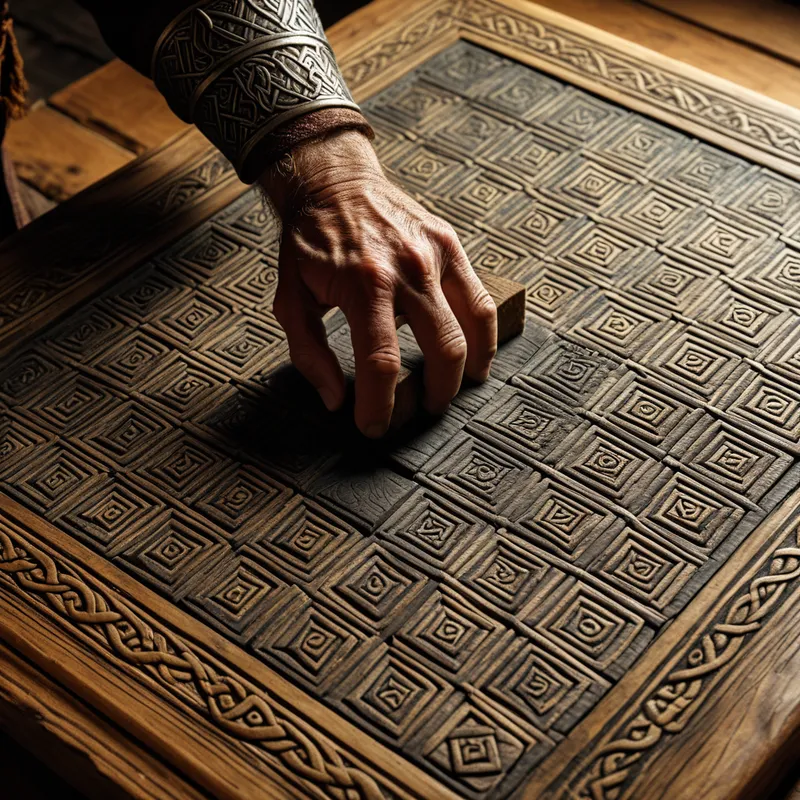
Hnefatafl was not merely a pastime; it was a cultural technology for thinking. From the Viking Age through the medieval period, across Scandinavia, Iceland, and the Norse settlements, boards have been found carved into stone, wood, and even into the very planks of ships. This was a game of the jarls and the contemplative, often played with expensive pieces of glass, antler, or amber.
Its primary context was likely the long, dark winters. By firelight, in the smoky interior of a hall, men would play out this ritual of asymmetric siege. It trained the mind in strategic thought, in seeing the whole board—the whole world—at once. It modeled the reality of their world: a central homestead or kingdom (the King) perpetually under potential threat from external forces (the attackers), requiring clever defense and the strategic use of limited resources. The game was a narrative engine, generating endless variations of the core myth without a single spoken word. It was history, prophecy, and strategy distilled into a silent dance on a checkered field.
Symbolic Architecture
The myth of Hnefatafl is a profound map of the psyche and the cosmos. The board itself is Yggdrasil’s order made manifest—a squared circle, the structured universe.
The King is the Self, the central, organizing principle of consciousness. He is not aggressive but purposeful. His goal is not conquest, but attainment of a sacred boundary.
The attackers represent the multitude—the chaotic outer world, the pressures of fate, the unconscious impulses, and the collective forces that seek to overwhelm individual sovereignty. They are not "evil," but are a necessary opposing force; without them, there is no game, no test, no meaning.
The defenders are the ego’s resources: consciousness, discipline, cultivated skills, and loyal complexes. Their role is sacrificial. They must be spent wisely to create openings for the Self.
The four corner sanctuaries are the transcendent functions—the points of contact with the divine or the complete Self. They are not "outside" the game but are its ultimate aim. Reaching one signifies not escape from life, but the successful integration of the center with the periphery, achieving a stable, renewed order.
The Dreamer's Resonance
When this myth stirs in the modern dreamer, it rarely appears as a literal board game. Instead, one dreams of being at the center of a pressing situation—a workplace closing in, a circle of demanding faces, a geometric room whose walls subtly constrict. The somatic feeling is one of silent pressure, of being strategically encircled. There is often a known goal—a door, a light, a symbol—that feels just out of reach, and the dream-ego knows it must move toward it without direct confrontation.
This dream signals a psychological state where the conscious ego (the defenders) feels outnumbered by unconscious contents or life demands (the attackers). The psyche is enacting the Hnefatafl process: it is forcing a crisis of navigation. The dream is asking: What are you willing to sacrifice—what old defense, what stubborn position—to create a path for your essential self to move toward wholeness? The anxiety in the dream is the tension of the game itself; the resolution, if it comes, is the profound relief of the King’s safe move.

Alchemical Translation
The alchemical process mirrored in Hnefatafl is that of coagulatio—the making solid, the attainment of the sacred stone, the Philosopher’s King. It models the individuation journey where the ego must learn to serve the Self.
The initial state is nigredo, the blackening: the King is surrounded, trapped in the material and psychological conflict. The húnn are the relentless prima materia, the chaotic stuff of life that seems hostile. The movement of the pieces is the separatio and circulatio—the sorting, the sacrificing of lesser attachments (defender pieces) to distinguish what is essential (the King).
The final move to the sanctuary is the rubedo, the reddening: the dawn of the conscious realization of sovereignty. It is the moment the ego understands its true role is not to be the solitary ruler, but the navigator for the deeper, central Self.
For the modern individual, this translates to any life situation where one feels besieged. The alchemical instruction is: Do not try to fight the encircling forces on their terms. Instead, identify your central, non-negotiable value (the King). Recognize what defenses (habits, beliefs, resources) can be strategically released to create space. Then, with patience and precision, move your core value toward its sanctuary—a integrated state of being where it is both central to your identity and safely connected to the boundaries of your world. You are not winning a war; you are completing a sacred circuit, affirming order within the beautiful, terrible game of existence.
Associated Symbols
Explore related symbols from the CaleaDream lexicon: