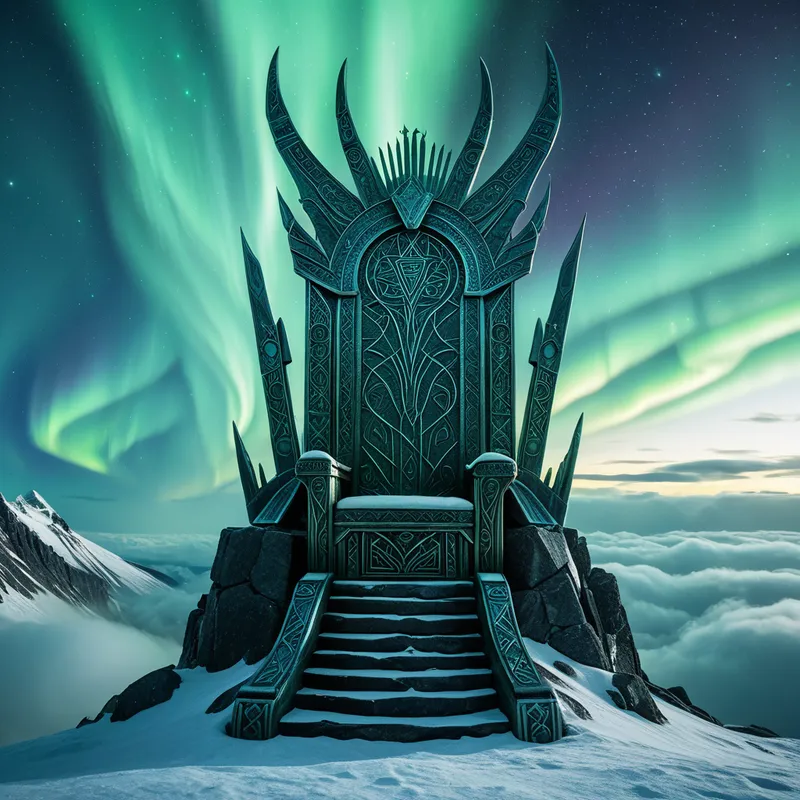
Hliðskjálf Myth Meaning & Symbolism
The myth of Odin's high seat, Hliðskjálf, from which all worlds are seen, revealing the power and peril of unbound perception.
The Tale of Hliðskjálf
Hear now of the seat that sees. Not in the deep earth, nor in the high branches of the Yggdrasil, but in the very heart of Asgard, within the shining hall of Oðinn. The air there is still, thick with the scent of aged wood and cold stone. It is a silence that listens.
They call it Hliðskjálf. No ordinary chair, this. Its back reaches toward the rafters like a silver cliff-face, carved with the secret histories of worlds. To sit upon it is to be undone and remade. For from Hliðskjálf, all things are laid bare. The nine realms are not distant lands, but patterns woven upon a single, vast tapestry. The murmur of the Jötnar in Jötunheimr is a clear whisper. The sigh of the dead in Valhalla is a chorus. The rooting of the great serpent Jörmungandr in the deep sea is a tremor felt through the bones of the throne.
And upon it sat the Allfather, his single eye like a cold star. He sought not gossip, but fate. He yearned to see the weave, not the thread. One day, his gaze, sweeping across Miðgarðr and beyond, snagged on a brilliance in Vanaheimr. It was Freyja, of the shimmering Brisingamen, in a moment she believed utterly private. The vision was not stolen; it was simply there, an unavoidable truth in the field of his perception. A profound violation, seamless and absolute.
The silence in the hall deepened. The ravens, Huginn and Muninn, ceased their rustling. The weight of the gaze settled, not as a weapon, but as a law of nature. For to see all is to be implicated in all. The knowledge was immediate, costly, and bore the bitter taste of sovereignty. The tale does not end with a battle or a curse, but with the slow, chilling understanding in Odin's own heart—the understanding that comes when one truly sees, and in seeing, is forever bound to the seen. The throne showed him everything, and in that everything, he found his own solitude.

Cultural Origins & Context
The myth of Hliðskjálf is woven into the Poetic Edda and Prose Edda, preserved in 13th-century Iceland but echoing beliefs far older. This was not a story for casual entertainment; it was a theological and philosophical cornerstone. In a culture where fate (ørlög) was woven by the Nornir and even gods were subject to Ragnarök, the question of knowledge and power was paramount.
The skald or storyteller recounting this myth would be addressing fundamental tensions in the Norse worldview. Odin is the god of kings, of the hanged, of the runes, and of poetry—a figure obsessed with wrenching knowledge from the cosmos to stave off an inevitable end. Hliðskjálf represents the ultimate expression of this obsession: a technology of consciousness. Its societal function was to model the paradox of leadership and wisdom. A king or chieftain must see—must know his lands, his people, his threats. But this myth warns that such sight is not a passive gift; it is an active, burdensome, and morally complex responsibility that isolates even as it empowers.
Symbolic Architecture
Hliðskjálf is not merely a watchtower; it is the archetypal seat of consciousness. It symbolizes the achieved point of awareness from which the totality of one’s inner and outer worlds becomes simultaneous. It is the pinnacle of perception, where the observer is no longer a participant in the drama but its director and witness.
The throne is the fixed point around which the universe revolves, but to sit upon it is to become the axis, bearing the weight of all rotation.
The myth’s central conflict is not between Odin and Freyja, but between sight and privacy, knowledge and innocence, power and connection. Odin’s gaze violates not out of malice, but because absolute perception cannot respect boundaries. In the symbolic architecture, Freyja represents that which is whole, contained, and sovereign in its own right—the other that is consumed by being fully known. The throne thus becomes an instrument of profound alienation, revealing that to see everything is to be separate from everything. It is the ultimate symbol of the ego’s aspiration to complete control through complete knowledge, and the existential loneliness that is its inevitable price.
The Dreamer's Resonance
When this myth stirs in the modern unconscious, it often manifests in dreams of overwhelming vision or surveillance. The dreamer may find themselves in a high place—a lighthouse, a skyscraper penthouse, a mountain summit—from which they can see every detail of their life, their city, or their relationships with terrifying clarity. Alternatively, they may dream of being the object of such a gaze, feeling exposed and known in a way that is less loving than anatomizing.
Somatically, this can feel like a pressure behind the eyes, a hyper-vigilant alertness, or a chilling detachment. Psychologically, it signals a critical phase in the process of self-awareness. The psyche is attempting to integrate disparate parts—the repressed memories (the distant lands of Jötunheimr), the inner potentials (the shining beauty of Vanaheimr), and the buried traumas (the cold halls of Hel). The dream-throne forces a panoramic view the waking ego may resist. The discomfort is the friction of individuation—the necessary, painful act of seeing oneself and one’s world whole, without the filters of story or self-deception.

Alchemical Translation
The alchemical journey modeled by Hliðskjálf is the transmutation of partial sight into holistic perception, and the subsequent integration of the seer with the seen. The base material is our fragmented, ego-bound consciousness, which sees only what serves its immediate needs and narratives. The first operation is ascent—the difficult climb to a vantage point beyond the personal. This is the work of meditation, therapy, and shadow-work, sacrificing the comfort of limited perspective.
The throne is forged in the fire of attention and cooled in the waters of non-judgment. To sit upon it is to hold the tension between knowing and being.
The climax, the viewing of Freyja, represents the coniunctio or sacred marriage within the psyche. It is not a union of love, but of awareness. The conscious mind (Odin) fully beholds the anima, the soul-image, or a core complex (Freyja) in its pristine, autonomous reality. This is a violent grace—it shatters illusions of ownership or projection. The final stage is not mastery, but sovereign responsibility. The alchemist does not rule what they see; they bear witness. The gold produced is not power over others, but the unshakeable, lonely, and ultimately compassionate authority of one who has seen the full pattern of their own fate and chosen to engage with it consciously. The throne remains, but the seer is forever changed, carrying the high hall within.
Associated Symbols
Explore related symbols from the CaleaDream lexicon: