Hiranyagarbha Myth Meaning & Symbolism
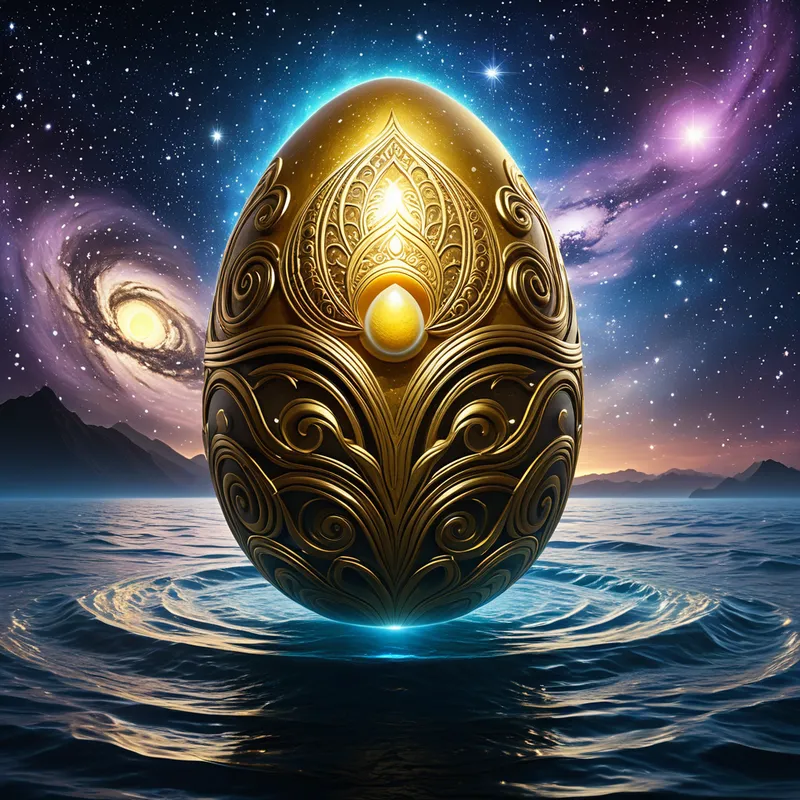
The primordial golden egg from which all existence emerges, a cosmic womb containing the seed of Brahma and the potential for all worlds.
The Tale of Hiranyagarbha
Before time had a name, before space had a measure, there was only the One. Not a being, but a presence—a boundless, silent, dark expanse. The Apas, the waters of potential, lay in a dreamless, motionless sleep. There was no above, no below, no here, no there. Only a profound, pregnant stillness.
Then, a vibration. A hum that was not a sound, but the first intention of sound. A warmth that was not light, but the desire for light. From the heart of that infinite darkness, a golden radiance began to coalesce. It was not a sun, for there was no sky to hold it. It was a concentration, a gathering of the essence of all that could be. It swelled in the womb of the void, taking form not as a star or a god, but as an egg. A perfect, self-contained Hiranyagarbha.
It floated, solitary and magnificent, upon the waters of the causeless cause. For an acon, which is both a moment and an eternity, it rested, incubating the totality of existence within its luminous shell. Inside, the principles of heat and cold, male and female, substance and spirit, churned in a divine alchemy.
Then came the stirring. From within the golden heart of the egg, a consciousness awoke. It was the Brahma, the architect of worlds, though he did not yet know his name or his task. He felt the confines of his glorious prison and, with a thought that was also an act, he stretched. The shell, which was the boundary between being and non-being, could not contain the force of this awakening desire.
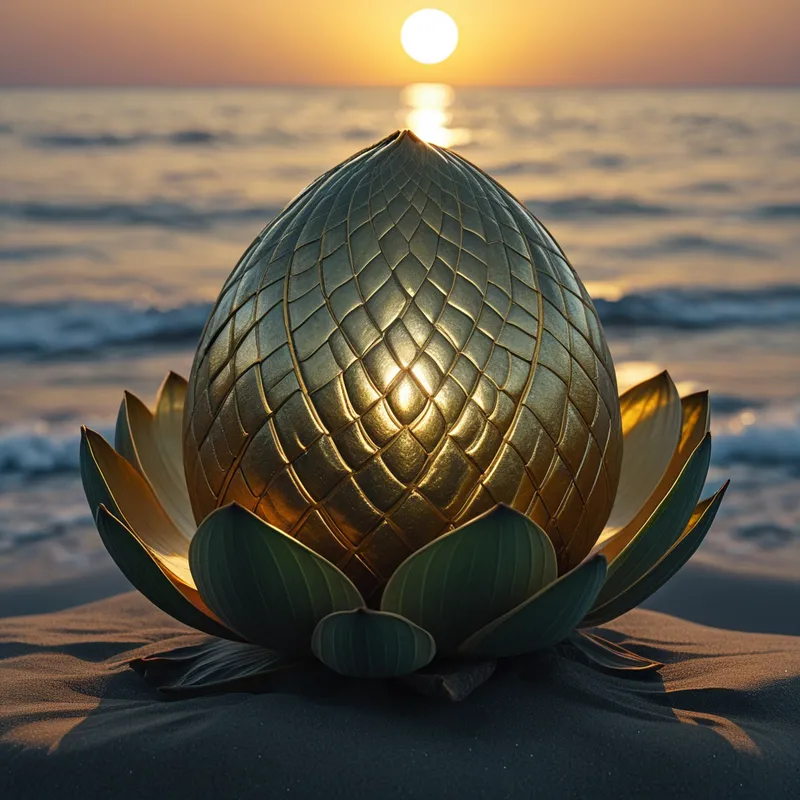
With a sound that was the mother of all sounds—the sacred syllable Aum—the Hiranyagarbha split. Not with violence, but with the inevitability of a lotus bud opening to the dawn. The two halves of the golden shell parted. One rose upward, becoming the vault of the heavens. The other sank downward, becoming the foundation of the earth. And in the space between, Brahma stood upon a lotus that grew from the navel of the Vishnu, who rests upon the cosmic serpent in the very same waters.
The golden womb had given birth. Not to a child, but to the possibility of children—to the three worlds, the directions, the elements, and the endless cycle of days and nights. The radiant substance of the Hiranyagarbha did not vanish; it became the subtle fabric of reality itself, the golden thread woven into the tapestry of all that is, was, and will be.
Cultural Origins & Context
The myth of the Hiranyagarbha is not a single story from a single book, but a foundational concept woven into the earliest philosophical strata of Vedic thought. It appears in the majestic Rigveda (RV 10.121), in the profound Upanishads like the Maitrayaniya, and is elaborated in the grand narrative compendiums, the Puranas.
Its primary tellers were the rishis, who transmitted it not merely as a creation story, but as a cosmological principle. Its function was multifaceted: it provided an origin myth that moved beyond tribal gods, offering a unified, abstract source for the cosmos. It served as a bridge between the ritualistic fire sacrifices of the early Vedas and the later, introspective quest for Brahman. Societally, it established a model of the universe as an organic, living emanation from a single, radiant source, reinforcing the idea of an inherent, divine order (rita/dharma) woven into creation itself.
Symbolic Architecture
The Hiranyagarbha is the ultimate symbol of unmanifest potential. It is not chaos, but structured latency. The golden shell represents the boundary of the phenomenal world, the maya that both contains and conceals the infinite. The waters upon which it floats are the subconscious of the cosmos, the formless prakriti before it is catalyzed by consciousness (purusha).
The cosmic egg is the psyche in its pre-personal state: whole, complete, and asleep to its own contents. To crack it is the first act of awareness, which is simultaneously an act of self-limitation and creation.
Psychologically, Hiranyagarbha represents the Self in its embryonic, pre-individuated state. It is the totality of the psyche—conscious and unconscious, personal and collective—before the ego (Brahma, the creator who must actively differentiate) arises to organize it. The cracking of the egg is the inevitable, often traumatic, birth of consciousness itself. It is the moment we realize we are separate from the undifferentiated unity, initiating the lifelong project of exploring and integrating the worlds (inner and outer) that have been born from that rupture.
The Dreamer's Resonance
When this myth stirs in the modern dreamer, it often signals a profound state of psychic pregnancy. One may dream of being inside a glowing sphere, a protective but confining bubble, or a room with golden walls. There is a feeling of immense potential coupled with a sense of waiting, of incubation. The somatic experience can be one of warmth, fullness, or slight pressure—a sense of being about to become.
This dream pattern manifests when the unconscious is preparing a major reorganization of the personality. A new complex, a latent talent, or a deeper understanding of one's purpose is gestating. The conflict is not yet external; it is the internal tension between the comfort of undifferentiated potential and the urgent, life-giving need to emerge. The dreamer is in the liminal space between being and becoming. The resolution in the dream—whether the shell cracks, dissolves, or is peacefully left behind—hints at the psyche's readiness (or resistance) to the impending birth of a new conscious attitude.
Alchemical Translation
The journey of the Hiranyagarbha models the alchemical opus of individuation. The first matter (prima materia) is the undifferentiated psyche—the "dark waters" of our unresolved past, instincts, and collective inheritance. The "heating" process is the application of conscious attention, often through suffering, analysis, or creative work. This heat causes the golden essence—the unique, divine core of the individual, the Atman—to coagulate into an "egg."
Individuation is not about creating a self, but about incubating the Self that already is, until it is strong enough to break its own shell and assume its creative authority.
The sustained incubation is the period of inner work, where one holds the tension of opposites without rushing to premature conclusions. Finally, the cracking is the nigredo giving way to the albedo—the dawn of a new, more comprehensive consciousness. The risen shell becomes the expanded structure of the personality, capable of holding a wider reality. The fallen shell becomes the grounded connection to the earthly world. The modern individual undergoing this process moves from a state of passive potential (floating in the waters of life's circumstances) to active creation (becoming the Brahma of their own inner universe), ordering their chaos into a cosmos with its own inherent law and beauty. The goal is not to return to the golden egg, but to recognize that its substance now constitutes the very ground of one's being.
Associated Symbols
Explore related symbols from the CaleaDream lexicon: