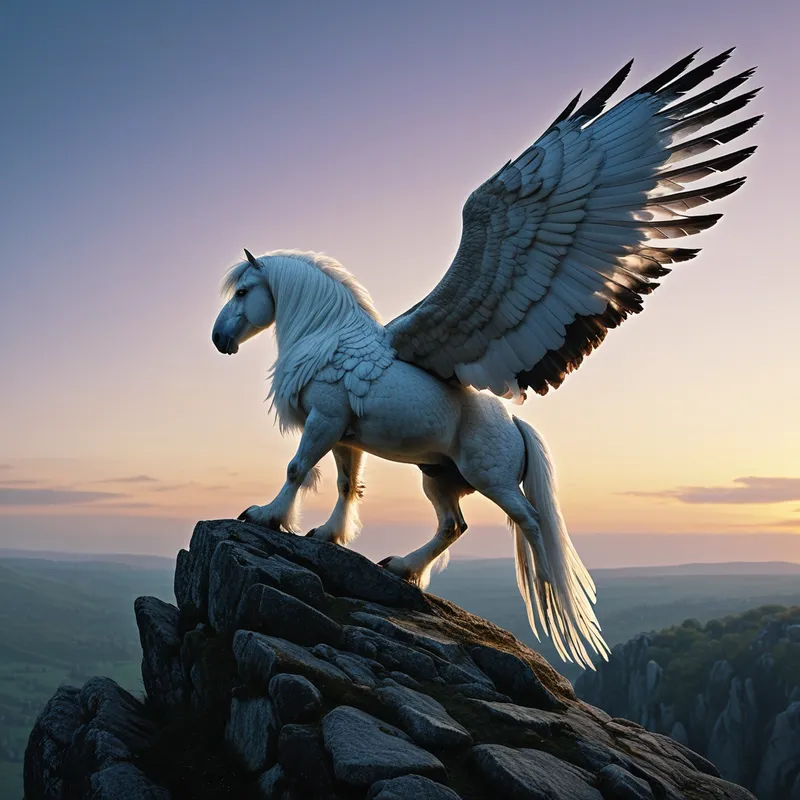
Hippogriff Myth Meaning & Symbolism
A creature born of eagle and mare, the Hippogriff symbolizes the improbable union of opposites, tamed only by the purest courage and love.
The Tale of the Hippogriff
Hear now a tale not of the earth, nor of the sky, but of the impossible seam between them. In an age when maps bore dragons at their edges and the air itself was thick with portent, there existed a creature spoken of in hushed tones by firelight. Its name was Hippogriff.
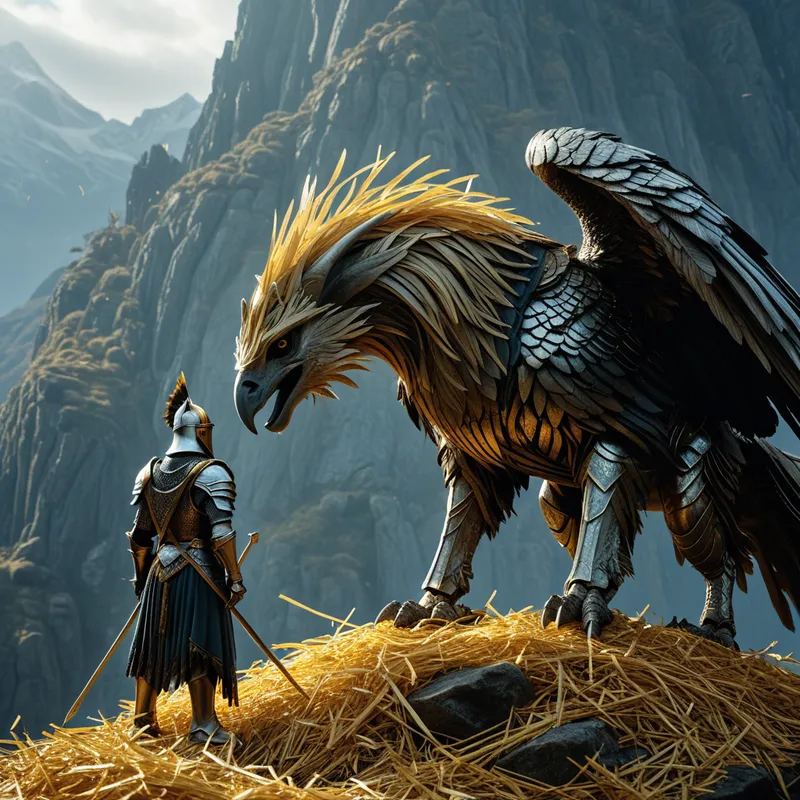
It was said to dwell in the highest, most remote crags of the Riphaean Mountains, where the winds are knives and the clouds are its floor. Its nest was not of twigs, but of gilded straw and the bones of those who sought to claim its glory, woven with threads of lightning. Its foreparts were those of a monstrous eagle, feathered in tawny gold and storm-grey, with a beak that could crack stone and eyes that held the pitiless blue of a high winter sky. From the ribs back, it was a stallion of impossible perfection, muscles coiled like river-currents under a coat of purest white. When it moved, it was the thunder of hooves; when it took flight, it was the silencing of the storm.
Many a lord, armored in pride and the finest steel, climbed those bitter slopes. They came with nets of silver chain and spells written on parchment. They sought to bind the creature, to make its power their own, to prove that will alone could master the impossible. The mountain returned their armor to the valleys, piece by piece, tarnished and empty. The Hippogriff remained, a solitary king of an airy realm, its cry a challenge that echoed in the dreams of the pure and the ambitious alike.
Then came one not of renown. A youth, perhaps, or a knight whose deeds were written in kindness, not in blood. He bore no net, and his sword remained sheathed. His climb was not an assault, but a pilgrimage. When he finally stood on the ledge, the wind screaming around him, the beast did not attack. It watched, those ancient eyes seeing not a threat, but a question. The knight did not reach for a weapon. Instead, he bowed his head, and offered what he had: his own vulnerability, his awe, and a heart unclouded by the desire to possess.
A silence fell, deeper than the mountain’s. The Hippogriff paced, the clash of its dual nature a discordant rhythm—clip-clop, scrape-scrape. Then, it lowered its great eagle’s head. The knight, his hand steady though his soul trembled, touched the feathered neck. It was not a capture, but a covenant. In that touch, the impossible seam was stitched. With a cry that was neither eagle’s shriek nor horse’s whinny, but a new, third sound, the Hippogriff knelt. And when the knight mounted, they did not simply fly; they became flight itself, a single entity soaring over the world of either/or, leaving the realm of mere possibility far below.
Cultural Origins & Context
The Hippogriff is a creature of late medieval romance, a product of the literary imagination rather than ancient folk belief. Its most famous appearance is in Orlando Furioso by Ludovico Ariosto, where it serves as the steed of the hero Ruggiero. Ariosto did not invent it from nothing; he was playing a sophisticated literary game. The concept stems from a line by the Latin poet Vergil, who wrote of grafting different species as a metaphor for impossibility: “to cross griffins with horses.” Medieval bestiaries were filled with chimeras like the Griffin, a symbol of divine power, often shown as the enemy of horses. The Hippogriff, by being the offspring of that impossible enmity, was a witty, poetic escalation—a symbol not just of hybridity, but of reconciliation.
Its societal function was multifaceted. For the aristocratic audiences of chivalric romances, it was a symbol of the highest, most rarefied quest, attainable only by the most virtuous knight. It also reflected a medieval worldview obsessed with categorization and the wondrous violation of those categories. In a culture that rigidly defined the realms of animals, humans, and angels, creatures like the Hippogriff existed in the thrilling, dangerous borderlands, challenging the very order of God’s creation. It was a narrative device that allowed the hero to transcend ordinary geography and moral dilemmas, literally rising above the tangled earthly conflicts of the poem.
Symbolic Architecture
The Hippogriff is the embodied symbol of the coniunctio oppositorum—the sacred marriage of opposites. It is not a clumsy graft, but a new, coherent whole born from irreconcilable parents.
The Griffin represents the sovereign union of the King of the Beasts (lion/earth) and the King of the Birds (eagle/air)—a divine, untouchable totality. The horse, especially in medieval symbology, represents instinct, passion, the chthonic force of nature, and the mortal body. Their union is not just unlikely; it is heresy against the natural order. Thus, the Hippogriff is the child of a metaphysical revolution.
Psychologically, it represents the integration of our highest aspirations (the eagle: spirit, intellect, ambition) with our grounded, instinctual nature (the horse: body, passion, the unconscious). We often experience these as at war: the mind judging the body’s needs, spiritual goals feeling sabotaged by earthly desires. The Hippogriff is the living proof that this war can end in a generative truce, creating a new faculty of being—the ability to move with grounded power and spiritual vision.
The knight who tames it does so not through force, but through recognition and courage of a different order. His victory is one of relationship, not domination. He must approach the impossible not as a problem to be solved, but as a being to be met.
The Dreamer's Resonance
When the Hippogriff appears in a modern dream, it rarely arrives as a simple, majestic figure. Its manifestation is often fraught with the tension of its own nature. One might dream of a beautiful horse that suddenly sprouts ragged, unfinished wings, struggling to lift off. Or a powerful eagle found tangled in stable harnesses, shrieking in frustration. The dreamer may be trying to saddle it, only to find the tack doesn’t fit, or they may be fleeing from it as it alternates between a charging stallion and a diving raptor.
These dreams signal a critical phase in what Jung called the transcendent function—the psyche’s attempt to create a third, reconciling position from two conflicted opposites within the self. The somatic feeling is often one of exhilarating yet terrifying instability: the ground feels unsure, the air feels too thin. Psychologically, the dreamer is grappling with a profound inner division—perhaps between a demanding career (eagle) and a longing for creative freedom or family (horse), or between a spiritual ideal and a compelling physical desire. The Hippogriff’s chaotic presence indicates that these opposites have collided with enough force to potentially generate something new, if the dreamer can find the courage to stay present in the dissonance without forcing a premature, one-sided resolution.
Alchemical Translation
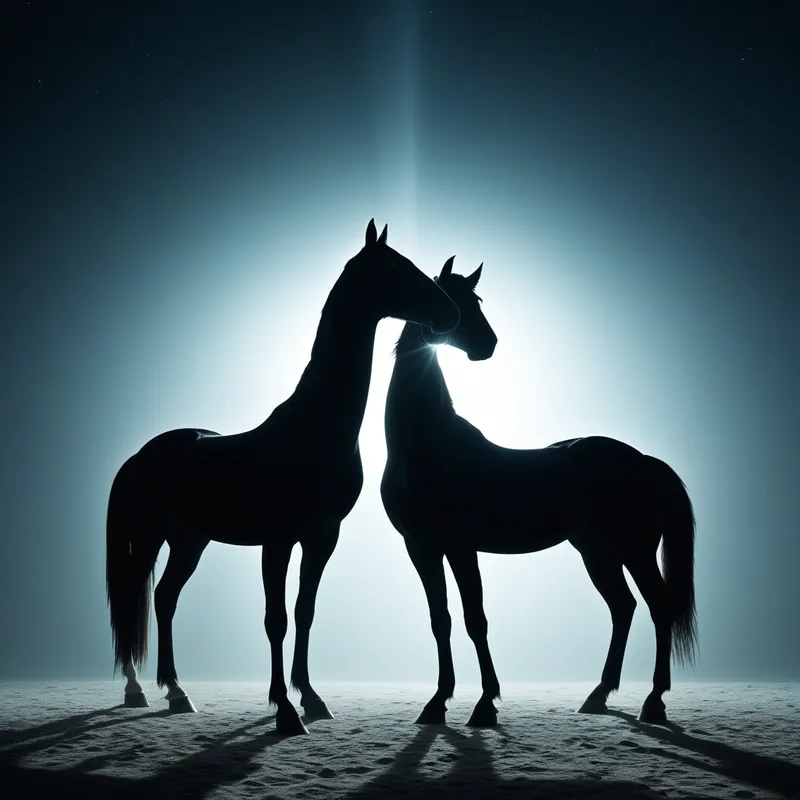
The myth of the Hippogriff is a perfect allegory for the alchemical process of individuation. The initial state is one of stark opposition: the Griffin (a fixed, archetypal symbol of spiritual power) and the Mare (the raw, fertile, but unrefined prima materia of the personal psyche). Their enmity is the neurosis, the inner conflict that causes suffering.
The knight’s journey up the mountain is the arduous work of consciousness, confronting the heights and depths of one’s own nature. The offering of the empty hand is the crucial stage of mortificatio—the death of the old, heroic ego that seeks to conquer the unconscious. It is an act of surrender to a truth greater than the will.
Taming the Hippogriff is the coniunctio itself. It represents the birth of the Self, the central archetype of wholeness. This new entity is the “winged horse,” the integrated personality. It possesses the eagle’s panoramic consciousness and the horse’s connection to the life force. Flight, then, is the symbol of the transcendent function realized—the ability to navigate life from this unified perspective, to see the pattern (eagle’s view) while remaining fully embodied in the journey (horse’s gait).
For the modern individual, the process is not about finding a mythical beast, but about recognizing the “Hippogriff moments” in our own lives. These are the instants when a long-standing inner conflict suddenly, unexpectedly, reveals a hidden unity—when a perceived weakness is seen as the necessary ground for a strength, or when a lofty ideal finds its perfect, practical expression. To ride the Hippogriff is to live from that integrated center, where spirit and instinct are not masters and servants, but partners in the singular act of becoming.
Associated Symbols
Explore related symbols from the CaleaDream lexicon: