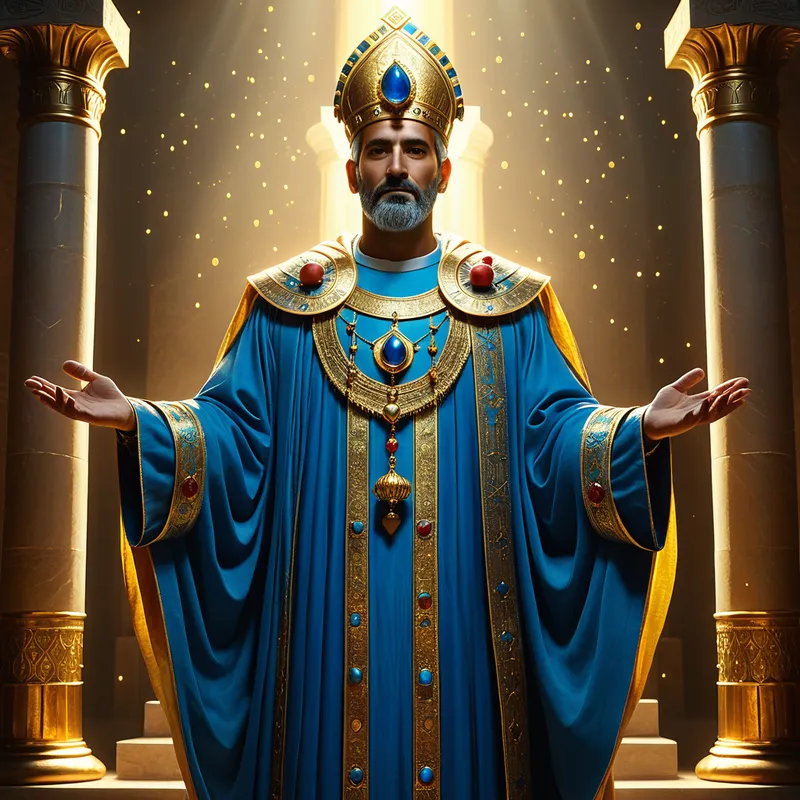
High Priest's garments Myth Meaning & Symbolism
A sacred vestment woven from sky, earth, and spirit, worn to bridge the chasm between the human and the divine on the holiest of days.
The Tale of the High Priest's garments
Hear now the tale of the Garments of Glory, woven not merely of thread and gold, but of covenant and terror.
In the heart of the desert, under a sky scraped raw by the sun, stood the Mishkan—the Dwelling. It was a place of whispers and smoke, where the presence of the Tetragrammaton pressed against the fabric of the world like a breath held too long. And into this charged silence, once a year on the Day of Atonement, Yom Kippur, one man alone would walk.
He was the Kohen Gadol, the High Priest. But before he could dare approach the inner veil, he must be unmade and remade. They would wash his body with pure water, not for cleanliness, but for dissolution—stripping him of his common self. Then, layer by sacred layer, they would clothe him in a new identity.
First, the linen tunic, simple and pure, touching his skin. Over it, the robe of the ephod, entirely of blue, the color of the heavens. At its hem, alternating bells of gold and woven pomegranates: a sound of approach and a symbol of fertility, life announcing itself to death. Then the ephod itself, of gold, blue, purple, scarlet, and fine twined linen, a tapestry of the cosmos. On its shoulders, two shoham stones, each engraved with the names of six tribes of Israel. The weight of the people was upon his shoulders, a literal burden of intercession.
Upon his heart, they fastened the Choshen Mishpat, the Breastplate of Judgment. A square of folded fabric, set with twelve stones in four rows—carnelian, topaz, emerald—each stone a tribe, each tribe a facet of a fractured whole. Within its fold lay the Urim and Thummim, the mysterious instruments of divine clarity. On his head, the final crown: a mitre of fine linen, and upon his forehead, a plate of pure gold, inscribed with the words Kodesh La'YHWH.
Thus armored in sanctity, he became a living bridge. He would take the blood of the bull, his own sin offering, and the blood of the goat, the people’s offering, and pass through the veil into the Kodesh HaKodashim, the Holy of Holies. Here, in a darkness so absolute it was palpable, above the kapporet of the Ark, the Presence dwelt. To stand here, incorrectly attired, incorrectly intentioned, was to be unmade by holiness. He would sprinkle the blood, speaking the sacred name, weaving a thread of atonement from the profane earth to the sacred heart of heaven. The bells on his hem would tinkle a fragile song of a living man in the realm of absolute life—a sound for those waiting outside, a proof he had not been consumed.
And then, he would emerge. Pale, trembling, sanctified. The garments, now charged with the encounter, were removed, and he would return to his brothers, a man again, bearing the fragile peace of a year’s reconciliation.
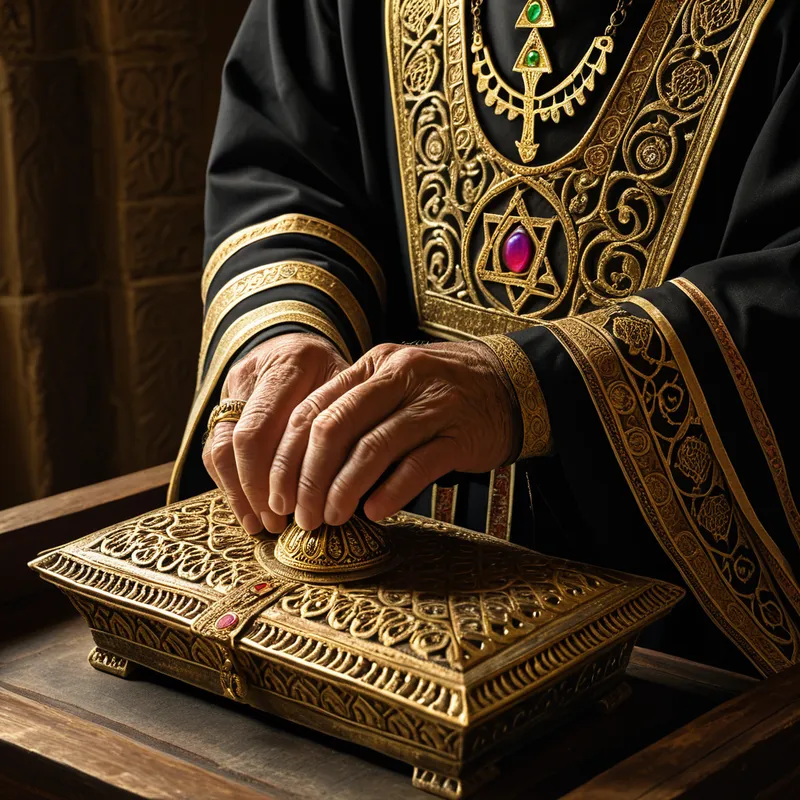
Cultural Origins & Context
This is not a myth from the misty prehistoric past, but a detailed, prescriptive ritual recorded in the Torah, primarily in the book of Exodus. It emerged from the crucible of the Israelite experience in the wilderness, following the revelation at Sinai. Its function was profoundly societal and cosmological. The Mishkan was understood as a microcosm of creation, and the High Priest’s ritual as the act that sustained the cosmic order and maintained the covenant between YHWH and His people.
The story was passed down not as a folktale but as sacred law, studied by priests and later by rabbis. Its telling was both instructional and awe-inspiring, a reminder that the community’s relationship with the divine was fragile, mediated, and required exacting protocols. The garments were not personal attire but official, consecrated vessels. Their creation was attributed to divinely inspired craftsmen, Bezalel and Oholiab, blurring the line between crafting and divine revelation. This ritual was the axis around which the ancient Israelite understanding of sacred space, mediated atonement, and communal identity turned.
Symbolic Architecture
The garments are a perfect symbolic architecture for the psychology of mediation and conscious transformation. The Priest does not approach as a naked soul, but as a consciously constructed entity. Each layer represents a necessary aspect of bringing the fragmented self and the fragmented community into a state of wholeness before the ultimate unity.
The vestments are not a disguise, but a revealed anatomy of the soul tasked with bearing the sacred.
The shoulder stones symbolize the burden of collective responsibility carried consciously. The breastplate over the heart represents the organization of one’s deepest loves, loyalties, and judgments (the tribes) into a coherent, beautiful, and functional order. The Urim and Thummim within it signify the intuitive, non-rational faculty required for discernment in moments of supreme ambiguity. The golden plate on the forehead, inscribed with “Holiness to the LORD,” marks the ultimate dedication of the intellect and identity to a transcendent purpose. Even the bells and pomegranates embody the paradox: the audible proof of life in the place of absolute being (bells), and the fertile, seeded potential of the material world (pomegranates) adorning the hem of the garment that enters the realm of pure spirit.

The Dreamer's Resonance
When this myth surfaces in modern dreams, it rarely appears as biblical pageantry. Instead, one might dream of wearing an impossibly heavy, ornate jacket or uniform that feels both empowering and suffocating. One might dream of a task where they must carry a fragile, complex object (the breastplate) representing their family, workplace, or all their relationships into a terrifyingly important meeting (the Holy of Holies). The somatic feeling is often one of immense pressure on the shoulders and chest, a literalized “weight of the world.”
Psychologically, this dream pattern signals a confrontation with the archetype of the mediator. The dreamer is in a process where they must consciously hold tension—between personal desire and collective responsibility, between instinct and morality, between chaos and order. The dream asks: What have you taken upon your shoulders? What judgments are you carrying over your heart? Are you attempting to approach a profound inner truth (the Self) in a haphazard way, or are you preparing meticulously, constructing a conscious vessel capable of containing the experience?

Alchemical Translation
The alchemy here is not of base lead to gold, but of the scattered psyche into a vessel for the Self. The individuation process modeled is one of conscious ritualization of the personality.
First, the washing: the dissolution of the ego’s casual identity. Then, the donning of the garments: the deliberate, artful construction of a persona in its highest, most sacred sense—not a mask to hide behind, but an instrument crafted for a specific, transcendent function. The ego (the priest) does not disappear; it becomes the operator of this intricate psychological technology.
The goal is not to live in the sacred garments, but to learn how to wear them when entering the inner sanctum, and how to remove them upon return.
The journey into the Kodesh HaKodashim is the confrontation with the numinous core of the psyche. The “blood” he carries is the vital life-force of one’s own sins (the bull) and the shared burdens of one’s community or inherited complexes (the goat). To bring this raw material before the ultimate source of meaning is the act of atonement (at-one-ment)—reintegrating the rejected and the burdensome into a reconciled whole.
The return is critical. The modern individual must learn this same rhythm: the courage to consciously prepare, to enter the terrifying depths of self-confrontation, and then to return, integrating that sanctifying awareness back into the ordinary world. We are all, at times, called to be our own High Priest—to bear the weight of our choices with conscious dignity, to organize the chaos of our hearts into something discerning and beautiful, and to approach our deepest truths not with casual arrogance, but with prepared, reverent intent.
Associated Symbols
Explore related symbols from the CaleaDream lexicon: