
High Priest's Breastplate Myth Meaning & Symbolism
A sacred garment of twelve stones representing the tribes, worn by the High Priest to bear their names and discern divine will before the presence of Yahweh.
The Tale of the High Priest’s Breastplate
Breathe the dust of [the desert](/myths/the-desert “Myth from Biblical culture.”/), hot and fine. Feel the weight of a people, countless as the sand, camped at the foot of a trembling mountain where the air itself crackles with a presence too vast to name. This is not a place for kings, but for a mediator. A bridge.
In the heart of the camp, a space is hollowed out—not by human hands, but by divine instruction. The [Tabernacle](/myths/tabernacle “Myth from Biblical culture.”/) stands, a tent of woven threads and beaten gold, a fragile vessel for the uncontainable. And for Aaron, the priest, a garment is fashioned. Not for battle, but for bearing. Not for rule, but for resonance.
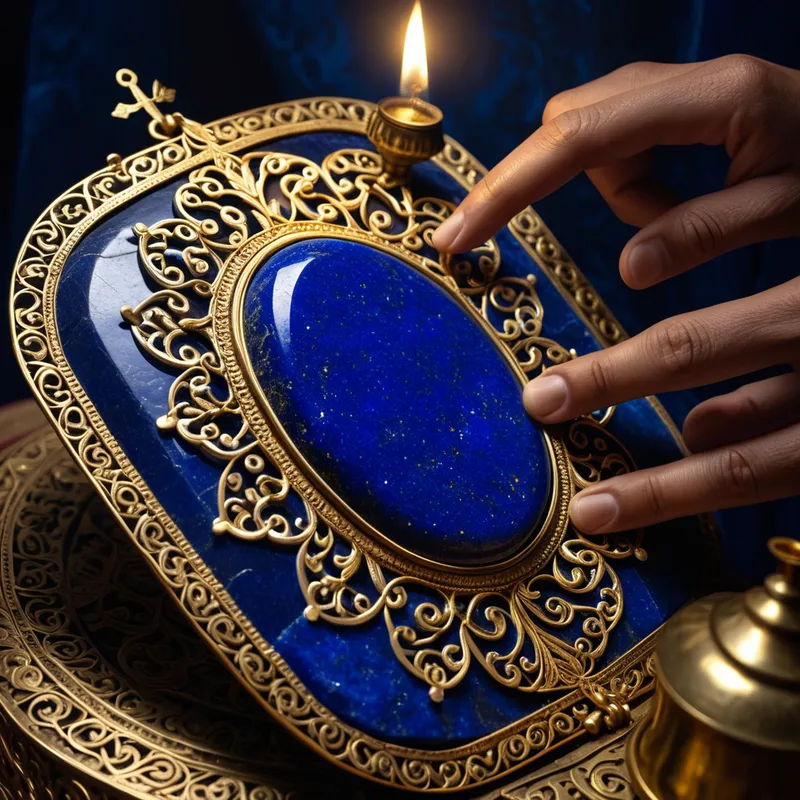
The craftsmen, Bezalel and Oholiab, work with trembling reverence. They take gold, blue, purple, and scarlet thread, weaving the ephod. But upon the heart, they place the masterpiece: the Breastplate of Judgment. A square of doubled linen, a span in width, set with four rows of three stones. Each stone is a world: a carnelian like captured sunset, a topaz holding pale light, an emerald of deep earth, a sapphire of night sky, a diamond’s fierce clarity, and others—twelve in all. Their names are engraved, not with chisel, but as if by the finger of a star: Reuben, Simeon, Levi, Judah… the names of the twelve tribes.
This breastplate is fastened with golden chains to the ephod’s shoulders, where two onyx stones rest. Aaron dons the linen tunic, the robe with pomegranates and golden bells, the turban with its plate of pure gold inscribed “HOLY TO YHWH.” Finally, he places the breastplate over his heart. He does not merely wear jewels; he carries a people. Their strife, their hope, their failures, their covenant—all are borne upon him into the Holy Place.
Once a year, on the Day of Atonement, the tension coils to its peak. The people hold their breath. Aaron, laden with the names, enters through [the veil](/myths/the-veil “Myth from Various culture.”/) into the terrifying silence of the Holy of Holies. There, before the Ark of the Covenant and the shimmering, unapproachable presence, he offers blood for the sins of the nation. The breastplate is there, over the heart that beats with mortal fear and sacred duty. And within the breastplate rest the [Urim and Thummim](/myths/urim-and-thummim “Myth from Biblical culture.”/)—mysterious stones of “Lights and Perfections.” Through them, the inarticulate cry of the people is translated; through the priest, the silent will of God is discerned. He emerges, not with a conqueror’s smile, but with the weary grace of one who has stood in the breach and lived. The bells on his robe have sounded, a tiny, brave music in the overwhelming silence, a sign that the mediator still breathes, and the connection holds.
Cultural Origins & Context
This is not a myth from the mists of pre-history, but a detailed ritual prescription embedded in the legal and narrative heart of [the Torah](/myths/the-torah “Myth from Jewish culture.”/), specifically the book of Exodus. It originates from the formative, wilderness period of ancient Israel, a time of forging a national and religious identity distinct from the empires of Egypt and Canaan. The story of the breastplate’s construction is presented as direct divine revelation to [Moses](/myths/moses “Myth from Biblical culture.”/) on [Mount Sinai](/myths/mount-sinai “Myth from Biblical culture.”/), making it a cornerstone of the priestly (P) tradition.
Its primary function was societal and theological. It served as a powerful, tangible symbol of unity. The twelve disparate tribes, each with its own character and territory (or priestly role, in Levi’s case), were literally bound together on the heart of their representative before God. The breastplate ritualized the concept of collective responsibility and mediated identity. Furthermore, it established the Aaronic priesthood as the essential conduit between the holy, transcendent deity and the flawed, human community. The “Judgment” in its name was active—it was the instrument for discerning divine will in matters of law, war, and leadership. Passed down through priestly lineages and meticulously recounted in liturgy, the myth of the breastplate reinforced a world order where chaos was held at bay through sacred order, ritual precision, and an authorized human agent who could bear the terrifying privilege of proximity to the Divine.
Symbolic Architecture
The Breastplate is a supreme [symbol](/symbols/symbol “Symbol: A symbol can represent an idea, concept, or belief, serving as a powerful tool for communication and understanding.”/) of the mediated self. It represents the conscious, constructed [identity](/symbols/identity “Symbol: Identity represents the sense of self, encompassing personal beliefs, cultural background, and social roles.”/) that stands at the [intersection](/symbols/intersection “Symbol: An intersection symbolizes the crossroads of decision-making, presenting choices and the potential for change.”/) between the inner totality of a people (or an individual [psyche](/myths/psyche “Myth from Greek culture.”/)) and the transcendent “Other.”
The priest does not speak for himself, but bears the names. The self becomes a vessel for the chorus of the whole.
The twelve stones are the clearest symbol. They represent the complete, differentiated whole—the twelve tribes, the twelve months, the zodiacal completeness of the [cosmos](/symbols/cosmos “Symbol: The entire universe as an ordered, harmonious system, often representing the totality of existence, spiritual connection, and the unknown.”/) in [microcosm](/symbols/microcosm “Symbol: A small, self-contained system that mirrors or represents a larger, more complex whole, often reflecting the universe within an individual.”/). No tribe is omitted; the scoundrel and the [king](/symbols/king “Symbol: A symbol of ultimate authority, leadership, and societal order, often representing the dreamer’s inner power or external control figures.”/), the merchant and the [farmer](/symbols/farmer “Symbol: Farmers symbolize hard work, nurturing, and the cultivation of not just crops, but also personal growth and community.”/), all have their place on the [heart](/symbols/heart “Symbol: The heart symbolizes love, emotion, and the core of one’s existence, representing deep connections with others and self.”/). Psychologically, this is [the ego](/myths/the-ego “Myth from Jungian culture.”/)’s [task](/symbols/task “Symbol: A task represents responsibilities, duties, or challenges one faces.”/) of acknowledging and integrating the full [spectrum](/symbols/spectrum “Symbol: A continuum of possibilities, representing diversity, transition, and the full range of existence from one extreme to another.”/) of one’s inner “tribes”—the various complexes, talents, wounds, and sub-personalities that constitute [the Self](/myths/the-self “Myth from Jungian culture.”/).
The position over the heart is crucial. Judgment here is not cold intellect, but heartfelt discernment. The Urim and Thummim, whose exact [nature](/symbols/nature “Symbol: Nature symbolizes growth, connectivity, and the primal forces of existence.”/) is deliberately obscure, symbolize the mysterious process by which [intuition](/symbols/intuition “Symbol: The immediate, non-rational understanding of truth or insight, often described as a ‘gut feeling’ or inner knowing that bypasses conscious reasoning.”/) and [clarity](/symbols/clarity “Symbol: A state of mental transparency and sharp focus, often representing resolution of confusion or attainment of insight.”/) (“Lights and Perfections”) emerge from the [tension](/symbols/tension “Symbol: A state of mental or emotional strain, often manifesting physically as tightness, pressure, or unease, signaling unresolved conflict or anticipation.”/) of holding opposites. The answer is not spoken; it is revealed from the [depth](/symbols/depth “Symbol: Represents profound layers of consciousness, hidden truths, or the unknown aspects of existence, often symbolizing introspection and existential exploration.”/) of the carried burden.
The golden chains linking it to the [shoulder](/symbols/shoulder “Symbol: Shoulders are symbols of support, burden-bearing, and personal strength, representing the weight of responsibilities and the ability to carry them.”/) stones signify that this burden of wholeness is also a [responsibility](/symbols/responsibility “Symbol: Responsibility in dreams often signifies the weight of duties and the expectations placed upon the dreamer.”/) that rests on one’s [strength](/symbols/strength “Symbol: ‘Strength’ symbolizes resilience, courage, and the ability to overcome challenges.”/) and [authority](/symbols/authority “Symbol: A symbol representing power structures, rules, and control, often reflecting one’s relationship with societal or personal governance.”/) (the shoulders). The entire apparatus is connected; the heart’ burden and the [shoulder](/symbols/shoulder “Symbol: Shoulders are symbols of support, burden-bearing, and personal strength, representing the weight of responsibilities and the ability to carry them.”/)’s duty cannot be separated.
The Dreamer’s Resonance
When this myth stirs in the modern dreamer, it often signals a profound process of ethical or integrative crisis. One might dream of a heavy, beautiful chest plate, of trying to fit mismatched stones into slots, or of standing before a great, silent presence while wearing a garment that feels both empowering and unbearably heavy.
Somatically, this can manifest as pressure or warmth in the chest center—a feeling of being “on the heart.” Psychologically, the dreamer is likely grappling with the weight of responsibility, perhaps feeling like a mediator in a family or professional conflict, bearing the “names” of others’ expectations or conflicts. More deeply, it may reflect the ego’s confrontation with the Self—the need to acknowledge and consciously carry all the disparate, often conflicting, parts of one’s own psyche (the “tribes”) without disowning any. The dream poses the question: What are the “twelve stones” you are called to carry? What sacred duty feels both like a privilege and a terrifying burden? The absence of clear answers in such dreams mirrors the function of the Urim and Thummim; the guidance comes not as a voice, but as a shift in the weight one carries.

Alchemical Translation
The alchemical process modeled here is not the creation of gold from lead, but the creation of a mediating consciousness from the raw ore of collective and personal existence. It is [the opus](/myths/the-opus “Myth from Alchemical culture.”/) of individuation as sacred office.
The [prima materia](/myths/prima-materia “Myth from Alchemical culture.”/) is the chaotic, tribal multitude of the inner life—our raw instincts, competing values, and unintegrated memories. [The first stage](/myths/the-first-stage “Myth from Alchemical culture.”/) is differentiation (engraving the names on unique stones), recognizing each part in its distinct nature. Then comes the binding (setting the stones in gold), the conscious act of constructing a framework—a personal ethics, a life structure—that can hold these opposites in tension without collapsing.
The Holy of Holies is the inner sanctum of the Self, where the ego, wearing the breastplate of its hard-won integrity, stands before the ultimate mystery of its own existence.
The crucial, transformative stage is presentation. The ego, now acting as the “high priest” of the psyche, must deliberately bring this constructed wholeness into the presence of the numinous—the transcendent value, the ultimate concern, the awe-inspiring mystery of the Self. This is the moment of judgment and atonement (“at-one-ment”). It is a sacrifice of the ego’s illusion of autonomy. In that silent confrontation, the old, petty judgments are burned away, and a new form of discernment—the Urim and Thummim of intuitive wisdom—becomes accessible.
The final product is not a static perfection, but a functioning mediation. The individual becomes a living bridge, capable of carrying the tensions of life (inner and outer) without being shattered, and of translating profound, often silent, inner guidance into action in [the world](/myths/the-world “Myth from Tarot culture.”/). The bells on the robe sound: the mediator lives, and the connection between the human and the divine, the partial and the whole, is maintained.
Associated Symbols
Explore related symbols from the CaleaDream lexicon: