Hestia's Hearth Myth Meaning & Symbolism
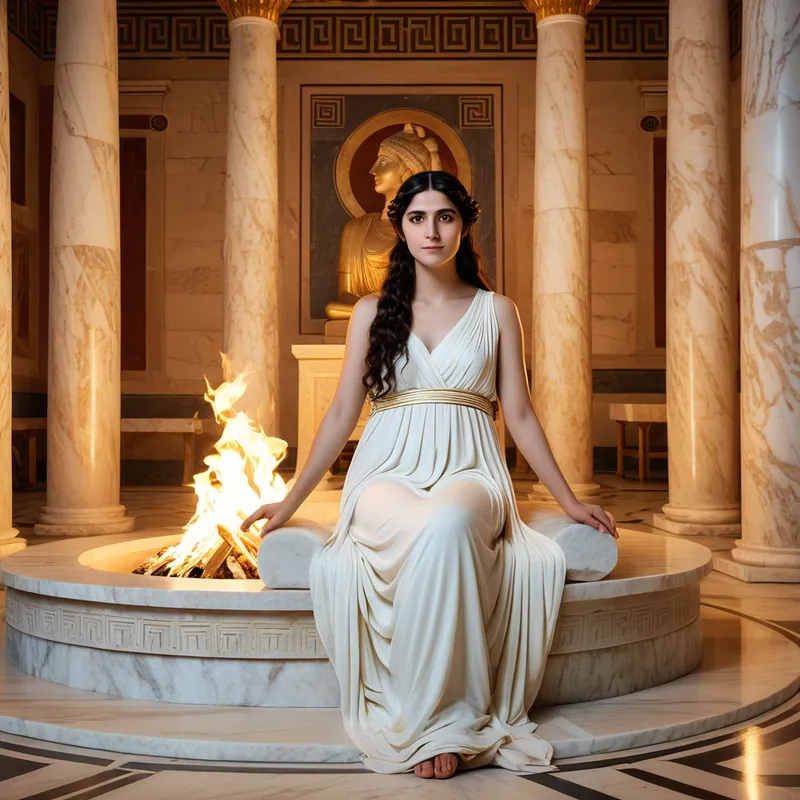
The myth of Hestia, first-born Olympian who tends the sacred hearth, embodying the eternal center of home, community, and the soul's unshakable sanctuary.
The Tale of Hestia's Hearth
Before the clamor of heroes and the thunder of gods, there was a silence. It was not an empty silence, but a deep, humming quiet, like the space between heartbeats. From this primordial stillness, she was born first: Hestia. Her breath was not wind, but warmth. Her first cry was not a sound, but the soft, crackling sigh of a flame taking hold on a bed of tinder.
While her siblings—Zeus, Poseidon, Demeter—claimed their glittering domains of sky, sea, and field, Hestia asked for no kingdom. She reached into the void and gathered the first ember, not of destruction, but of creation. She cupped it in her hands, a living, breathing coal, and with a whisper, she placed it upon a simple, flat stone. Thus, the first hearth was kindled. Its light did not blaze; it glowed. It did not roar; it murmured. It was a sun for the interior world.
The great hall of Olympus rose around her, glittering with cold marble and gold. Yet, in its very center, Hestia remained. She sat on a plain woolen cushion, not a throne. Her task was eternal vigilance. She fed the fire with dry olive wood and fragrant herbs. She swept the ash, not as refuse, but as sacred residue. When gods quarreled, shaking the foundations of the world, they would eventually return, drawn to that steady light. They would sit on the stones warmed by her fire, and in its presence, oaths became binding, and strife cooled to truce.
The conflict came not from monsters, but from desire. Both Apollo, lord of radiant form, and Pan, spirit of untamed earth, sought her hand. They brought gifts of prophecy and ecstasy. Hestia listened, her face illuminated by her own constant flame. Then, she placed her hand upon the hearthstone. “I cannot go,” she said, her voice the sound of settling embers. “For if I leave this fire, it will die. And if this fire dies, the center of all things—of your homes, your temples, your very bonds—will grow cold and hollow.” To seal this vow, she laid her hand upon the head of Zeus and swore an eternal oath of virginity, not of absence, but of utter presence. She sacrificed a path of her own to become the path home for all others. And so, she remained. The first-born became the still point, the unmoved mover, the breath at the center of the house, the city, and the cosmos.
Cultural Origins & Context
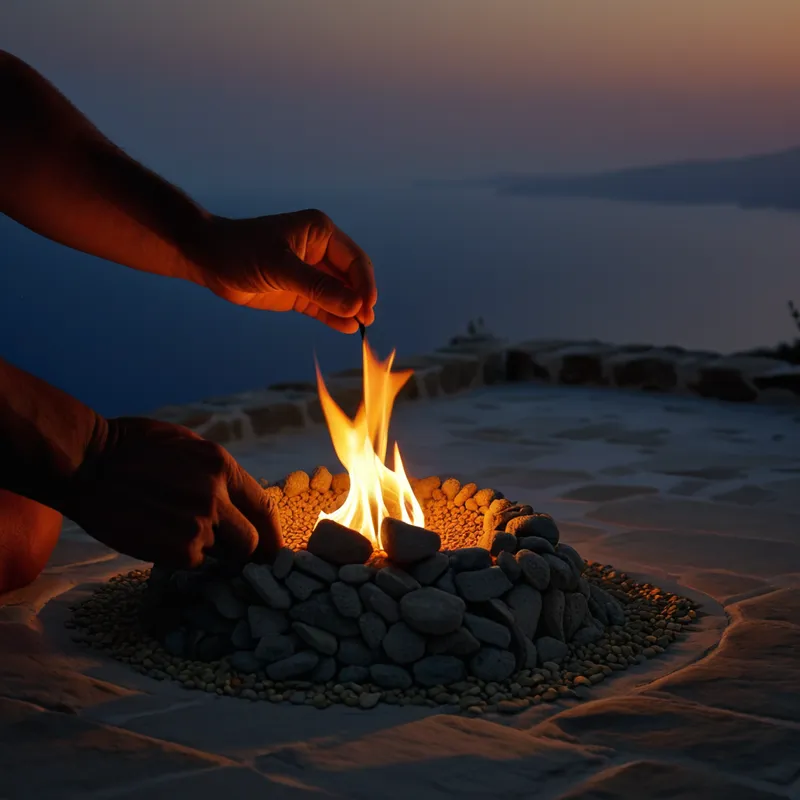
Hestia’s myth was not sung in epic cycles of adventure but whispered in daily ritual. She had no grand temples; her sanctuary was every household and every civic prytaneion. Her story was passed down not by bards, but by mothers teaching daughters how to tend the fire, and by priests transferring the sacred flame from the city’s heart to a new colony. She was the first deity invoked in every prayer and the last to receive a portion of every sacrifice—the alpha and omega of divine interaction.
This was her societal function: to sacralize the concept of center. The hearth fire was never allowed to die out completely. Its embers were banked at night and revived at dawn. When a family married, fire was carried from the bride’s parental hearth to light the new couple’s hearth, physically weaving the social fabric. When a Greek colony was founded, settlers carried coals from the mother-city’s hestia, making the new settlement a literal offspring of the old. Hestia was the psychological and social glue, the silent covenant that held the private and the public sphere together in a sacred unity.
Symbolic Architecture
Hestia represents the archetypal principle of the temenos—the sacred, enclosed precinct at the center of chaos. She is not the content of the home (that is Hera), nor its bounty (that is Demeter). She is the container itself, the defining boundary that creates an interior. The hearth is the axis mundi of the domestic world.
To tend the hearth is to tend the soul’s own center, the immutable point around which the whirlwind of identity, emotion, and experience must revolve.
Psychologically, Hestia symbolizes the ego’s capacity for centering and introspection. In a pantheon of gods projecting power outward—conquering, loving, creating, destroying—Hestia’s power is implosive. It is the power of being rather than doing. Her “virginity” is not a rejection but a symbol of psychological integrity—a self-contained, self-nourishing wholeness that requires no external validation to exist. She embodies the sacredness of routine, the divinity of the mundane act done with full presence. The ash she tends is the fertile ground of memory and experience, from which new understanding can grow.
The Dreamer's Resonance
When Hestia’s pattern stirs in the modern unconscious, it often manifests in dreams of profound centering amidst dislocation. One might dream of a single, perfectly lit room in an otherwise endless, dark mansion. Or of finding a working fireplace in a derelict apartment, its flame steady and warm. There may be dreams of cleaning or repairing a central, neglected object—a stove, a lamp, a simple circle on the floor.
These dreams signal a somatic and psychological process of re-collection. The psyche, fragmented by the demands of outer life (the persona of Apollo) or overwhelmed by chaotic emotion (the Dionysian surge), is seeking its own hearthstone. The dreamer is not being called to action, but to stillness. The body may crave ritual—the simple, repetitive act of making tea, lighting a candle, or arranging a space. This is the somatic expression of Hestia: creating a physical anchor for a psychic state of calm, embodied presence. It is the self caring for the self at the most fundamental level, rebuilding the inner temenos that has been violated by overwhelm.

Alchemical Translation
The alchemical process mirrored in Hestia’s myth is coagulatio—the stage where volatile spirits are brought down to earth and given solid, lasting form. Her entire existence is a sustained act of coagulation. She takes the fiery, chaotic potential of creation (the first ember) and fixes it in a specific, enduring location (the hearth). For the modern individual pursuing individuation—the integration of the conscious and unconscious into a cohesive Self—Hestia models the essential, often overlooked first step: establishing the inner vessel.
Individuation does not begin with a heroic quest into the unknown; it begins with the silent, courageous act of staying put at the center of one’s own being.
The “sacrifice” of Hestia—refusing the proposals of Apollo and Pan—is the critical psychic act of renouncing identification with brilliant consciousness (Apollo) and chaotic unconsciousness (Pan) in order to hold the tension between them. She becomes the mediating center. The modern alchemical work is to build this inner hearth through daily practice: meditation, journaling, mindful ritual. It is to honor the “ash”—the spent experiences, failures, and griefs—not as waste, but as the necessary substrate that insulates and sustains the living flame of awareness. In tending this fire, one does not become Hestia; one discovers that Hestia has always been there, the silent, warm, utterly reliable center of the psychic house, waiting only for the attention that transforms a house into a home, and a personality into a Self.
Associated Symbols
Explore related symbols from the CaleaDream lexicon:
- Oven
- Polished Table
- Shivering Fireplace
- Winter Hat
- Garnet Chalice
- Garnet Crystal
- Forbidden City Lantern
- Overstuffed Armchair
- Leather Couch
- Lounge Sofa
- Upholstered Armchair
- Crispy Waffle Iron
- Cast Iron Skillet
- Cake Stand
- Victorian Tea House
- Chalet
- Lattice Fence
- Beeswax Candle
- Tended Garden Plot
- Hearth Ember
- Frying Pan over Fire
- Cooking Pot of Clay
- Cooking Stone
- Ceremonial Fire
- Timber Hut
- Nomad's Fire
- Athanor