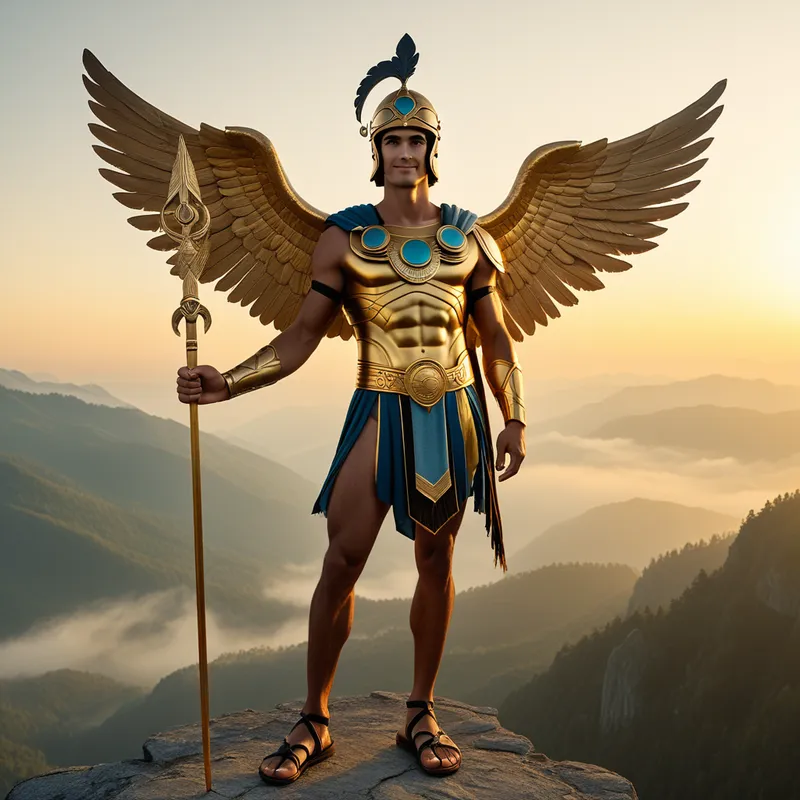
Hermes/Mercury (messenger god Myth Meaning & Symbolism
The story of the divine trickster, born at dawn, who steals divine fire to become the messenger between worlds, guiding souls and sparking invention.
The Tale of Hermes/Mercury
Before the sun had fully claimed the sky, in a shadow-dappled cave on the slopes of Mount Cyllene, a child was born. Not with a cry, but with a knowing silence. His mother, Maia, daughter of the Titan Atlas, had hidden herself away from the glittering eyes of Olympus. But this was no ordinary babe. Within the hour of his birth, he slipped from his swaddling clothes, his limbs strong and sure.
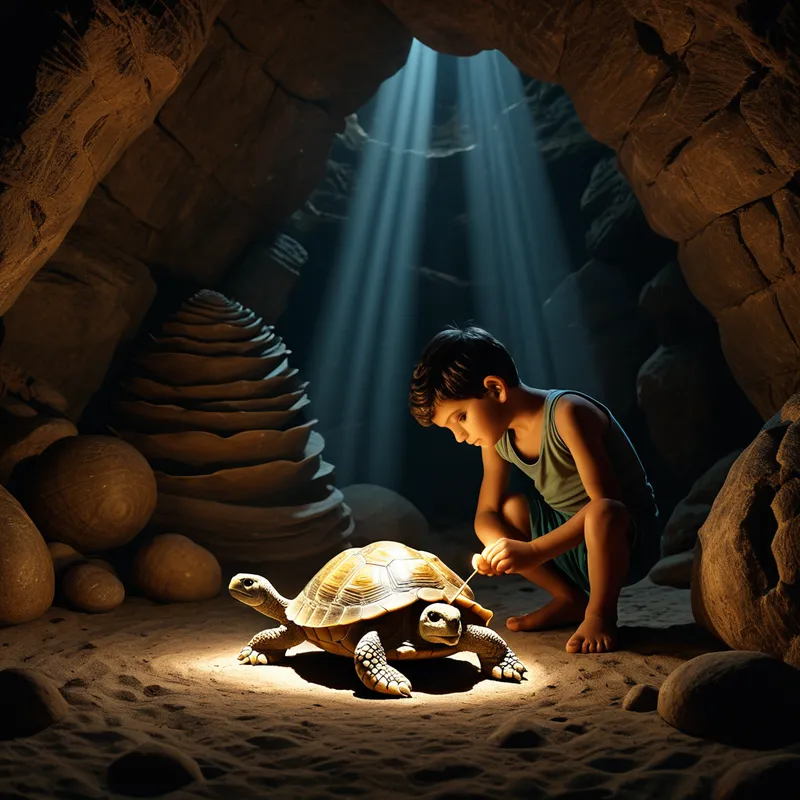
He stepped into the cool morning air, and his eyes, old as the hills, fell upon a tortoise grazing on the soft grass. A idea, swift and brilliant as lightning, struck him. With a touch both gentle and final, he transformed the creature’s life into a new kind of music. From its shell, sinew, and reeds, his clever fingers fashioned the first lyre. He plucked the strings, and a sound never before heard in the world spilled forth—a sound that could charm stone and soothe fury.
But invention sparked hunger. His gaze turned north, towards the sun-drenched pastures of Pieria. There, guarded by the slow-witted Argus, grazed the immortal cattle of his half-brother, Apollo. The infant god did not walk to them; he flew, his tiny feet barely touching the dew. To hide his trail, he crafted sandals of bark and myrtle, driving the cattle backwards, their hoofprints pointing toward the mountain, not away. He met an old man, Battus, on the road and bribed him with a cow for his silence—a promise soon tested and broken, earning the old man a transformation to stone for his loose tongue.
Back in his cave, with fifty head of divine cattle now hidden, the child did a thing of shocking audacity. He selected two of the finest beasts, slaughtered them with a ruthlessness belying his form, and offered their rich, savory smoke not to the Olympians, but to the twelve gods of the world. He included himself as the twelfth. Then, swift as a thought, he returned to his crib, pulling the blankets over himself as if he had never left.
The rage of Apollo was a terrible thing. The sun itself seemed to burn hotter as the god of light traced the impossible trail to the cave. He stormed inside, confronting Maia, pointing at the innocent-looking babe. “This child,” Apollo thundered, “is a thief and a liar!” From the blankets, the infant merely smiled and offered a perfect, plausible denial.
But before the great Zeus, father to them both, no lie could hold. Zeus, more amused than angry, commanded the truth. The child confessed with a disarming laugh, but then he did something else. He took up the lyre he had hidden and began to play. The music that flowed was not of this earth; it was the sound of wind in high places, the chuckle of streams, the very harmony of the spheres. Apollo’s anger melted away, replaced by a desperate, aching want. The cattle were forgotten. In that moment, a trade was born: the lyre for the stolen herd, and something more. In recognition of his cunning and his new, wondrous art, Apollo gave him the golden caduceus and a domain: he would be the messenger, the guide, the one who walks between all worlds.
Cultural Origins & Context
The figure of the swift-footed messenger god is a profound cross-cultural constant, with Hermes in Greece and Mercury in Rome representing its most crystallized forms. His stories are woven into the fabric of Homeric epic, Hesiod’s Theogony, and the Homeric Hymns, particularly the Hymn to Hermes, which details his precocious birth and theft. These were not static texts but living narratives performed by bards and rhapsodes, often at festivals or in communal gatherings.
His societal function was multifaceted. As Hermes Psychopomp, he was a crucial comfort in the face of mortality, the gentle guide for souls to the afterlife. As the god of roads, markets, and thresholds (herms), he presided over the uncertain spaces between—between cities, between a deal and its closure, between the known world and the wilderness. He was the patron of travelers, merchants, and thieves, acknowledging that all who cross boundaries operate in a realm of both opportunity and risk. His myths served as a cultural container for the ambivalence of cleverness, celebrating ingenuity while cautioning against its amoral application.
Symbolic Architecture
Hermes/Mercury is the archetypal embodiment of the trickster and the principle of connection. He is not the source of light (Apollo) or raw power (Zeus), but the means by which these forces are communicated, translated, and exchanged.
He is the spark in the synapse, the unexpected idea that bridges two seemingly unrelated thoughts, creating a third, new thing.
His symbols are a lexicon of mediation: the winged sandals and helmet for speed and traversal of realms; the caduceus, originally a herald’s staff, later associated with healing through its intertwining serpents (representing balanced opposites); and the purse or money bag, symbolizing commerce and the alchemy of value exchange. His very first act—killing the tortoise to create the lyre—is a foundational metaphor: the destruction of one form (earth-bound, slow, protected) to create another (aerial, resonant, artistic). He represents intelligence in motion, the cunning (mētis) required to navigate life’s complexities.
Psychologically, he personifies the anima/animus as connector between conscious and unconscious, and the psychopomp function within the psyche—the inner capacity to guide emerging, often fragile, contents from the depths of the unconscious into the light of awareness.

The Dreamer's Resonance
To dream of Hermes/Mercury is to dream of a psychic state of transition and message-receiving. The somatic experience is often one of lightness, restless energy in the limbs, or a feeling of being “in transit.” You may dream of missed flights, suddenly finding secret passages in familiar buildings, or receiving a cryptic, urgent message (a letter, a text, a symbol) whose meaning is elusive.
Such dreams surface during life’s thresholds: career changes, the beginning or end of relationships, creative blocks, or periods of important decision-making. The Hermes dream is the psyche’s signal that you are in a liminal space. The trickster energy may manifest as a sudden, ingenious solution to a stuck problem, or as a frustrating, chaotic disruption of plans—both are his domain. He challenges rigid thinking and invites adaptability. If the dream figure feels menacing or the messages are terrifying, it may indicate a resistance to a necessary change, or that the psyche’s communications are being distorted by fear.

Alchemical Translation
The individuation process modeled by Hermes is not one of heroic conquest or deep introspective diving, but of lucid circulation. His myth teaches the alchemy of the intermediary.
The goal is not to become the sun, but to learn the art of reflecting its light into the darkest valleys and carrying its warmth to the coldest shores.
The first stage is the Hermetic theft: stealing “fire” (inspiration, insight, energy) from a dominant, perhaps unconscious, complex (Apollo’s cattle, representing structured order, talent, or tradition) to fuel one’s own nascent development. This is the “illegitimate” but necessary act of ego-consciousness claiming resources from the unconscious for its own growth.
The second is the invention of the lyre: transforming the raw, stolen material (the shell of an old defense or habit) into an instrument of personal expression and reconciliation. This is the creation of a symbolic attitude that can harmonize opposites.
The final, enduring stage is taking up the caduceus: embracing the role of self-psychopomp. This means consciously mediating between the inner opposites—conscious and unconscious, thinking and feeling, persona and shadow—allowing the serpents of conflict to intertwine around the central axis of the Self, not to fight, but to create a dynamic, healing equilibrium. One becomes the messenger of one’s own depths, translating the raw symbols of the soul into a language the waking life can understand and integrate.
Associated Symbols
Explore related symbols from the CaleaDream lexicon: