
Hermes' Winged Sandals Myth Meaning & Symbolism
The tale of the messenger god's winged sandals, granting him the power to traverse all boundaries between the divine, human, and underworld realms.
The Tale of Hermes’ Winged Sandals
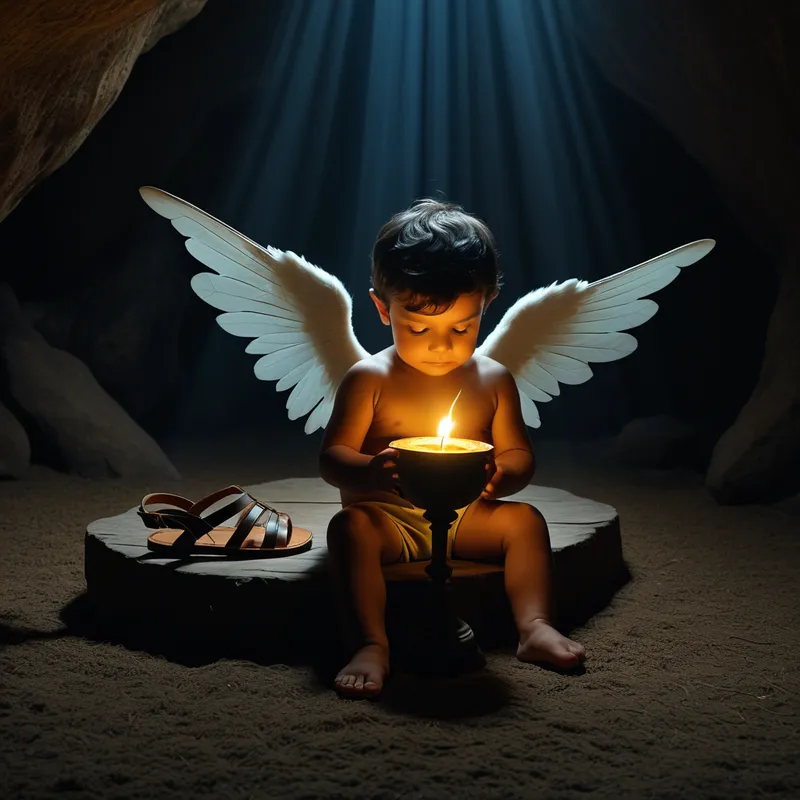
Before the world knew his name, he stirred in the silver-dark womb of a mountain cave. He was Hermes, son of Zeus and the nymph Maia, and from his first breath, the air hummed with a new kind of potential. His eyes, still wet with birth, saw not the dim walls of the cave, but the shimmering pathways between things—between thought and deed, between a wish and its fulfillment.
On that very first day, while his mother slept, an irresistible itch for motion took him. He crawled from his cradle and stepped into the wider world. His gaze fell upon the sun-cattle of his half-brother, Apollo, sacred beasts that gleamed like captured daylight. With a laugh that was the sound of wind through reeds, the infant god devised a theft of pure genius. He drove the cattle backwards, weaving a spell of confusion, their hoofprints pointing the wrong way, and hid them away.
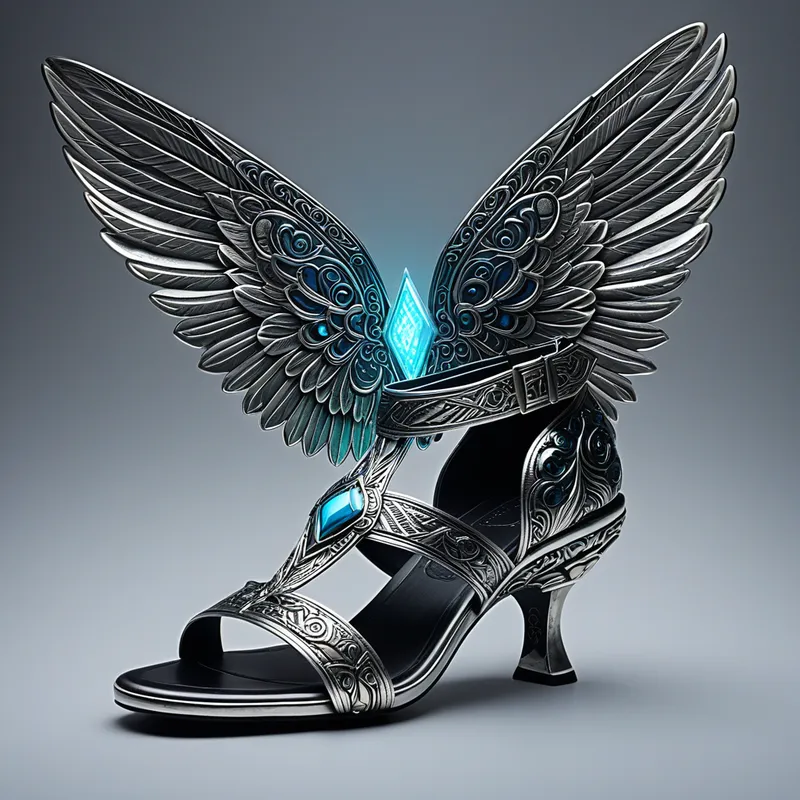
But to move is one thing; to move with purpose, another. He needed a vessel for his boundless speed. With the cunning of a born craftsman, he took the hides of the slaughtered cattle and, from the supple leather, fashioned something never before seen. Not just sandals, but instruments of passage. To them, he bound the wings of a great bird—or perhaps he captured the very concept of flight itself—creating the first talaria.
He fastened them to his small, swift feet. The moment they touched his skin, a circuit was completed. He was no longer a child in a cave, but a point of motion in the cosmos. He took a step and was at the cave’s mouth; another, and he was atop the mountain, the world spread beneath him like a map of possibilities. The wings beat with a silent, golden hum, a vibration that resonated with the hidden roads between Olympus, Earth, and even the sunless land of Hades.
When the furious Apollo finally tracked him down, radiating solar wrath, the infant did not cower. Instead, he offered a gift: the lyre he had invented from a tortoise shell. Enchanted by the music, Apollo’s anger melted. In the ensuing pact, Hermes presented his winged sandals as a token of his new office. Apollo, recognizing a power that complemented his own solar chariot, accepted. Zeus, watching from on high, laughed with thunderous delight and proclaimed Hermes the divine herald. The sandals were returned, now sanctified as the official badge of the one who could go anywhere, speak to anyone, and weave the fabric of the worlds together with the speed of a thought.
Cultural Origins & Context
This myth is preserved primarily in the Homeric Hymn to Hermes, a poetic text likely composed in the 6th or 5th century BCE. It belongs to the rich oral and literary tradition of ancient Greece, where such hymns were performed at religious festivals, serving both as sacred narrative and communal entertainment. The tale of Hermes’ birth and early deeds functioned as an aetiology—a foundational story explaining the origin of the god’s attributes and domain.
In a society where travel was perilous, communication slow, and boundaries (between city-states, between the civilized and the wild) were starkly defined, Hermes was an essential psychological and religious figure. He was the god of the threshold, the herm. His sandals, therefore, were not mere tools of travel but sacred instruments that legitimized and empowered the act of crossing. They symbolized safe passage for merchants, heralds, and travelers. The myth sanctioned Hermes’ role as the mediator, the one who could negotiate between the wrath of Apollo and the justice of Zeus, between the human petitioner and the distant god, between the living soul and the realm of the dead.
Symbolic Architecture
The winged sandals are an archetypal symbol of psychic velocity. They represent the mind’s capacity to traverse inner landscapes with impossible speed, connecting disparate thoughts, memories, and realms of consciousness.
The sandal is grounded in the earth, but the wing aspires to the sky; the symbol is the reconciliation of these opposites, the embodied spirit.
First, they signify liminality. Hermes is the god of the in-between: doors, crossroads, transitions. The sandals are the vehicle that makes dwelling in this transitional space not only possible but powerful. They allow one to be in the process of becoming, to inhabit the threshold itself as a place of potential and creation.
Second, they embody communication and connection. The speed of the sandals is the speed of the message, the intuition, the synaptic flash. They represent the faculty that links conscious intent with unconscious impulse (as in Hermes’ infantile theft), the ego with the shadow, the personal psyche with the archetypal realm.
Finally, they are an instrument of cunning and transformation. Hermes does not use brute force; he uses cleverness (metis). The sandals facilitate a style of action that is indirect, adaptive, and creative. They are the means by which raw instinct (the cattle) is transformed into cultural artifact (the lyre, the sandals themselves) and social accord.
The Dreamer’s Resonance
When the image of winged sandals or their sensation—that feeling of effortless, gliding speed—appears in a modern dream, it often signals a crucial moment of psychic navigation. The dreamer is not merely observing a myth; they are embodying the Hermetic function within their own psyche.
Somatically, one might dream of feet that feel incredibly light, of moving without walking, of skimming over obstacles or landscapes. This reflects a psychological process where a previously burdensome or complex internal conflict is suddenly being traversed with new ease. An insight is arriving with swift clarity. The dreamer is developing the capacity to move between different parts of themselves—between a wounded inner child and a responsible adult, between a rigid belief and a liberating new perspective—with agility.
Conversely, dreaming of losing the sandals, or of them being broken or heavy, can indicate a feeling of being trapped in a single perspective, stuck at an inner crossroads, or unable to communicate a vital inner truth. The Hermes energy is blocked, and the dream calls for a reactivation of that nimble, connecting intelligence.

Alchemical Translation
The myth of the winged sandals provides a profound model for the individuation process, the alchemical journey of becoming a more integrated, whole Self. This is not a journey of linear conquest, but of agile circulation between the elements of one’s being.
The initial state is the “cave”—the unconscious, undifferentiated psyche of the infant god, brimming with potential but unexpressed. The theft of the cattle is the first, often disruptive, eruption of unconscious content (instincts, drives, shadow material) into conscious awareness. It creates a crisis, a “problem” (Apollo’s wrath) that demands a solution.
Individuation is not a flight from the earth, but a mastery of the space between earth and sky, facilitated by the crafted, sacred tool.
The crafting of the sandals is the critical alchemical act: the creation of a mediating function. The dreamer takes the raw, instinctual material (the hides) and, through conscious effort and cunning (Hermes’ inventive skill), fashions a tool for navigation. This tool is the transcendent function—the psychic capacity born from the tension of opposites that allows for movement to a new level of understanding.
Wearing the sandals symbolizes the integration of this function. The dreamer can now consciously travel between the “Olympus” of their highest ideals, the “Earth” of daily reality, and the “Hades” of the repressed personal and collective shadow. They become their own herald, carrying messages between these realms. The final gift-exchange with Apollo represents the sublimation of raw instinct into cultural and spiritual value (the lyre for music, the sandals for sacred office), achieving a new, harmonious order within the psyche ruled by the sovereign Self (Zeus). The winged sandals, thus, are the enduring symbol of the liberated, connecting, and endlessly moving spirit within the alchemy of a life fully lived.
Associated Symbols
Explore related symbols from the CaleaDream lexicon: