Hermes Trismegistus Myth Meaning & Symbolism
The myth of the thrice-great sage, a fusion of Greek and Egyptian wisdom, embodying the transmission of divine knowledge and the alchemy of consciousness.
The Tale of Hermes Trismegistus
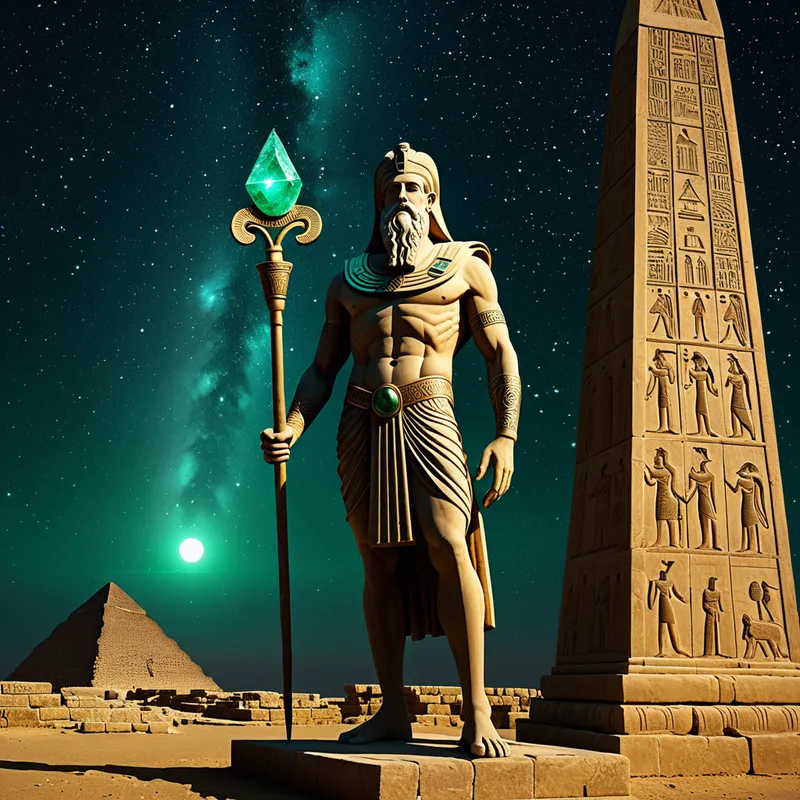
Listen, and let the veils between worlds grow thin. In the time when gods walked with men and the sands of Egypt whispered secrets to the winds of Greece, there arose a figure cloaked in the mystery of ages. He was not born of a single womb, but of the longing union of two great rivers of wisdom. Some called him Thoth, the measurer, the scribe of the gods who carved destiny with a feather. Others knew him as Hermes, the swift-footed, the guide of souls, the trickster at the crossroads.
In the silent heart of the night, when the star Sothis blazed like a silver tear in the sky’s dark cheek, these two spirits did not clash, but embraced. From their confluence stepped forth a being thrice-crowned in greatness: Hermes Trismegistus. His sandals were dusted with the ochre of the Nile delta and the marble powder of Athenian temples. In his hand, he carried not a simple herald’s staff, but the caduceus, around which two serpents—one of knowing, one of being—writhed in an eternal, wise dance.
He walked through the world as a shadow cast by a divine sun, appearing to the pure of heart and seeking of mind. To a priest in a sun-baked temple, he might whisper the geometries of the heavens. To a philosopher in a moonlit grove, he might reveal the hidden sympathies between the root of a plant and the passion in a man’s heart. His greatest gift was not a single truth, but the key—the understanding that all is connected, that the macrocosm of the stars is mirrored in the microcosm of the soul. He inscribed this key upon a tablet of radiant emerald, a scripture of light that declared the fundamental unity of all things.
His tale has no mortal end, for he retreated not into death, but into the very fabric of wisdom itself. He became the patron of hidden things, the guardian of thresholds, the silent author of every scroll that bridges one world to the next. Wherever knowledge is passed from master to disciple, wherever two disparate truths are woven into a greater one, there walks the echo of the Thrice-Great One.
Cultural Origins & Context
The figure of Hermes Trismegistus is a profound cultural hybrid, a theological and philosophical syncretism born in the fertile, intercultural cauldron of Hellenistic Egypt, particularly in Alexandria. Following the conquests of Alexander the Great, Greek culture and Egyptian tradition engaged in a deep, centuries-long dialogue. Greek settlers and scholars, encountering the immensely ancient and sophisticated Egyptian pantheon, sought equivalencies. The Egyptian Thoth, lord of magic, writing, and the moon, was naturally aligned with the Greek Hermes, the clever god of communication, boundaries, and interpretation.
This was not mere scholarly footnote, but a living, devotional process. By the 2nd and 3rd centuries CE, a body of texts began to circulate—the Hermetica. These texts, written in Greek but steeped in Egyptian cosmological concepts and emerging Neoplatonic thought, were presented as revelations from the divine sage Hermes Trismegistus. They functioned as sacred lore for esoteric circles, offering a path to spiritual awakening (gnosis) through knowledge of the cosmos and oneself. The myth served to authorize a new, universal wisdom tradition, giving ancient prestige to a new synthesis that promised liberation from material illusion.
Symbolic Architecture
At its core, the myth of Hermes Trismegistus symbolizes the principle of transmission and the alchemy of synthesis. He is not a god of static truth, but of dynamic translation—between divine and human, between cultures, between the inner and outer worlds.
The caduceus is not merely a staff; it is the spine of reality, around which the dualities of spirit and matter, conscious and unconscious, eternally coil and converse.
He represents the psychopomp function of the mind itself—the faculty that guides fragments of insight from the unconscious depths (the Egyptian underworld) to the light of consciousness (the Greek agora). The "thrice-great" title signifies a transcendence of ordinary duality; he is great as Thoth (wisdom), great as Hermes (communication), and greatest as their unified, transcendent form. This is the archetype of the integrated Self, where opposing forces are not conquered, but reconciled into a higher, generative order. The Emerald Tablet, with its dictum "As above, so below," encodes the symbolic law of correspondence: the inner landscape of the psyche is a faithful, if mysterious, reflection of the cosmic order.

The Dreamer's Resonance
When the archetype of Hermes Trismegistus stirs in the modern dreamscape, it often manifests as a period of profound psychic bridging and translation. The dreamer may encounter a mysterious guide or teacher who speaks in riddles, find themselves in a library containing books in forgotten languages they suddenly understand, or discover a secret room in their house that connects to a vast, ancient temple.
Somnologically, this signals a process of hermeneutics—the interpretation of previously inaccessible parts of the self. The somatic feeling is often one of electric curiosity mixed with awe, a tingling at the threshold of a major insight. It is the psyche’s way of announcing that disparate elements—a professional skill (Hermes) and a deep, intuitive knowing (Thoth); a personal heritage and an adopted culture—are ready to be synthesized into a new, more potent personal myth. The anxiety sometimes present is the natural fear of the messenger who must cross boundaries and deliver news that may disrupt the status quo of the ego.

Alchemical Translation
In the alchemical vessel of individuation, the myth of Hermes Trismegistus maps directly onto the stage of coniunctio oppositorum—the sacred marriage of opposites. The modern individual’s journey is often one of fragmentation: the logical mind versus the intuitive heart, the persona presented to the world versus the private shadow, one cultural identity versus another.
The work is not to choose one over the other, but to become the crucible in which both are melted down and reborn as a third, more conscious substance.
The "Hermes" aspect of the psyche must actively engage in commerce with the foreign territory of the unconscious (the "Egyptian" Thoth). This requires the cunning to navigate inner resistance, the speed to catch fleeting insights, and the communicative skill to translate symbolic, often non-verbal, psychic material into forms the ego can comprehend. The resultant "Hermes Trismegistus" state is a psychic position of empowered wisdom. One becomes the author of one’s own Hermetica, no longer merely a sufferer of internal conflicts but the scribe and sage who understands their necessity and their place in the greater text of the Self. The ultimate emerald tablet is the individuated consciousness itself, upon which is written the unshakeable knowledge of its own divine, interconnected nature.
Associated Symbols
Explore related symbols from the CaleaDream lexicon: