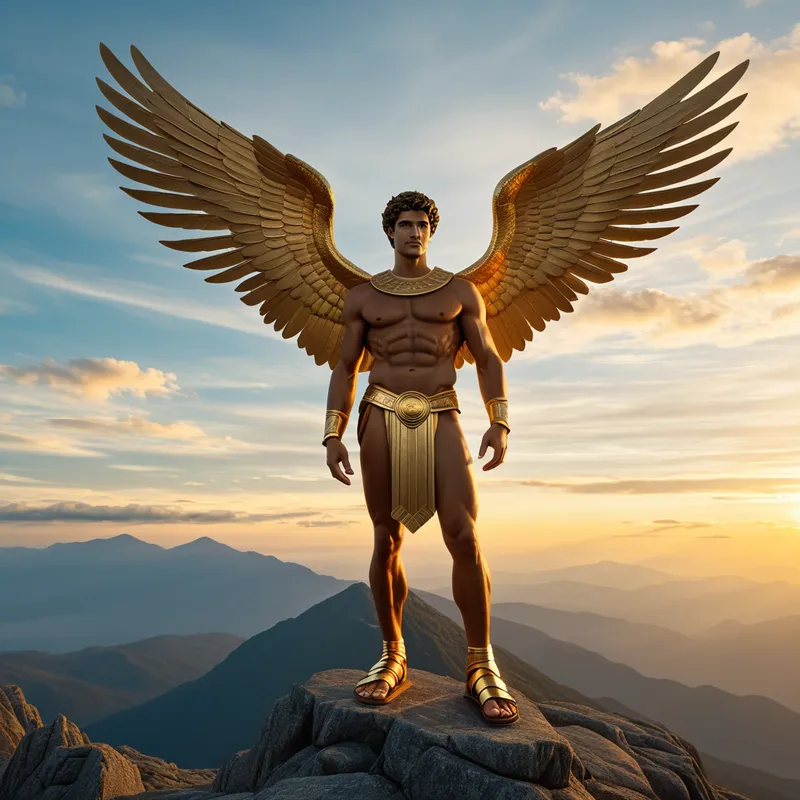
Hermes' Talaria Myth Meaning & Symbolism
The divine sandals of Hermes, granting flight and speed, symbolize the messenger's power to traverse all realms and the human capacity for swift transformation.
The Tale of Hermes’ Talaria
Listen. Before [the world](/myths/the-world “Myth from Tarot culture.”/) was set in its orderly ways, when the breath of creation was still fresh on the stones, a child was born in a shadow-dappled cave on Mount Cyllene. His name was [Hermes](/myths/hermes “Myth from Global/Universal culture.”/), and from his first breath, he was restless. [The womb](/myths/the-womb “Myth from Various culture.”/) of [the earth](/myths/the-earth “Myth from Hindu culture.”/) was too still for him. His eyes, sharp as a hawk’s, saw not just the walls of [the cave](/myths/the-cave “Myth from Platonic culture.”/) but the spaces between things—the paths that led upward to the blinding realm of his father, Zeus, and downward to the sunless kingdom of [Hades](/myths/hades “Myth from Greek culture.”/).
On the very day of his birth, this precocious infant slipped from his cradle. He found a [tortoise](/myths/tortoise “Myth from Greek culture.”/), its slow life a mirror of the world he wished to escape. With a [flash of insight](/myths/flash-of-insight “Myth from Alchemical culture.”/) that was both cruel and brilliant, he hollowed its shell, strung it with gut, and invented the lyre. Its music was the sound of potential itself. But music was not enough. He needed motion. He needed to go.
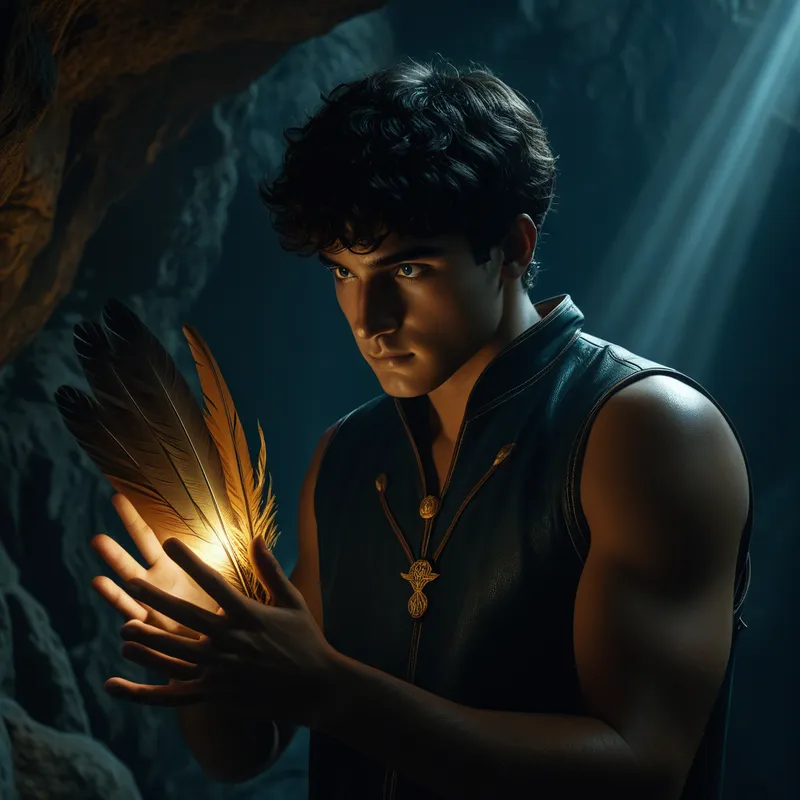
His eyes fell upon the sacred cattle of his brother, Apollo, grazing in the Pierian meadows. Under the cloak of twilight, the infant god became a thief. He drove the cattle backward, confusing their tracks, and fashioned sandals from the bark of a fallen oak and the leaves of a resilient myrtle. But these were no ordinary sandals. As he worked, he wove into them not just leather and twine, but his own divine essence—his insatiable curiosity, his boundless speed of thought, his desire to bridge what is separate. He plucked feathers from the messenger doves that nested in the cave’s mouth and bound them to the heels.
When he slipped them onto his feet, the world changed. The earth became a springboard. The air became a solid road. With a laugh that echoed between the mountains, he pushed off, and the ground fell away. He was not walking; he was translating his will directly into flight. He skimmed the waves of [the sea](/myths/the-sea “Myth from Greek culture.”/), so fast he did not sink. He traced the paths of [shooting stars](/myths/shooting-stars “Myth from Various culture.”/). He became a blur, a thought in motion, delivering his clever lies and stolen goods with impossible speed.
When the furious Apollo finally tracked him down, the confrontation was not just of theft, but of domains. Apollo demanded his cattle. Hermes offered the lyre. In that exchange—property for art, possession for inspiration—a pact was born. And Apollo, disarmed by beauty, looked at the strange sandals on his brother’s feet. “And those?” he asked. Hermes grinned. “These are my [Talaria](/myths/talaria “Myth from Greek culture.”/). With them, I will be your swift messenger. I will run your errands between the sun and [the shadow](/myths/the-shadow “Myth from Jungian culture.”/). I will go where you cannot.” And so it was. The thief was ordained the messenger, his instrument of rebellion becoming his symbol of office. The wings on his heels became as natural as breath, carrying the words of the gods across the chasms of the world.
Cultural Origins & Context
The myth of Hermes and his Talaria is woven into the earliest strands of Greek poetic tradition, most famously in the Homeric Hymn to Hermes. This was not a story confined to temple liturgy, but a popular, circulating epic song performed by bards (rhapsodes) at festivals and in the halls of the wealthy. Its function was multifaceted. On one level, it was an aetiological myth, explaining the origin of the god’s attributes: the lyre, the [herald](/myths/herald “Myth from Greek culture.”/)‘s staff (caduceus), and, crucially, the winged sandals.
More profoundly, it served a societal need to conceptualize and manage boundaries. Hermes was the god of [the threshold](/myths/the-threshold “Myth from Folklore culture.”/) (herm), of trade, and of the road. In a world where travel was dangerous and communication slow, Hermes embodied the hope of safe passage and the anxiety of the unknown. The Talaria myth gave a divine face to the human experience of crossing borders—geographic, social, and spiritual. It told people that the space between places (the marketplace, the city gate, the frontier) was not empty, but inhabited by a cunning, swift, and potentially helpful power. The story legitimized the figure of the traveler, the merchant, and the herald, making them under the protection of an Olympian.
Symbolic Architecture
The Talaria are far more than a divine mode of transport. They are a perfect [symbol](/symbols/symbol “Symbol: A symbol can represent an idea, concept, or belief, serving as a powerful tool for communication and understanding.”/) of Hermes’ [nature](/symbols/nature “Symbol: Nature symbolizes growth, connectivity, and the primal forces of existence.”/) and, by extension, a profound psychological glyph. They represent [the principle](/symbols/the-principle “Symbol: A fundamental truth, law, or doctrine that serves as a foundation for a system of belief, behavior, or reasoning, often representing moral or ethical standards.”/) of [connection](/symbols/connection “Symbol: Connection symbolizes relationships, communication, and bonds among individuals.”/) through [motion](/symbols/motion “Symbol: Represents change, progress, or the flow of life energy. Often signifies transition, personal growth, or the passage of time.”/).
The wing is not an escape from the earth, but the means by which the earth converses with the sky.
First, they symbolize psychic speed. This is not merely physical velocity, but the speed of [intuition](/symbols/intuition “Symbol: The immediate, non-rational understanding of truth or insight, often described as a ‘gut feeling’ or inner knowing that bypasses conscious reasoning.”/), of wit, of synaptic leaps. Hermes solves problems not through brute force but through lateral thinking and swift negotiation. The Talaria are the embodiment of this mental agility, the [ability](/symbols/ability “Symbol: In dreams, ‘ability’ often denotes a recognition of skills or potential that one possesses, whether acknowledged or suppressed.”/) to “think on one’s [feet](/symbols/feet “Symbol: Feet symbolize our foundation, stability, and the way we connect with the world around us, often reflecting our sense of direction and purpose.”/)” with divine grace.
Second, they represent liminality. Hermes is the god of “the between.” His sandals allow him to traverse all three realms: [Olympus](/symbols/olympus “Symbol: In Greek mythology, Mount Olympus is the divine home of the gods, representing ultimate power, perfection, and spiritual transcendence.”/) ([the sky](/myths/the-sky “Myth from Persian culture.”/)/[consciousness](/symbols/consciousness “Symbol: Consciousness represents the state of awareness and perception, encompassing thoughts, feelings, and experiences.”/)), [Earth](/symbols/earth “Symbol: The symbol of Earth often represents grounding, stability, and the physical realm, embodying a connection to nature and the innate support it provides.”/) (the mundane/ego), and [Hades](/symbols/hades “Symbol: Greek god of the underworld, representing death, the unconscious, and hidden aspects of existence.”/) (the [underworld](/symbols/underworld “Symbol: A symbolic journey into the unconscious, representing exploration of hidden aspects of self, transformation, or confronting repressed material.”/)/unconscious). The Talaria are the tools of [the psychopomp](/myths/the-psychopomp “Myth from Various culture.”/), the guide of souls, facilitating necessary [movement](/symbols/movement “Symbol: Movement symbolizes change, progress, and the dynamics of personal growth, reflecting an individual’s desire or need to transform their circumstances.”/) between states of being—waking and dreaming, [life](/symbols/life “Symbol: The symbol of ‘Life’ represents a journey of growth, interconnectedness, and existential meaning, encompassing both the joys and challenges that define human experience.”/) and [death](/symbols/death “Symbol: Symbolizes transformation, endings, and new beginnings; often associated with fear of the unknown.”/), known and unknown.
Finally, they signify communication as a dynamic act. A message is not a [static](/symbols/static “Symbol: Static represents interference, disruption, and the breakdown of clear communication or signal, often evoking feelings of frustration and disconnection.”/) object; it is an [event](/symbols/event “Symbol: An event within dreams often signifies significant life changes, transitions, or emotional milestones.”/) that must traverse a [space](/symbols/space “Symbol: Dreaming of ‘Space’ often symbolizes the vastness of potential, personal freedom, or feelings of isolation and exploration in one’s life.”/). The Talaria ensure the message arrives, that meaning is delivered. They symbolize the connective [tissue](/symbols/tissue “Symbol: Represents emotional release, vulnerability, and the delicate nature of feelings or physical fragility.”/) of the [cosmos](/symbols/cosmos “Symbol: The entire universe as an ordered, harmonious system, often representing the totality of existence, spiritual connection, and the unknown.”/) itself, the neural pathways of a collective [psyche](/myths/psyche “Myth from Greek culture.”/) where thoughts, words, and souls are in constant, swift exchange.
The Dreamer’s Resonance
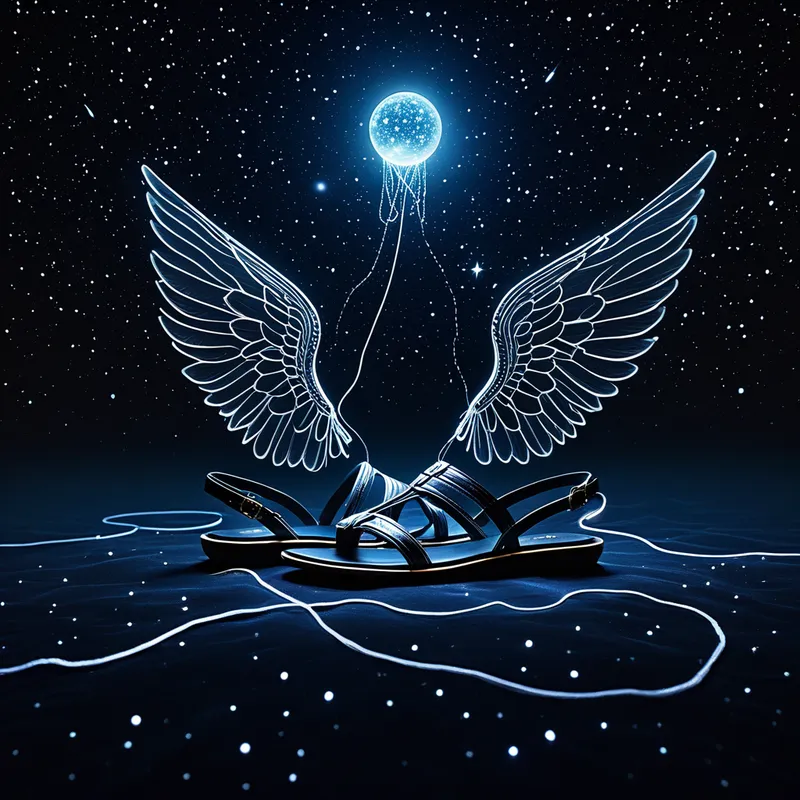
When the image of winged sandals or effortless flight from the feet appears in a modern dream, it rarely speaks of literal travel. It signals a psychological process of rapid integration or necessary escape. The dreamer may be experiencing a sudden insight, a “Eureka!” moment that connects disparate aspects of their life. The Talaria in a dream suggest the psyche is activating its own Hermetic function: it is finding clever, swift paths through an internal blockage.
Somatically, this can feel like a lightness in the legs, a feeling of being “quick-witted” or “a step ahead.” Conversely, dreaming of losing the Talaria, or of them being broken, often correlates with feelings of being stuck, mentally sluggish, or unable to communicate one’s needs effectively. It indicates a frustration with the pace of one’s inner or outer life. The dream is presenting the symbol of the solution—the need to cultivate that inner Hermes, the agile, boundary-crossing part of [the self](/myths/the-self “Myth from Jungian culture.”/) that can navigate complex emotional or intellectual terrain with speed and grace.
Alchemical Translation
The individuation process, the journey toward psychic wholeness, is not a slow, plodding pilgrimage. It is punctuated by moments of Hermetic flight—sudden integrations, shocking insights, and swift transitions between stages of the self. The myth of the Talaria models this alchemical “quickening.”
The first step of the journey is not taken with the foot, but with the imagination binding feathers to the heel.
Initially, the nascent self (the infant Hermes) acts out of a kind of divine selfishness, stealing energy (Apollo’s cattle) from other parts of the psyche to fuel its own growth. This is the necessary, often chaotic, rebellion of a new consciousness. The crafting of the Talaria is the crucial act of making one’s unique tool for transformation. It is not given; it is fashioned from the materials at hand—our innate talents, our wounds, our stolen moments of clarity. We must build our own capacity for swift movement.
The alchemical translation occurs when this stolen energy and self-made tool are put in service of a greater whole. Hermes does not keep his speed for himself; he becomes the Messenger. In our own lives, the psychic speed we develop—our intuition, our communicative skill, our ability to move between different social roles or internal states—must eventually become a service function. It becomes the means by which we mediate between our own inner opposites (conscious and unconscious, spirit and matter), and between ourselves and the world. The Talaria symbolize the moment when personal agility is transmuted into connective grace, when our speed is no longer for escape, but for the sacred task of delivering meaning, of guiding lost parts of the soul home, and of weaving the disparate realms of our experience into a coherent, swiftly flowing whole.
Associated Symbols
Explore related symbols from the CaleaDream lexicon: