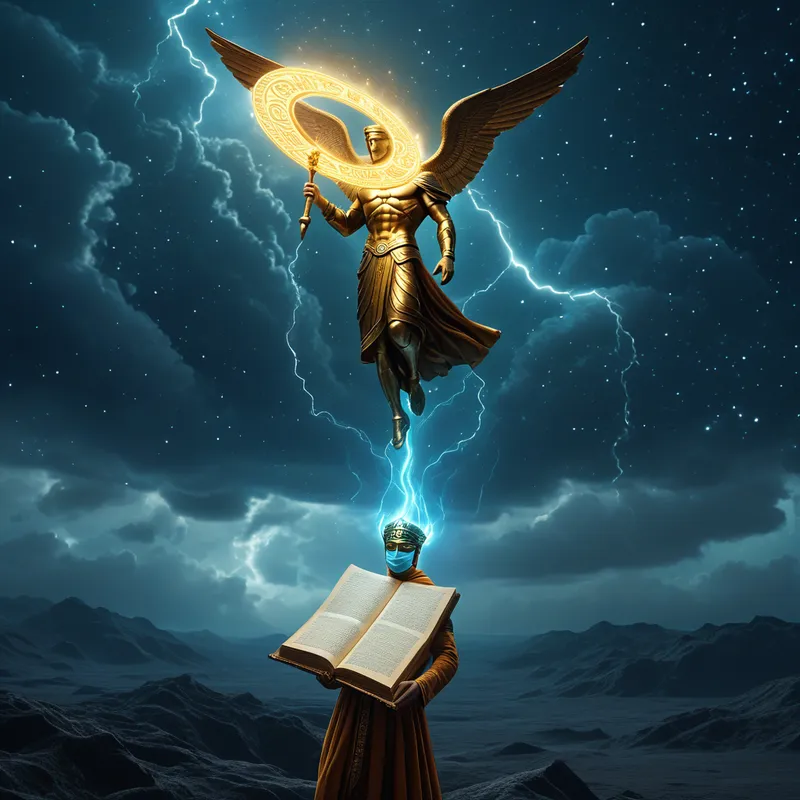
Hermes delivering divine messa Myth Meaning & Symbolism
The myth of the divine messenger, a universal archetype of communication between realms, symbolizing the transmission of fate, truth, and psychic insight.
The Tale of Hermes delivering divine messa
The air on Olympus was not still. It thrummed with the unspoken will of the immortals, a pressure that preceded thunder. In the hall of polished sky-stone, Zeus sat, not as a reveler, but as a sovereign. The scales of fate, which even he could not overturn, had tipped. A decision, vast and irrevocable, had been forged in the furnace of divine council. It was a verdict for a hero, a curse for a city, a seed for an empire—a truth too potent to be shouted across the heavens. It needed a courier.
And so he was summoned. Not with a bellow, but with a thought that pierced the layers of [the world](/myths/the-world “Myth from Tarot culture.”/). From [the crossroads](/myths/the-crossroads “Myth from Celtic culture.”/) where paths are born, from the deep where sleep meets memory, he arrived. [Hermes](/myths/hermes “Myth from Global/Universal culture.”/). His sandals, winged with the breath of the swiftest wind, barely kissed the floor. In his hand was not his playful kerykeion, but a scroll sealed with the wax of celestial fire. The message itself seemed to hum, a contained vibration that made the light in the room warp.
“Go,” said Zeus, and [the word](/myths/the-word “Myth from Biblical culture.”/) was not a command but an invocation of function. “To the weeping king in his tower of grief. To the hero blinded by his own glory. To the mortal poet who dreams our faces. Carry this. Let nothing—not the lament of spirits, not the temptation of [nymphs](/myths/nymphs “Myth from Greek culture.”/), not the rage of Titans buried deep—alter your course or delay your step. The word must land as it was forged.”
Hermes met the god’s gaze, and in that moment, he was no trickster. He was a vessel. He nodded, a sharp, efficient motion. Then he turned, and the world blurred.
His journey was a symphony of transitions. He plunged from the crystalline clarity of the peak into the turbulent, sighing realm of the clouds. He skimmed the surface of the wine-dark sea, where the salt spray tried to lick the seal. He cut through the forests of the mortal world, where shadows reached for him with woody fingers, and the air grew thick with the smells of earth, decay, and blooming night-flowers. He was the needle, and the fabric of reality was the cloth being stitched by his passage.
His destination was never a pleasant place. It was a battlefield at dawn, stinking of blood and prophecy. It was a locked chamber where a fateful choice was about to be made. It was the shore where a lone figure stared at an unforgiving horizon. Hermes would materialize—not with a grand entrance, but with the sudden, undeniable presence of a fact. The air would chill. Time would seem to catch. He would extend his arm, the sealed decree glowing with its own [inner light](/myths/inner-light “Myth from Buddhist culture.”/).
No speech was needed. The recipient—king, hero, sinner, or sage—would look from the divine messenger’s unreadable eyes to the scroll. They would know. In that moment, they touched the immutable architecture of their destiny. Sometimes they raged. Sometimes they wept. Sometimes they accepted with a terrifying quiet. Hermes would wait, impassive, until the scroll was taken. The transaction of truth was complete. Then, as swiftly as he came, he would be gone—a shimmer, a whisper of displaced air, a memory of wings—already bound for the next peak, the next depth, carrying another fragment of the gods’ unthinkable will, weaving the world together with threads of spoken fate.

Cultural Origins & Context
The figure of the divine messenger is a true universal, a psychic necessity appearing in virtually every mythological and religious system. While we use the Greek name Hermes as a handle, the archetype is global. He is [Mercury](/myths/mercury “Myth from Roman culture.”/) to the Romans, Jibril ([Gabriel](/myths/gabriel “Myth from Biblical culture.”/)) delivering the Qur’an to Muhammad, the Gandharva of Hindu lore carrying celestial melodies, and the Eshu of the Yoruba, who speaks all languages and mediates between heaven and earth.
This myth was not “authored” but emerged. It was passed down in sacred hymns, carved into temple reliefs, enacted in ritual drama, and whispered in mystery cults. Its tellers were priests, bards, and shamans—individuals who themselves were seen as mediators between the human and the divine. Societally, the myth served a crucial function: it explained how the will of the ultimate powers (gods, fate, the cosmos) interfaces with the human realm. It made the abstract concept of “divine will” concrete, personal, and operational. It taught that fate arrives not as an anonymous force, but as a communication, delivered by a specific, albeit enigmatic, agent.
Symbolic Architecture
At its core, this myth is about the [mechanism](/symbols/mechanism “Symbol: Represents the body’s internal systems, emotional regulation, or psychological processes working together like a machine.”/) of [revelation](/symbols/revelation “Symbol: A sudden, profound disclosure of truth or insight, often through artistic or musical means, that transforms understanding.”/). The messenger is not the [source](/symbols/source “Symbol: The origin point of something, often representing beginnings, nourishment, or the fundamental cause behind phenomena.”/) of the message, but its essential [conduit](/symbols/conduit “Symbol: A passage or channel that transfers energy, information, or substance from one place to another, often hidden or structural.”/). He represents [the principle](/symbols/the-principle “Symbol: A fundamental truth, law, or doctrine that serves as a foundation for a system of belief, behavior, or reasoning, often representing moral or ethical standards.”/) of [connection](/symbols/connection “Symbol: Connection symbolizes relationships, communication, and bonds among individuals.”/) itself—the [psychopomp](/myths/psychopomp “Myth from Greek culture.”/) guiding souls, the [trickster](/symbols/trickster “Symbol: A boundary-crossing archetype representing chaos, transformation, and the subversion of norms through cunning and humor.”/) who crosses boundaries, and the linguist who translates the incomprehensible into a form that can, however painfully, be received.
The divine message is the unintegrated truth of the Self, and Hermes is the psychic function brave enough to retrieve it from the gods of the unconscious.
The message is always transformative and often disruptive. It shatters illusions, confirms deepest fears or hopes, and initiates a new phase of existence. The sealed scroll symbolizes a complete, self-contained package of [destiny](/symbols/destiny “Symbol: A predetermined course of events or ultimate purpose, often linked to spiritual forces or cosmic order, representing life’s inherent direction.”/) or [insight](/symbols/insight “Symbol: A sudden, deep understanding of a complex situation or truth, often arriving unexpectedly and illuminating hidden connections.”/)—it cannot be partially delivered or negotiated. The winged travel signifies the non-[linear](/symbols/linear “Symbol: Represents order, predictability, and a direct, step-by-step progression. It symbolizes a clear path from cause to effect.”/), instantaneous [nature](/symbols/nature “Symbol: Nature symbolizes growth, connectivity, and the primal forces of existence.”/) of psychic communication; insight flies where [logic](/symbols/logic “Symbol: The principle of reasoning and rational thought, often representing order, structure, and intellectual clarity in dreams.”/) plods. The impassive [delivery](/symbols/delivery “Symbol: Delivery in dreams often symbolizes the process of bringing something new into your life, such as ideas, changes, or emotions.”/) underscores a brutal psychological fact: the unconscious does not care about our comfort. It delivers its contents neutrally. Our [reaction](/symbols/reaction “Symbol: A reaction in a dream signifies the subconscious emotional responses to situations we face, often revealing our coping mechanisms and fears.”/)—our rage, [despair](/symbols/despair “Symbol: A profound emotional state of hopelessness and loss, often signaling a need for transformation or surrender to deeper truths.”/), or [acceptance](/symbols/acceptance “Symbol: The experience of being welcomed, approved, or integrated into a group or situation, often involving validation of one’s identity or actions.”/)—is our work to do.

The Dreamer’s Resonance
When this myth pattern activates in the modern [psyche](/myths/psyche “Myth from Greek culture.”/), it often manifests in dreams of urgent communication. You dream of receiving a sealed letter, a ringing phone with a cryptic message, a email you cannot open, or a stranger who whispers a single, life-altering word before vanishing. Somaticly, you may wake with a start, a sense of pressure in your chest, or the eerie feeling of a presence just departed.
Psychologically, this signals that a content from the deep unconscious—the “divine” realm of the psyche—is seeking conscious integration. The dream-ego is being cast in the role of the mortal recipient. The anxiety or urgency reflects [the ego](/myths/the-ego “Myth from Jungian culture.”/)‘s resistance to this new, often demanding, piece of self-knowledge. It might be a call to a vocation, the undeniable truth about a relationship, or [the shadow](/myths/the-shadow “Myth from Jungian culture.”/) aspect of your personality demanding acknowledgment. The dream is the moment of delivery. The waking life that follows is the long, often difficult, process of unsealing the scroll and reading its contents.

Alchemical Translation
The alchemical journey mirrored in this myth is the phase of coniunctio—[the sacred marriage](/myths/the-sacred-marriage “Myth from Various culture.”/) of opposites, which requires a messenger to facilitate the union. For the individual on the path of individuation, the “gods” are the autonomous complexes and archetypal forces of the unconscious. The “divine message” is the next non-negotiable step in one’s psychological development.
Individuation is heeding the messages you did not send for and cannot send back.
The modern Hermes-work is the cultivation of an inner function that can travel freely between consciousness and the unconscious. This is the function of active imagination, dream interpretation, and mindful introspection. It requires the Hermes-like qualities of agility, cunning, and neutrality. You must learn to “fly” past the defenses (the “lamenting spirits” and “tempting nymphs” of resistance) to retrieve the truth. Then, you must deliver it to your conscious self with unwavering fidelity, even when that conscious self—the “king in his tower”—does not want to hear it.
The [triumph](/myths/triumph “Myth from Roman culture.”/) is not in changing the message, but in finally accepting the scroll. The act of reception itself is the alchemical transmutation. It is the moment the leaden, stuck weight of ignorance or denial is touched by the mercurial spark of truth, beginning its transformation into the gold of self-awareness and wholeness. We do not become the gods, but by faithfully receiving and integrating their messages, we become fully, authentically human.
Associated Symbols
Explore related symbols from the CaleaDream lexicon: