Hermes at the marketplace boun Myth Meaning & Symbolism
A trickster god's encounter at a liminal market reveals the hidden costs of exchange and the soul's price for passage between worlds.
The Tale of Hermes at the marketplace boun
Listen. The air is thick with the scent of cumin and copper, of sweat and sweet oil. This is no ordinary agora, but the liminal market, the Bazaar of Thresholds, which hums at the edge of the waking world and the land of shades. Its stalls are piled high with whispers, with chances not taken, with futures still coiled tight like sleeping serpents.
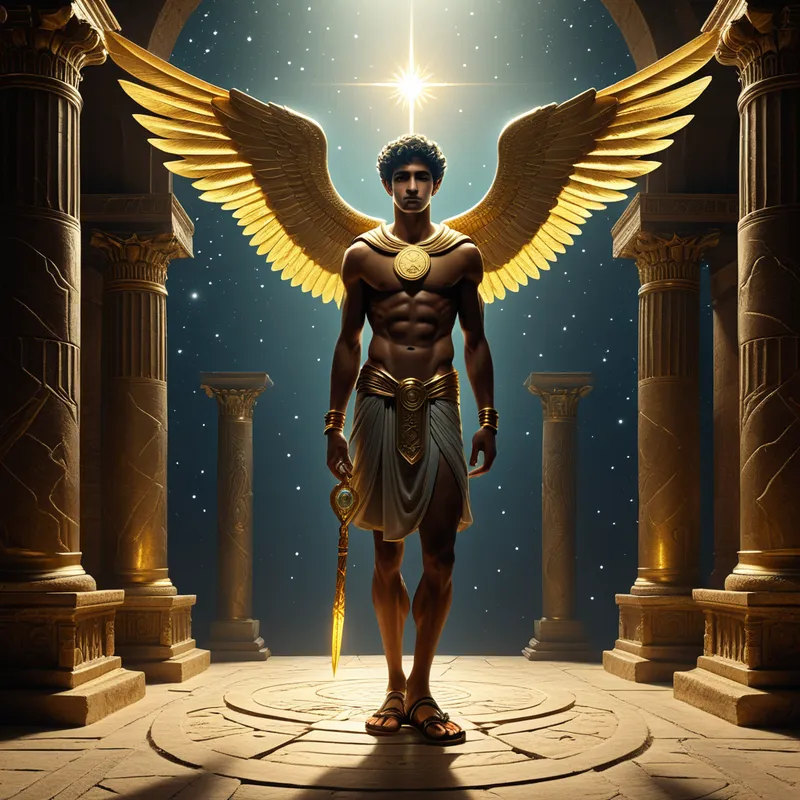
And into this churning sea of potential steps [Hermes](/myths/hermes “Myth from Global/Universal culture.”/). Not as the majestic Olympian, but as the quick-fingered youth, the guide of souls, the trickster at [the crossroads](/myths/the-crossroads “Myth from Celtic culture.”/). His winged sandals are dusty from the long road, his caduceus silent in his hand. He has come not to trade spices or linen, but for passage. For every gate demands a toll, and the gate he seeks—a portal shimmering like a heat haze at [the market](/myths/the-market “Myth from Various culture.”/)‘s far end—is guarded.
The guardian is known only as the Boun. A figure of immense and silent presence, not of muscle but of immutable law. He stands before the shimmering arch, a boundary made flesh. No plea, no divine pedigree moves him. Only the correct currency. Hermes, master of exchange, smiles his sly smile. He reaches into the pouch at his hip, the one that usually holds the luck of thieves, and produces a coin. It is a perfect, golden obol, the kind placed on the eyes of the dead for Charon. He offers it.
The Boun does not take it. His gaze, if he has eyes, falls upon the coin, then upon the god. A voice like shifting stones speaks a single word: “Insufficient.”
Hermes’ smile falters. He produces another, then a handful—coins from forgotten empires, tokens of broken oaths, polished stones that were once heart’s desires. Each is weighed and found wanting. The market’s noise seems to recede, leaving only the silent confrontation at [the threshold](/myths/the-threshold “Myth from Folklore culture.”/). The god of thieves is finding nothing in his bag of tricks can steal this passage.
Frustration, a rare guest for Hermes, flickers across his face. Then, insight—the true insight of the trickster. It is not the material of the toll, but its nature. The price for crossing a boundary is a piece of the boundary itself. A piece of himself that belongs to the realm he is leaving.
He looks at his caduceus, the symbol of his role as messenger, as connector. He looks at his winged sandals, the gift of flight. Too essential. Then his fingers brush the strings of the small, tortoiseshell lyre at his side—his first creation, fashioned from a stolen beast, the instrument with which he once soothed the wrath of Apollo. It was born of cunning and theft, but also of art and reconciliation. It was the first [thing](/myths/thing “Myth from Norse culture.”/) he ever made from a transaction.
With a resolve that feels like loss, he plucks a single, shining string from the lyre. It vibrates with a pure, heartbreaking note that hangs in the air. He coils it into a circle, a loop of resonant potential. This is no coin. It is a fragment of his story, a note of his personal melody. He offers the silent loop.
The Boun extends a hand. The loop is placed upon its palm. For a moment, the entire market holds its breath. Then, the guardian steps aside. The shimmering arch brightens, [the way](/myths/the-way “Myth from Taoist culture.”/) forward clear. Hermes passes through, his lyre now silent, his bag lighter of a certain kind of magic, but carrying the profound knowledge of what it truly costs to move from one state of being to another. The market’s noise swallows the moment, and the tale is left echoing in its stalls.
Cultural Origins & Context
The myth of “Hermes at the Marketplace Boun” does not hail from a single, canonical text like the Homeric Hymns, but emerges from the interstices of global trickster lore and the universal human experience of negotiation at life’s thresholds. It is a paralipomenon—a whispered aside in the grand narrative, passed down not by epic poets, but by travelers, merchants, and philosophers at the edges of campfires and in the porticoes of markets from the [Silk Road](/myths/silk-road “Myth from Chinese culture.”/) to the Mediterranean.
Its societal function was multifaceted. For merchants, it was a cautionary tale about the true cost of a deal, reminding them that the most valuable currency is often non-material. For initiates in mystery cults, it modeled the necessary sacrifice of a former identity to gain new knowledge or status. In a broader sense, it gave narrative form to the universal anxiety and anticipation felt at any border—be it of a city, a social class, or a phase of life. The “Boun” is the personification of the immutable law of transition: to gain something new, something old must be rendered up. The myth taught that even the gods are subject to this law.
Symbolic Architecture
The myth is a dense [matrix](/symbols/matrix “Symbol: A dream symbol representing the fundamental structure of reality, consciousness, or the self. It often signifies feelings of being trapped, controlled, or questioning the nature of existence.”/) of symbols speaking directly to the [psyche](/myths/psyche “Myth from Greek culture.”/)‘s [navigation](/symbols/navigation “Symbol: The act of finding one’s way or directing a course, symbolizing life direction, decision-making, and the journey toward goals.”/) of change. Hermes, the [trickster](/symbols/trickster “Symbol: A boundary-crossing archetype representing chaos, transformation, and the subversion of norms through cunning and humor.”/), represents the adaptive, cunning, and communicative [aspect](/symbols/aspect “Symbol: A distinct feature, quality, or perspective of something, often representing a partial view of a larger whole.”/) of [consciousness](/symbols/consciousness “Symbol: Consciousness represents the state of awareness and perception, encompassing thoughts, feelings, and experiences.”/). The marketplace is the [collective unconscious](/symbols/collective-unconscious “Symbol: The Collective Unconscious refers to the part of the unconscious mind shared among beings of the same species, embodying universal experiences and archetypes.”/) made manifest as a bazaar of possibilities, memories, and potential identities.
The true toll for crossing a threshold is never gold, but a strand of the story you were telling yourself on the other side.
The Boun is the psychic [guardian](/symbols/guardian “Symbol: A protector figure representing safety, authority, and guidance, often embodying parental, societal, or spiritual oversight.”/) of the threshold, often related to the threshold [guardian](/symbols/guardian “Symbol: A protector figure representing safety, authority, and guidance, often embodying parental, societal, or spiritual oversight.”/) [archetype](/symbols/archetype “Symbol: A universal, primordial pattern or prototype in the collective unconscious that shapes human experience, behavior, and creative expression.”/). He is the [resistance](/symbols/resistance “Symbol: An object or tool representing opposition, struggle, or the act of pushing back against external forces or internal changes.”/) of the psyche itself to radical change, the internal law that demands [integration](/symbols/integration “Symbol: The process of unifying disparate parts of the self or experience into a cohesive whole, often representing psychological wholeness or resolution of internal conflict.”/), not evasion. His [rejection](/symbols/rejection “Symbol: The experience of being refused, excluded, or dismissed by others, often representing fears of inadequacy or social belonging.”/) of conventional [currency](/symbols/currency “Symbol: Currency represents value exchange, personal worth, and societal power dynamics. It symbolizes resources, control, and the abstract systems governing human interaction.”/) signifies that psychological transformation cannot be bought with old habits, intellectual [knowledge](/symbols/knowledge “Symbol: Knowledge symbolizes learning, understanding, and wisdom, embodying the acquisition of information and enlightenment.”/), or social [capital](/symbols/capital “Symbol: A capital city represents the center of power, governance, and national identity, often symbolizing authority, structure, and collective aspirations.”/) alone.
The [lyre](/symbols/lyre “Symbol: The lyre symbolizes harmony, creativity, and the connection between the divine and human experiences.”/) string is the master [symbol](/symbols/symbol “Symbol: A symbol can represent an idea, concept, or belief, serving as a powerful tool for communication and understanding.”/). It represents a creative [capacity](/symbols/capacity “Symbol: A measure of one’s potential, limits, or ability to contain, process, or achieve something, often reflecting self-assessment or external demands.”/) born from a past integration (the reconciliation with Apollo). To sacrifice it is to sacrifice a known mode of [harmony](/symbols/harmony “Symbol: A state of balance, agreement, and pleasing combination of elements, often associated with musical consonance and visual or social unity.”/), a skill that defined [the self](/myths/the-self “Myth from Jungian culture.”/). The [payment](/symbols/payment “Symbol: Symbolizes exchange, obligation, and value. Represents what one gives to receive something in return, often tied to fairness, debt, or spiritual balance.”/) is not a [loss](/symbols/loss “Symbol: Loss often symbolizes change, grief, and transformation in dreams, representing the emotional or psychological detachment from something or someone significant.”/) of essence, but a surrender of a specific [expression](/symbols/expression “Symbol: Expression represents the act of conveying thoughts, emotions, and individuality, emphasizing personal communication and creativity.”/) of that essence to fund a new [journey](/symbols/journey “Symbol: A journey in dreams typically signifies adventure, growth, or a significant life transition.”/).
The Dreamer’s Resonance
When this myth pattern stirs in the modern dreamer, it often manifests as dreams of being stuck at a checkout counter, unable to pay; of forgetting a crucial password or item for a journey; or of facing a silent, imposing figure at a door or bridge. The somatic experience is one of frustrated anxiety, a feeling of being just short of a breakthrough.
Psychologically, this indicates the dreamer is at a genuine liminal point in their life—a career shift, the end of a relationship, a spiritual awakening. The unconscious is signaling that the old “coins”—the old resumes, the old arguments, the old self-images—are “insufficient.” The psyche’s Boun is demanding a more authentic currency. The dream is an invitation to inventory one’s inner “lyre”: what cherished skill, comfortable narrative, or prized identity might need to be temporarily surrendered or transformed to enable passage? The frustration in the dream is the friction of the soul preparing to make a real, costly trade.

Alchemical Translation
In the alchemical vessel of individuation, this myth maps the process of [nigredo](/myths/nigredo “Myth from Alchemical culture.”/) and ablutio. Hermes, the [Mercurius](/myths/mercurius “Myth from Alchemical culture.”/) spirit, must himself be transformed. His initial attempts to pay with “stolen” or generic currency represent [the ego](/myths/the-ego “Myth from Jungian culture.”/)‘s desire to solve a deep transformation with superficial or borrowed solutions.
The alchemy of the self requires that you pay with a substance minted in your own life’s furnace, not with the foreign coin of others’ expectations.
The surrender of the lyre string is the critical moment of mortificatio. It is the willing deconstruction of a talent or identity, even a successful one, because it belongs to the “marketplace” of the old life. This sacrifice funds the sublimatio—the passage through the archway. The silent lyre is not a permanent loss; after the transition, the music may return, but it will be a new music, informed by the journey. For the modern individual, the myth teaches that profound growth is not a transaction of effort for reward, but a sacrificial exchange where a piece of who you were becomes the token for who you are becoming. The Boun is not an enemy, but the severe midwife of the authentic self, ensuring the price of admission is paid in the only currency that guarantees true entry: a fragment of your own, lived truth.
Associated Symbols
Explore related symbols from the CaleaDream lexicon: