
Hermes as the messenger god in Myth Meaning & Symbolism
The story of the fleet-footed god who moves between Olympus, Earth, and the Underworld, carrying messages, luck, and the souls of the dead.
The Tale of Hermes as the messenger god in
Before the first word was spoken, there was the space between. In that liminal breath, he was born. Not in the golden halls of Zeus, but in a deep, shadowed cave on the slopes of Mount Cyllene. His mother, the starry nymph Maia, had sought solitude, but the child of the sky-father would not be contained by darkness.
From his first breath, the air shivered. He was not an hour old when he slipped from his cradle, his eyes—ancient and laughing—already scanning the twilight of the cave. His limbs, though newborn, thrummed with a restless energy. And then he saw it: a great tortoise, ambling at the cave’s mouth. With a sound that was neither cry nor song, the babe approached. His small hands, guided by a knowledge older than himself, worked with impossible speed. He hollowed the shell, stretched sinews across it, and from its curve, he drew forth the first music—a sound that was both lament and invitation. The lyre was born from play, from the meeting of cleverness and chance.
But play soon turned to hunger, a divine appetite. He left the cave, the lyre tucked away, and found the sun-drenched pastures of Apollo. There, fifty cattle of immortal beauty lowed. With a grin that held the secret of the crossroads, the infant god devised a trick. He drove the cattle backward, so their hoofprints pointed toward the cave, not from it. He crafted sandals of brushwood to disguise his own tiny steps. He stole the herd, and for their sacrifice, he used the method of fire-sticks, a new art for the gods. The scent of roasting meat, rich and forbidden, was his first message to Olympus.
The sun grew cold. Apollo, in a rage that could scorch the earth, traced the deception—not by the tracks, but by the testimony of an old farmer who had seen a “child” driving beasts. He stormed into Maia’s cave, confronting the babe swaddled in innocence. But the infant merely smiled and offered not denial, but a gift. He took up the tortoise-shell lyre and plucked its strings. The music that flowed forth was not mere sound; it was the very essence of connection, of harmony wrested from dissonance. Apollo’s anger melted into awe. The cattle were forgotten. The lyre was traded for the herd, and more—for a promise, and a staff.
Zeus, who had watched this drama unfold from his throne, did not punish. He laughed, a sound of thunder and delight. He saw in this cunning child the perfect solution to a celestial problem. The world was vast, divided: the shining order of Olympus, the chaotic tumult of Earth, the silent depths of Hades. Messages were lost. Souls wandered. Truths were bent. The realms needed a connector, a translator, one who could move through all borders without being bound by any.
And so Zeus bestowed the title. He gave the boy the winged hat and sandals, symbols of swift thought and unfettered travel. He placed in his hand the caduceus, a staff to guide and to pacify. “You,” declared the Thunderer, “shall be my voice. You shall carry the words of the gods to mortals and the prayers of mortals to the gods. You shall guide the newly dead to the river Styx. You shall be the patron of travelers, of thieves, of merchants, of all who dwell in the in-between. You are Hermes, the messenger.”
Thus, the trickster was made the herald. The thief became the guide. And the space between breaths became a road, forever traveled by the one who speaks for all, yet belongs to none.

Cultural Origins & Context
The figure of Hermes emerges from the rich oral traditions of ancient Greece, his stories crystallizing in the epic poetry of Homer and the Homeric Hymns (specifically the Hymn to Hermes). He was not a god of centralized power or cosmic order, but a god of the periphery. His worship was ubiquitous yet personal, found not only in grand temples but at roadside cairns (herms), which were often simple stone pillars adorned with his head and a phallus, marking boundaries and protecting travelers.
As a mythic construct, Hermes served a critical societal function in a polytheistic world view. The Greeks perceived their universe as a series of distinct, often conflicting, domains. Hermes’ role was to mediate these tensions—between the divine and the human, the living and the dead, the civilized and the wild, the honest deal and the clever swindle. He was the divine infrastructure for communication and exchange, both literal and metaphysical. His myths were told not just to explain natural phenomena but to model a necessary psychological and social skill: the art of navigation, of translating between different realms of value, meaning, and reality.
Symbolic Architecture
Psychologically, Hermes represents the archetypal principle of the psychopomp (soul-guide) and the connective intelligence of the psyche. He is not the content of a message, but the process of its delivery; not the truth itself, but the means by which truth (or illusion) travels.
He is the function of consciousness that builds bridges between the unconscious and the conscious mind, between intuition and logic, between what is known and what is yet to be understood.
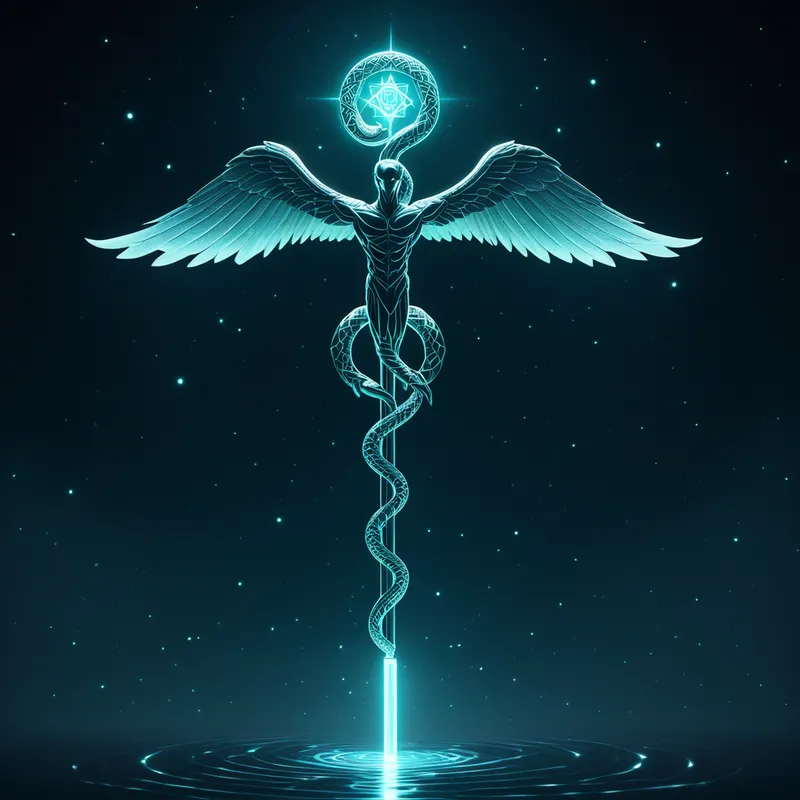
His theft of Apollo’s cattle symbolizes the necessary “theft” of energy from one psychic complex (Apollo’s solar consciousness, representing order, light, and conscious identity) to fuel the emergence of a new, more fluid capability. The invention of the lyre signifies the creation of a reconciling symbol—art, language, or insight—that can harmonize opposing forces. The caduceus, with its two serpents entwined around a central staff, is a profound image of the reconciliation of opposites (conscious/unconscious, life/death, good/evil) into a higher, guiding unity. Hermes is the archetype of the Trickster, who disrupts stagnant order to allow for new possibilities and connections.
The Dreamer's Resonance
When the Hermes pattern stirs in the modern dreamscape, it often manifests as dreams of urgent messages, missed communications, or finding oneself in liminal spaces: airports, hallways, bridges, or crossroads at twilight. One might dream of a mysterious guide who appears suddenly, delivers a cryptic phrase, and vanishes, or of trying to send an email or text that keeps transforming or failing to send.
Somatically, this can feel like a buzzing restlessness, a feeling of being “in transit” psychologically. It indicates a process where unconscious content is seeking a pathway to consciousness. The dream ego is being tasked with a Hermes-function: to carry something from one part of the psyche to another. The frustration of failed communication in the dream mirrors the resistance in the waking psyche to integrating a new insight, emotion, or memory. The dream is an enactment of the messenger’s journey, highlighting the blocks (the “angry Apollo” of our rigid attitudes) and the potential tools (the “lyre” of a new perspective) available for the crossing.

Alchemical Translation
The individuation process modeled by Hermes is one of psychic mobility and linguistic alchemy. It is the journey from being trapped in a single, monolithic self-concept (the cave) to becoming a conscious traveler within one’s own vast interior.
The first stage is the theft: the unconscious (the infant Hermes) “steals” energy from our dominant, conscious attitude (Apollo’s cattle). This feels like a crisis—a loss of certainty, a burst of irrational behavior, or a compulsive new interest that disrupts our status quo. The second stage is the invention: from the raw material of this disruption (the tortoise shell of the situation), we must consciously craft a tool for meaning-making—a new story, a creative outlet, a reflective practice (the lyre). This tool allows us to “speak to” and reconcile with the powerful complex we initially robbed.
The final stage is the commission: when we consciously take up the caduceus. This means accepting our role as messengers to ourselves, committing to translating the symbols of our dreams, synchronicities, and emotions into lived understanding.
To integrate Hermes is to become your own psychopomp. It is to develop the inner herald who can respectfully navigate the shining heights of your ideals, the tangled middle-world of your daily life, and the shadowed depths of your unresolved pain, carrying intelligence between them all. It is to recognize that the truth is not just in the message, but in the courage and cunning required to deliver it across the borders of your own soul.
Associated Symbols
Explore related symbols from the CaleaDream lexicon: