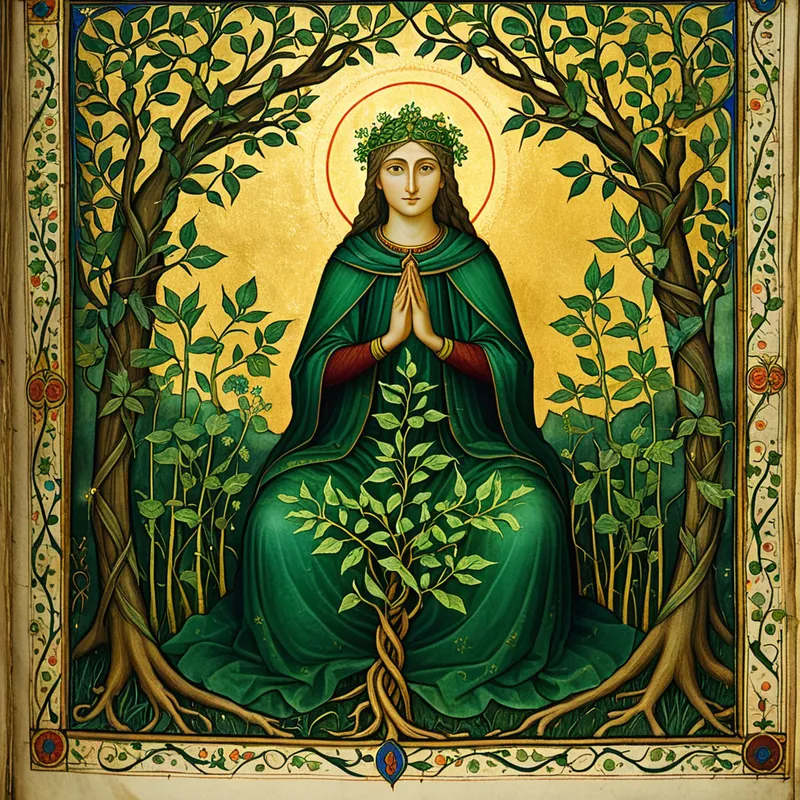
Herbals Myth Meaning & Symbolism
A myth of the green soul, where a healer's journey into the whispering woods reveals the living language of plants and the earth's hidden wisdom.
The Tale of Herbals
Listen, and let the scent of damp earth and crushed sage carry you back. Not to a time of kings and castles, but to the quiet, humming time of the liminal wood. Here, where the light falls in dappled coins, there lived a soul apart from the plough and the pew. Some called them a cunning-man or a green-witch; they called themselves a listener.
Their name is lost, as all true names of power are, but we shall know them as the Herbalist. Their cottage was of wattle and daub, its thatch sprouting houseleek and feathery yarrow. Inside, the air was thick with the breath of drying blossoms, bitter roots, and sweet resins—a cathedral of scent. But the Herbalist’s true sanctuary was the forest’s deep heart, a place avoided by others, where the trees grew close and the silence had a voice.
One autumn, when the veil between worlds grew thin, a blight fell upon the village. Not of pestilence, but of a profound forgetting. The children ceased to laugh, the elders’ stories dried up on their tongues, and a grey numbness crept from hearth to hearth. The priest prayed, the lord levied a tax, but the silence only deepened. Desperate, the villagers turned their hollow eyes to the path leading to the Herbalist’s wood.
The Herbalist felt this forgetting like a cold root in their own chest. They knew the cure did not lie in their hung bunches of herbs, but in the source of the green word itself. And so, as the moon swelled full, they entered the forest not as a forager, but as a supplicant. They walked until their own name faded from memory, until the path vanished, and they stood in a grove so ancient the stones were pillows for moss.
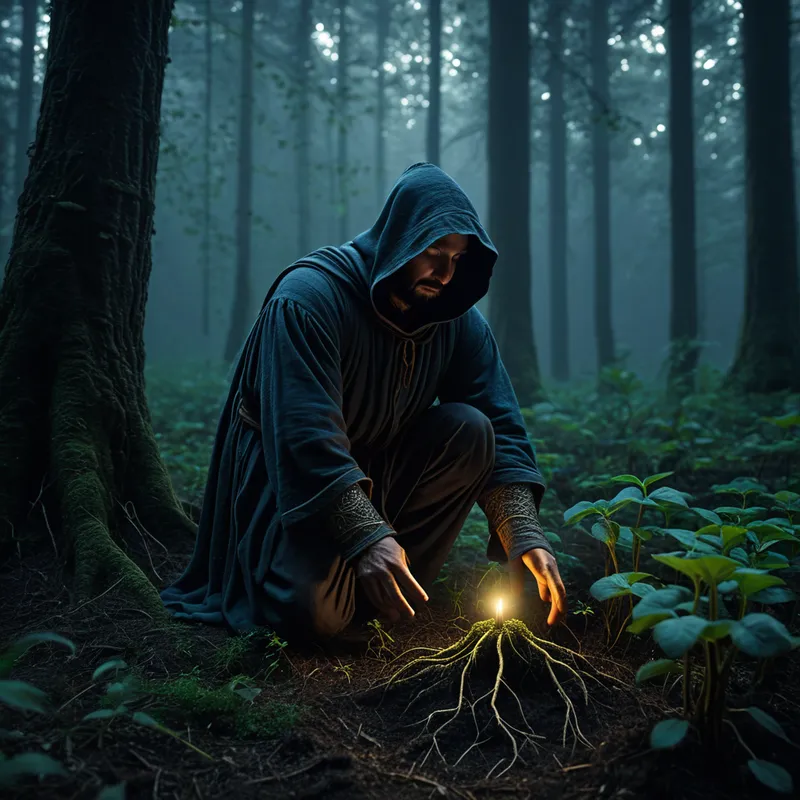
There, they did not speak. They knelt, pressed their palms to the cold, black humus, and waited. Hours bled into the night. Just as despair began to frost their heart, they felt it: a vibration, deep and slow, rising through the soil into their bones. It was a rhythm older than prayer. Then came the whispers—not in the ear, but in the blood. The gnarled oak spoke of steadfastness, its voice the creak of enduring wood. The fragile fern shared the secret of unfolding in shadow. The poisonous monkshood hissed of necessary boundaries, while the humble plantain sang a ballad of healing wounds.
The forest was not a collection of things, but a congress of beings, each with a story, a virtue, a warning. The Viriditas—the divine greening power—flowed through them all, a luminous river of soul-stuff. The Herbalist, by emptying themselves of human clamor, had become a vessel for this living language.
When they returned at dawn, their eyes were the color of deep shade. They did not bring a single herb, but a new silence—one brimming with presence. They moved through the village, not speaking, but touching a drooping shoulder here, a furrowed brow there. Where their fingers brushed the earth, small, unlikely flowers pushed through the frost. Where their gaze rested, a forgotten lullaby would tumble from a mother’s lips. The cure was not a potion, but a remembrance: the reminder that they were not alone, that they were woven into the same living, whispering tapestry as the oak and the nettle. The grey numbness receded, washed away by the rediscovered chorus of the world.
Cultural Origins & Context
The myth of the Herbals is not a single story with a fixed canon, but a pervasive narrative pattern woven through the fabric of medieval European folk belief. It lived in the practices of the cunning-folk, the hedge-witches, and the monastic herbalists in their scriptoriums. It was passed down not in epic poems, but in whispered instructions from grandmother to grandchild, in the marginalia of herbals where fantastical mandrakes were drawn, and in the rituals of gathering plants at specific planetary hours.
Its societal function was dual. On a practical level, it encoded vital empirical knowledge—which plants healed wounds, which induced sleep, which could poison. On a transcendent level, it served as a vital counter-narrative to the often stark, transcendent theology of the medieval Church. It rooted the sacred immanently in the created world. The forest, the meadow, and the humble garden patch were not merely resources or temptations, but pages in a living bible, each leaf a glyph written by the divine hand. This myth affirmed a world ensouled, where relationship and respectful dialogue with nature were the paths to wisdom and healing.
Symbolic Architecture
At its core, the myth of the Herbals is a map of the psyche’s relationship to the deep, instinctual, and vegetative layers of the unconscious. The Herbalist represents the ego that dares to venture beyond the cultivated "village" of conscious identity and social persona.
The journey into the forest is the descent into the natura naturans, the primal, creative ground of being that precedes and undergirds all form.
The "blight of forgetting" symbolizes a state of psychic disconnection, where the conscious mind is severed from its nourishing roots in the instinctual and archetypal world. The cure is not an attack on the symptom, but a restoration of connection. The whispering plants represent the autonomous, living complexes and archetypal patterns of the unconscious. They do not speak the language of logic, but of symbol, sensation, and image—the "green language."
The Herbalist’s act of kneeling and listening is the crucial attitude of receptivity. It is the suspension of the ego’s will to know in favor of the psyche’s capacity to listen. The resulting wisdom is not intellectual but embodied—a Viriditas that flows through the individual, making them a conduit for healing not by doing, but by being in right relationship.
The Dreamer's Resonance
When this myth stirs in the modern dreamer, it often manifests as dreams of profound encounters with the plant world. One might dream of a house whose walls are alive with growing, pulsing ivy, or of discovering a secret, luminous mushroom circle in a familiar urban park. Perhaps the dreamer finds themselves able to understand the language of trees, or they are given a specific, unknown seed to plant.
Somatically, this can correlate with a period of "rooting"—a felt need to ground, to simplify, to reconnect with the body and its rhythms. Psychologically, it signals a process where deeply buried, instinctual knowledge (the "folk wisdom" of the psyche) is seeking to communicate with the conscious mind. The dreamer may be in a state of "spiritual forgetting," feeling arid, disconnected, or overly abstract. The dream plants are the emerging symbols of a needed vitality, a specific quality of healing (the stinging nettle for boundaries, the rose for love) that must be integrated. The process is one of re-membering—literally, putting the fragmented parts of the soul back into a living relationship.
Alchemical Translation
In the alchemical opus, the initial stage is nigredo, a descent into the dark, fertile chaos. The village's grey forgetting is this nigredo. The Herbalist’s journey mirrors the alchemist’s work of patiently attending to the prima materia—the raw, unconscious content symbolized by the wild forest.
The transmutation occurs not through force, but through the slow, patient cultivation of a relationship with the rejected, wild, and "poisonous" aspects of the self.
The listening is the coniunctio, the sacred marriage between the directed consciousness (the Herbalist) and the autonomous, vegetative soul (the plants). From this union blooms the viriditas—the greening of the psyche. This is the lapis in its organic form: not a static stone, but a living, growing wholeness.
For the modern individual, the myth models the path of individuation as a re-sacralization of the ordinary. Our "forest" may be the neglected depths of our own instinctual life, our creative impulses, or our bodily wisdom. The "cure" for modern alienation is to cease seeking answers only from outside (the "priest" or the "lord" of external authority and dogma) and instead learn the arduous, humble practice of kneeling in the soil of our own experience and listening for the whispers that have been there all along, waiting to re-green our world from the roots up.
Associated Symbols
Explore related symbols from the CaleaDream lexicon: